Tuesday, October 11, 2016

Catching up with the executive branch in Texas

- Workforce Commission: Houston area adding about 700,000 jobs, 2014 to 2024.

The Texas Workforce Commission has released its occupation forecast for the Houston area. The agency found that between 2014 and 2024, this metro will add roughly 700,000 jobs.

"Now, that number is probably high given... their base year was a year of really strong job growth," Patrick Jankowski, regional economist with the Greater Houston Partnership, told Houston Public Media. "It'll probably be somewhat less than that. But it still shows that Houston, in spite of the current downturn, is going to have some significant job growth over the long term."
The sectors that are predicted to see the most growth are restaurants, hotels, education, healthcare and professional services.

Feds Force States to Follow Medicaid Agenda by Holding Funds Hostage.

A federal agency may be punishing states that refuse to expand Medicaid or adopt new program rules by withholding funds meant to help uninsured individuals.
The Centers for Medicare & Medicaid Services (CMS) has allegedly threatened several states for not expanding the program. States have also been penalized for not adopting new program regulations and rules. Cato Institute Scholar Michael Cannon notes the agency has a history of pressuring states into doing its bidding.
“It is problematic, of course, that CMS might be using funds to leverage or coerce states,” Cannon told InsideSources. “There’s a history of the federal government trying to coerce states into doing its bidding and there is a history of CMS trying to bend the law to get states to do its bidding.”
The Texas Health And Human Services Commission (HHSC) recently was disallowed roughly $27 million in funding Sept. 1 meant to help residents in the state without insurance. The notice came after the agency already assured the state last year that funds could continue on through 2017, reported The Texas Tribune.

- North Texas Hospitals Face $27 Million Penalty in Medicaid Dispute.

Hospitals in the Dallas-Fort Worth region were overpaid by $27 million in federal funds to provide health care for the uninsured, according to a new order from the Obama administration, which is threatening to take the money back.
Federal health officials allege that Texas has allowed private hospitals to leverage donations to local governments in order to improperly draw matching federal funds. Texas officials say they will challenge the decision, which appears to contradict an earlier directive by the Obama administration.

It’s the latest development in a protracted tug-of-war over a multibillion-dollar pot of mostly federal Medicaid funding known as the 1115 waiver, which Texas has come to rely on when footing the bill for its uniquely large population without health insurance. In May, Texas and the federal government agreed to a 15-month renewal of the funding stream, despite the Obama administration's preference that some of the money be used to buy health insurance for low-income Texans under the Affordable Care Act. Nearly one in five Texans is uninsured, according to the federal government, the highest rate of any state.

- CPS crisis continues, with more endangered children going unseen across Texas.

As the state's child welfare system reels from an exodus of child abuse investigators, tens of thousands of potentially endangered children are going unseen for weeks and months, and the dangerous trend shows no sign of abating.
A new release of data by Child Protective Services indicates no region is more precarious than Harris County, which aDallas Morning News investigation in May showed was headed for trouble due to enormous backlogs of child abuse cases.
Across Texas, as of Sept. 12, more than 4,700 children at risk of physical or sexual abuse or severe neglect should have already had face-to-face contact with a child abuse investigator but haven't, the data show.

When children are seen, CPS investigators across the state are failing about 31 percent of the time to make initial contacts with families within required deadlines.
"Imagine if you had 31 percent of your 911 dispatch calls going unanswered by the police — that's what this is the equivalent of," said Scott McCown, a law professor and director of the Children's Rights Clinic at UT-Austin.

- TDCJ to consider layoffs, prison closures to offset budget cuts.

Texas Department of Criminal Justice officials, warning that a $214 million cut in their proposed budget could force the layoffs of up to 1,200 guards and reduce key services, confirmed Thursday that they may consider closing additional prisons.
The acknowledgment came as the agency's governing board approved the shutdown of the 450-bed South Texas Intermediate Sanction Facility, a lockup for parole violators across from Minute Maid Park in downtown Houston, as a way to help make up for a 4-percent budget reduction mandated by state leaders.
Bryan Collier, executive director of the corrections system, said that if legislative leaders cannot be convinced to exempt his agency from the mandate, then layoffs of guards remain a possibility, along with reductions in convict health care, meals, as well as prison and parole operations. The agency currently has just over 2,000 vacancies among its 25,000-plus correctional officer positions.

The Wikileaks leaks

A handful anyway - not quite getting the media coverage they would if the Trump tape hadn't emerged.

- WikiLeaks hack reveals cozy relationship between Clinton campaign, super PAC.

A top attorney for Hillary Clinton’s presidential campaign sent a memo to campaign aides teaching them how to legally communicate with a pro-Clinton super PAC, emails released Monday by WikiLeaks show.
While Clinton has claimed her campaign has nothing to do with the super PAC Priorities USA, a leaked email from the personal account of Clinton’s campaign chairman, John Podesta, suggests differently.
In the email, Clinton attorney Marc Elias outlined what is basically a strategy for steering large campaign donors to the super PAC without breaking the law.

Hillary Clinton transcripts: WikiLeaks posts apparent excerpts from private Wall Street speeches.

Wikileaks has dumped thousands of emails from Hillary Clinton campaign chair John Podesta, which includes apparent excerpts from Ms Clinton’s paid, closed-door speeches to Wall Street executives after leaving her position as Secretary of State.

In the excerpts, flagged in a 25 January email, Ms Clinton apparently suggested that Wall Street insiders were best qualified to regulate the banking industry and also included her apparent admission of the need for money from banking executives for political fundraising.

The group posted more than 2,000 emails on Friday evening, claiming they came from an email account belonging to Mr Podesta. Wikileaks promised to continue publishing emails from a trove of more than 50,000 emails obtained from a hack of the Democratic National Committee (DNC) this year
.

- Search the emails yourself here.

From Vox: A Trump collapse could give Democrats back the House. Here’s the math.

This is what Paul Ryan is worried about.

- Click here for a look at the current breakdown in the House.

- Click here for the article.

If this new tape has a similar effect, Clinton could obviously expect an easy victory. But that kind of Trumpian meltdown would also give Democrats a chance to reclaim a prize that has long looked far out of reach — the House of Representatives.

The House has long looked like impossible to flip because gerrymandering has given Republicans a fortress of extraordinarily safe seats. (In 2012, for instance, Democratic House candidates won 1.7 million more votes than their Republican foes — and still ended up with 33 fewer members of the House.) Democrats need to win 30 Republican-held seats to flip the House, and are widely expected to nab closer to 15.

But one political analyst I interviewed earlier this campaign thinks an epic Trump collapse might be enough to overcome that built-in advantage. Geoffrey Skelley, of the University of Virginia’s Center for Politics, argues that a Clinton victory of 6 points or more might be enough to put the House back in play.
Right now, the polling averages suggest Clinton is running around 5 points ahead of Trump. If she can use this Trump implosion to further increase her national lead, at least according to Skelley’s projections, she may give down-ballot Democratic allies a real chance at reclaiming Congress. And that would have huge consequences for the next two years of American government.
Projection: A 6-point Clinton victory would put 50 Republican-held House seats in play
Skelley’s math is rooted in a simple fact: If the Democratic presidential nominee wins a House district, the Democratic congressional candidate also probably wins that House seat.

This is not an ironclad rule, but it’s a pretty good indicator — in 2012, only 6 percent of districts that voted for Barack Obama voted a Republican into the House.
This is the key to understanding why Skelley thinks a 6-point Clinton win could put the House in play. That kind of national victory would likely mean 50 House districts currently controlled by Republicans would vote for Clinton — therefore suggesting they have a good shot of also going blue at the House level.

For more on the subject:

- The Odds of a Democratic Sweep Next Month Are Small But Rising.
- The House May Be in Play.
- Why It’s Impossible for Democrats to Win the House.

From the NYT: Latest Election Polls 2016

- For perusal in class today.

Catching up with the Republican Party and its presidential nominee

- The GOP tumbles toward anarchy: ‘It’s every person for himself or herself’.

The Republican Party tumbled toward anarchy Monday over its presidential nominee, as House Speaker Paul D. Ryan (Wis.) cut Donald Trump loose in an emergency maneuver to preserve the party’s endangered congressional majorities.
Ryan’s announcement that he would no longer defend or campaign with Trump prompted biting condemnations from within his caucus and from Trump himself, who publicly lashed out at the speaker.
It was an extraordinary display of personal animus just four weeks before the election, destroying any semblance of party unity behind a nominee who many GOP leaders said they could no longer stomach because of his character traits and tawdry campaign tactics.

Paul Ryan Turns Focus From Donald Trump to House Races, Roiling G.O.P.

The House speaker, Paul D. Ryan, dealt a hammer blow to Donald J. Trump’s presidential candidacy on Monday, dashing any remaining semblance of Republican unity and inviting fierce backlash from his own caucus by announcing that he would no longer defend Mr. Trump.
Mr. Ryan’s stance drew an immediate rebuke from Mr. Trump, who posted on Twitter that Mr. Ryan should focus on governing “and not waste his time on fighting Republican nominee.”
Mr. Ryan informed Republican lawmakers on a morning conference call that he would never again campaign for Mr. Trump and would dedicate himself instead to defending the party’s majority in Congress, according to five lawmakers who participated in the call and spoke on the condition of anonymity.
Effectively conceding defeat for his party in the presidential race, Mr. Ryan said his most urgent task was ensuring that Hillary Clinton did not take the helm with Democratic control of the House and Senate, two lawmakers said.

-
 Paul Ryan Needs Trump More Than Trump Needs Ryan.

House Speaker Paul Ryan is not a big fan of Donald Trump — that much is clear. He refused to back Trump during the Republican primaries and thenheld out on endorsing him even after Trump became the presumptive nominee. But eventually, Ryan did get behind Trump. And now, even after video of Trump bragging about being able to commit sexual assault has come to light, Ryan said he won’t defend Trump, but he has refused to unendorse the GOP nominee. Trump responded by attacking Ryan on Twitter.
A reasonable person might ask why, if Ryan was reluctant to support Trump to begin with, the speaker of the House isn’t washing his hands of the whole Trump campaign.
But the answer is simple: Republican voters like Trump; Ryan risks losing the support of rank-and-file GOPers if he hits Trump too hard.

enten-ryan-1

Monday, October 10, 2016

From 538: The Ross Perot Myth

The conventional wisdom is that Ross Perot pulled enough votes From HW Bush in 1992 to tip the election to Bill Clinton.

Here's a counter argument.

- Click here for the video.

Sunday, October 9, 2016

Fromk the Texas Tribune: Houston, and its global petrochemical hub, remain in the eye of the storm

Area state senator Larry Taylor is featured here.

More concerns for the 85th Session.

- Click here for the article.
The waters that make the Houston Ship Channel an important global port and hub of petrochemical activity are the same rising tides that - under the most dire scenarios - could one day cause catastrophe.

To the frustration of many, however, that looming threat of the day when, not if, a powerful storm surge descends on one of Texas' economic engines - ripping above-ground pipes from their fittings, tossing chemical storage tanks like empty soda cans and deluging entire manufacturing plants in brackish salt water - hasn't led to enough political and economic pressure to build what some consider the region's only option for keeping a hurricane from sweeping billions of dollars of Houston investment into the sea.

"We are eight years since Hurricane Ike… and we still don't have that one plan," said State Sen. Larry Taylor, R-Friendswood, referencing the last hurricane to wreak havoc across the Houston area. "That's troubling, but we're making progress... We will need it. It is not a matter of thinking it may happen some day, it will happen."

With the nation focused on Hurricane Matthew as it continues its march up the East Coast this weekend, some observers have noted Houston's massive role in world energy production and its exposure to storms that are increasing in intensity make it one of the most at-risk spots where devastation could not only claim local lives and structures, but send shockwaves through the economy.

Saturday, October 8, 2016

From Vox: A modest proposal to replace Trump with Pence — with or without Trump’s consent

The author is a well regarded constitutional scholar, so I'd give this some weight.

New territory here - but nothing outlandish.

- Click here for the article.

Sober Republicans understand that Donald Trump is unfit to wield the awesome power of the presidency, power that in his unsteady hands could imperil the republic and perhaps — given his cavalier discussion of nuclear weapons and generally reckless approach to foreign relations— doom the planet. But even now, at this very late date in the election season, there is one last chance for the Republican establishment to dump Trump: by flipping the ticket and putting the plodding, but at least plausible, Mike Pence in charge.

Watching the vice presidential debate, quite a few Republicans surely wished they inhabited the alternate universe in which Pence, an experienced politician with apparent steadiness and self-discipline, was their nominee. That does not have to be an idle thought; there’s a way to make it happen.

True, early voting has already begun in some places, and almost everywhere it is too late to revise ballots. But a flipped ticket does not require any formal ballot change.

The first step of The Flip must begin very soon — ideally, this week or next. At a joint press conference, Pence and Trump should with fanfare announce that, if they win in November, Pence will be in charge, thanks to the rules laid down by the Constitution’s 25th Amendment, which was ratified in 1967 after the assassination of John F. Kennedy.

At the press conference, Trump would solemnly pledge that on Inauguration Day, January 20, he will, only minutes after taking his oath of office, step aside by invoking the presidential disability provisions of Section Three of the Amendment — much as he might step aside if he were undergoing a scheduled coronary bypass that day. He will give notice on Inauguration Day to the president pro tempore of the Senate and the speaker of the house that he is "unable to discharge the powers and duties of his office."

Once Trump does step aside on Inauguration Day, Pence would automatically become acting president of the United States under Section Three, entitled to all the powers of the office until Trump seeks to reassert his rights — which Trump at the press conference must promise he will never do. Trump, however, would technically retain the title of president.

For more:

- This Is How Republicans Could Force Trump Off the Ballot.
- There’s no longer any way for Republicans to boot Donald Trump from the ballot.
- Replacing Trump would mean mayhem for GOP: experts.
- Constitutional scholar offers plan to replace Trump.
- How Republicans Could Replace Trump Even if He Stays In.

From Vox: We’ve been totally wrong about Hillary Clinton’s young voter problem - And a big new study proves it.

A great, critical look at what polls do and do not tell us.

It also allows a critical look at media coverage of the race - one of the big takeaways: the third party movements are overhyped.

- Click here for the article.

The conventional wisdom about young voters in the 2016 presidential election goes something like this: White millennials are backing third-party candidates in unprecedented numbers, creating a major problem for Hillary Clinton.

It’s a theory that’s driven
hundreds of news articles and think pieces. I myself have advanced it in stories here at Vox. Clinton’s campaign appears to be taking the threat seriously.

But Jon Rogowski, a political scientist at Harvard, makes a pretty convincing case that this idea is wrong — or at least vastly overstated. Earlier this week, he and the researchers at
GenForward released the most thorough study I’ve seen to date of young voters and the 2016 presidential election.

Its findings suggest that the way we’ve been looking at “Clinton’s millennial problem” is upside down. Contrary to several other pollsters, the researchers found that far fewer young people will actually vote for the Libertarian Party’s Gary Johnson or the Green Party’s Jill Stein than has been widely reported. (This isn’t totally surprising, as third-party support historically falls off as we get closer to Election Day.)

Instead, Clinton’s millennial voter problem appears to come from a different source altogether: Young voters of color seem to be far less excited about her than they were about Barack Obama. That trend — rather than a largely imaginary groundswell of support for Johnson and Stein — poses the biggest obstacle to reassembling the Democratic Party’s youth voting bloc in 2016.

Friday, October 7, 2016

From Brookings: How rising polarization will challenge the next president

Regardless who wins - apparently - the political environment will negate the ability of the next president to get much done.

Dysfunction will continue.

- Click here for the article.

While most political observers are focused on the ups and downs of the presidential race, it’s not too early to think about the condition of our politics once it ends. There is no evidence that the campaign will do anything to reduce the partisan polarization that has blocked progress on vital national problems. On the contrary, it seems likely to deepen the crisis of governance that has hobbled the United States for much too long.
There are three reasons to fear the worst. In the first place, the campaign has done little to help voters understand the real choices we face, especially in the economic sphere. The recovery from the Great Recession has been achingly slow, wages have barely budged, many working-age Americans remain outside the labor force, and productivity—the key to higher living standards—has declined for three consecutive quarters. Slamming the door on immigration won’t cure these ills, and neither will protectionism. Policies such as paid family leave will help at the margin but leave the core of the problem untouched. The president-elect will not enter the transition with an economic mandate and will have to create one virtually from scratch.
Second, challenges to the legitimacy of elections and candidacies have disfigured our politics for the past four presidential elections, a trend that may well continue into 2017 and beyond. In the wake of the botched vote count in Florida and the Supreme Court’s controversial Bush v. Gore decision, many Democrats never accepted the legitimacy of George W. Bush’s inauguration. In 2008 and beyond, conspiracy theories about Barack Obama’s birthplace convinced many Americans that he was not an American citizens and was therefore ineligible to serve as president. This year’s Republican nominee, a principal proponent of these theories, has repeatedly warned his supporters that the election may be “rigged.” If he loses by a relatively narrow margin, there is a real danger that he may question the outcome and give his supporters additional reasons to reject the winner’s legitimacy.
Third, and most fundamentally, the 2016 campaign has further divided Americans along demographic lines, according to a just-released reportfrom the Pew Research Center. Among whites, men are 10 percentage points more likely to identify as Republicans than they were in 2008; individuals over 50 are 13 points more likely; whites with a high school education or less, 14 points more likely. Because white women haven’t shifted nearly as much, the gender gap among whites has widened significantly.

From the Texas Tribune: Analysis: In Texas, Lawmakers Regulate Their Own Regulators

In 2306, while walking though Article 3 of the Texas Constitution, we looked at the language that established the Texas Ethics Commission. We looked at the factors that made it toothless.

Here's more on that subject.

The author argues that one of the reasons ethics is tough to police - not surprisingly - is that people don't pay attention.

- Click here for the article.

Texas legislators apparently think the people appointed to regulate campaign finance and officeholder ethics are “haughty.”
God bwess their widdle hearts.
Seriously, senators made it clear at a State Affairs Committee meeting this week that they are riled up at the Texas Ethics Commission — and reveled in an opportunity to jab and poke at the officials who police their industry.
It’s an interesting setup, where the people who are being regulated are also the people in control, more or less, of the regulators. The hearing was also a great exhibition of lawmakers doing one of the things they do best: Bullying unelected state officials and employees.
They said the commission spends too much time on nickel-and-dime infractions — paperwork errors and the like. They griped about a commissioner who rejected a resignation request from Lt. Gov. Dan Patrick. Patrick wanted to appoint someone in Hugh Akin’s place and let him know; Akin let Patrick know, in a letter, that he’ll serve until his term ends 13 months from now.
This is an insiders’ fight. One reason it’s hard to write ethics laws is that most Texans don’t pay much attention to the mechanics of elections, lobbying or the everyday business of being an elected officeholder in Texas — except when there is a scandal big enough to stay in the news for a while.

For more:

- In Texas, a Collapse of Ethics Reform.
- Conservatives Call For Reform or Abolition of the Texas Ethics Commission.
- Ethics reform fight flares anew.
The brutal death of ethics reform in Texas.
- Republican Senators Grill Texas Ethics Commission.

From the National Archives: "Report of the Office of the Secretary of Defense Vietnam Task Force"

That's the official title of what is more commonly referred to as the Pentagon Papers. We've been discussing them in 2305 since the Nixon Administration tried but failed to prevent their publication through prior restraint. The freedom of the press, coupled with the unwritten right of the people to know, won out.

I've never actually read through them, but now's my chance - and yours.

- Click here for it.

The author of the study was Leslie Gelb, one of those figures you know little about, but seems to have spent time everywhere. Here's some of resume from Wikipedia. Think of this when we discuss the revolving door later this semester:

Dr. Gelb was Executive Assistant for Senator Jacob Javits from 1966 to 1967. He was director of Policy Planning and Arms Control for International Security Affairs at the Department of Defense from 1967 to 1969, winning the Pentagon's highest award, the Distinguished Service Medal. Robert McNamara appointed Dr. Gelb as director of the project that produced the controversial Pentagon Papers on the Vietnam War. From 1969–1973, Dr. Gelb was a Senior Fellow at the Brookings Institution.
He was diplomatic correspondent at The New York Times from 1973 to 1977.
He served as an Assistant Secretary of State in the Carter Administration from 1977 to 1979, serving as director of the Bureau of Politico-Military Affairs and winning the Distinguished Honor Award, the highest award of the US State Department. In 1980 he co-authored The Irony of Vietnam which won the Woodrow Wilson Foundation Book Award in 1981. From 1980–1981, he was also a Senior Associate at the Carnegie Endowment for International Peace.
He returned to the Times in 1981; from then until 1993, he was in turn its national security correspondent, deputy editorial page editor, editor of the op-ed page, and columnist. This period included his leading role on the Times team that won a Pulitzer Prize for Explanatory Journalism in 1986 for a six-part comprehensive series on the Star Wars Strategic Defense Initiative. In 1983, he also worked as a producer on the ABC documentary The Crisis Game, which received an Emmy award in 1984.
Dr. Gelb became President of the Council on Foreign Relations in 1993 and as of 2003 is its President Emeritus. From 2003-2015, he also served as Board Senior Fellow there. In addition to his work at Council on Foreign Relations, Dr. Gelb is also a member of the International Institute for Strategic Studies and is a fellow of the American Academy of Arts and Sciences.
He served as the chairman of the advisory board for the National Security Network, which identifies itself as a "progressive" think tank, and served on the boards of directors of several non-profit organizations including Carnegie Endowment, the School of International and Public Affairs, Columbia University, the James Baker Institute at Rice University, the Watson Institute for International Studies at Brown University, and the John F. Kennedy School of Government Center on Press, Politics and Public Policy.
He currently serves on the board of directors of the Iraq and Afghanistan Veterans of America and is a member of the board of advisors of the Truman Project and America Abroad Media.[8] Dr. Gelb also serves on the board of directors of the Center for the National Interest[9] and of the Diplomacy Center Foundation.[10] He also sits on the editorial advisory committee of Democracy magazine,[11] on the advisory council of The National Interest magazine,[12]and on the advisory board of the Peter G. Peterson Foundation. Dr. Gelb also serves on several commercial boards including Legg Mason closed end funds (since 2003), Aberdeen India and Asia Tigers funds (since 2003), and Centre Partners (since 2005). He is Trustee Emeritus of Tufts University.

Just as interesting is the profile of Daniel Ellsberg, the man who found, copied an leaked the document.

Ellsberg entered Harvard College on a scholarship, graduating summa cum laude with an A.B. in economics in 1952. He studied at the University of Cambridge for a year on a Woodrow Wilson Fellowship, then returned to Harvard for graduate school. In 1954, he enlisted in the U.S. Marine Corps and earned a commission. He served as a platoon leader and company commander in the 2nd Infantry Division, and was discharged in 1957 as a first lieutenant. Ellsberg returned to Harvard as a Junior Fellow in the Harvard Society of Fellows for two years, then began working as a strategic analyst at the RAND Corporation, where he concentrated on nuclear strategy and the command and control of nuclear weapons.
Ellsberg completed a PhD in Economics from Harvard in 1962. His dissertation on decision theory was based on a set of thought experiments that showed that decisions under conditions of uncertainty or ambiguity generally may not be consistent with well defined subjective probabilities. Now known as the Ellsberg paradox, this formed the basis of a large literature that has developed since the 1980s, including approaches such as Choquet expected utility and info-gap decision theory.
Ellsberg worked in the Pentagon from August 1964 under Secretary of Defense Robert McNamara as special assistant to the Assistant Secretary of Defense for International Security Affairs John McNaughton. He then went to South Vietnam for two years, working for General Edward Lansdale as a member of the State Department.
On his return from South Vietnam, Ellsberg resumed working at RAND. In 1967, he contributed to a top-secret study of classifieddocuments on the conduct of the Vietnam War that had been commissioned by Defense Secretary McNamara. These documents, completed in 1968, later became known collectively as the Pentagon Papers.

From 538: Where Clinton Is Setting Up Field Offices — And Where Trump Isn’t

A look at the ground game.

Neither is close to where Obama was in 2012.

- Click here for the article.

darr-campaign-offices-1-new


Neither campaign can claim a field operation equal to their party’s 2012 nominee. The Clinton campaign has work to do if it wants to reach Obama’s total of 790 field offices nationwide: Obama had 103 offices in Florida alone, for example (compared to Clinton’s 68), and his 61 Virginia offices far outpace her 27. Clinton may open more offices before the election is over, but she seems unlikely to match Obama.
Clinton’s operation is already much larger than Romney’s was, however. Her 489 total offices well exceed Romney’s 283, with larger disparities in battleground states (75 vs. 40 in Ohio; 57 vs. 25 in Pennsylvania; and 29 vs. 14 in Colorado).
On the Republican side, Trump’s operation lags well behind Romney’s. Romney had far more offices than Trump does in battleground states like Iowa (13 vs. 5), North Carolina (24 vs. 8), and Virginia (29 vs. 11). Of the 10 most critical states, Trump’s field offices exceed Romney’s only in Pennsylvania, which Trump currently has only about a 20 percent chance of winning. Trump has so far failed to match the organization of his Republican predecessor.

From the Cancer Letter: Slamming the Door - How Al Gilman Taught Texas a Lesson in Science

I'm editing the 2306 slides for Article 3 of the Texas Constitution and ran across this article related to the Cancer Prevention Research Institute of Texas which is the subject of the final section. This look sat the politics surrounding the institute, including the money grab that seems a natural consequence of making $3 billion available.

- Click here for the article.

And a taste of what's in it:
Planeloads of academics would come to Texas to review CPRIT scientific grants. Scientists who reviewed research proposals for the state-funded institute would later tell me that they had never served on a better peer review committee. For the first two-and-a-half years, the system worked smoothly.
There were no separate study sections for specific areas of research. The review committees were broadly constituted: basic, translational, clinical. There were no quotas for cancer type or research approach. There were no quotas based on geography. There were no quotas for science versus commercialization. The state law mandated that up to 10 percent of the funds were to be spent for evidence-based cancer prevention programs. The rest went to peer-reviewed science, including grants to companies, which were reviewed for both scientific quality and commercial potential.
Gilman walked into his office fully realizing that the job of CPRIT Chief Scientific Officer would entail working around bureaucratic absurdity and Texas-sized egos. But even being a seasoned academic politician, he could never have predicted that he would ultimately end up turning whistleblower in the name of defending of peer-reviewed science.
A year before his death from pancreatic cancer, Gilman sat down with me and provided a detailed account of his epic battle to protect public money from what he described as an arrogantly conceived, sloppily executed incursion. The stories of the ungluing of CPRIT and controversies at MD Anderson Cancer Center developed concurrently.
. . . The 11-member oversight committee provided no shield from political meddling. Indeed, Gilman used to say that only one of its 11 members knew that cancer was spelled with a “c.” (That wise man would be Joseph Bailes, an oncologist.)
And, finally, there was a proposal for a $20 million biotech incubator that was going to be located at MD Anderson Cancer Center.
Through this proposal—and the role of Lynda Chin, a senior scientist and wife of that institution’s president, Ronald DePinho—the problems at CPRIT merged with controversies over interactions between MD Anderson leadership and private industry. Gilman’s resignation brought these controversies to the attention of scientists and the public.
“I built something I am proud of, and now it’s being taken apart,” Gilman said to me at the time. “I can’t work for people who are pushing their own interests at the expense of the interests of cancer patients.”
Gilman was disappointed but not surprised.
“A wise and experienced friend said to me: ‘This is always the way it works when you put a large amount of public money on the table. The vultures and the hyenas lie low for two or three years to see how the system really works. And then they come in for their feast.’”

Thursday, October 6, 2016

From the Pew Research Center: Younger adults more likely than their elders to prefer reading news


The generational shift to digital media continues.

- Click here for the article.
|
When it comes to technology’s influence on America’s young adults, reading is not dead – at least not the news. When asked whether one prefers to read, watch or listen to their news, younger adults are far more likely than older ones to opt for text, and most of that reading takes place on the web.
Overall, more Americans prefer to watch their news (46%) than to read it (35%) or listen to it (17%), a Pew Research Center survey found earlier this year. But that varies dramatically by age. Those ages 50 and older are far more likely to prefer watching news over any other method: About half (52%) of 50- to 64-year-olds and 58% of those 65 and older would rather watch the news, while roughly three-in-ten (29% and 27%, respectively) prefer to read it. Among those under 50, on the other hand, roughly equal portions – about four-in-ten of those ages 18-29 and ages 30-49 – opt to read their news as opt to watch it.

Most of that reading among younger adults is through digital text rather than print. About eight-in-ten (81%) of 18- to 29-year-olds who prefer to read their news also prefer to get their news online; just 10% choose a print newspaper. The breakdown among 30- to 49-year-olds is similar. News readers who are ages 50-64, on the other hand, are more evenly split between a preference for the web (41%) and print paper (40%), while those 65 and older mostly still turn to the print paper (63%).
There is also evidence that younger adults who prefer to watch their news are beginning to make the transition to doing so on a computer rather than a television. While 57% of 18- to 29-year-old news watchers prefer to get their news via TV, 37% cite the web as their platform of choice. That is far more than any other age group, including double the percentage of 30- to 49-year-old news watchers.

From Bloomberg: Education Level Emerges as Sharp Dividing Line in Clinton-Trump Race

This is the third article making the same basic claim about an emerging dividing line among Republican identifiers - and the electorate in general.

- Click here for the article.

There are many demographic fault lines emerging in this year’s presidential campaign, but few are deeper than the division among likely voters based on educational attainment.
Those with the least number of years of education are far more likely to support Donald Trump, while those who have had the most schooling are much more likely to back Hillary Clinton, according to a Bloomberg Politics national pollreleased this week.
“The presence or absence of a college degree is more predictive of the vote in this election than we’ve seen in past elections,” said pollster J. Ann Selzer, who oversees many political surveys for Bloomberg Politics.

Another trend may also be developing in the campaign that could pose a threat to Clinton: apathy among potential voters under age 35.
Both of these subplots were revealed in the new poll, with educational level offering the starkest contrast.
Clinton wins the college-educated segment by 25 percentage points, 59 percent to 34 percent. Trump’s edge among those without a college education is 10 points, 52 percent to 42 percent.
Trump’s lead is 4-to-1 among white men with less than a college degree, 76 percent to 19 percent. Clinton’s advantage with college-educated women is 64 percent to 31 percent.
That’s vastly different from what was recorded in the 2012 presidential election, when exit polling showed 47 percent of voters were college graduates. In that contest, President Barack Obama only narrowly beat Republican challenger Mitt Romney among college graduates, 50 percent to 48 percent.
It’s also different from the two presidential contests before that. In 2008, Obama won among both those who did and did not graduate college by almost identical margins over Senator John McCain of Arizona (53 percent to 45 percent, and 53 percent to 46 percent).
In 2004, President George W. Bush beat then-Senator John Kerry of Massachusetts among those with no college degree, 53 percent to 47 percent. Among those with college degrees, the two men tied at 49 percent.

From the Christian Science Monitor: Pope Francis calls out journalists: Does the media needlessly foster fear?

The media can shape opinions about current events, does it so proper;y?

For our look at media bias.

- Click here for the article.

The Vatican’s Pope Francis has strived to be a voice of peace and unity on a continent struggling to deal with a refugee crisis. On Thursday he spoke out once again, this time against mass media, which he says has the power to shape the public’s response to that challenge.
During an address to Italy’s national journalism guild, Pope Francis told leaders of the industry that the press has the power to act like “terrorists” when it relies on gossip and rumors, particularly while covering humanitarian crises such as Europe’s influx of migrants. Yet while studies show that the press can help shape public dialogue, some experts say that the public opinion also plays a major role in shaping the tone that is reflected in the press.
“The bottom line is that there is a complex interaction between media, public opinion, and policymaking. To some extent, they’re indistinguishable from one another,” says Oxford University media analyst Robert McNeil. “They all drive one another.”
. . . As Europe struggles to understand and manage its uneasy new role as social support provider to thousands of migrants and refugees, the press plays a major role in educating existing citizens about their new neighbors.
And while some news providers have done an excellent job maintaining balance and showing humanity, according to Georgetown University refugee expert Rochelle Davis, others are showcasing Europe’s worst fears.
In 2013, the Migration Observatory at the University of Oxford, in Britain, combed through hundreds of news articles to quantitatively examine press coverage of the surge of refugees pouring into Europe by analyzing the frequency of words used in articles about the subject.
The resulting report found that the word “illegal” was most frequently used to modify the word “immigrants” in British publications, whereas “failed” was most often used to describe asylum seekers. “Jobs” and “economic” were also high-frequency words, perhaps speaking to British concerns about the job market due to high rates of immigration.

From 538: How I Acted Like A Pundit And Screwed Up On Donald Trump - Trump’s nomination shows the need for a more rigorous approach.

In 2305 today we looked at Nate Silver's bad call during the primary. Along with most other political observers, he discounted Trump's viability as a candidate for the Republican nomination. Here he tries to figure out what he got wrong and why. He calls himself a "data journalist" which suggests that his approach is rigorous and needs to be adjusted if proven faulty. Here's what he came up with.

- Click here for the article.
. . . I’m going to proceed in five sections:

1. Our early forecasts of Trump’s nomination chances weren’t based on a statistical model, which may have been most of the problem.
2. Trump’s nomination is just one event, and that makes it hard to judge the accuracy of a probabilistic forecast.
3. The historical evidence clearly suggested that Trump was an underdog, but the sample size probably wasn’t large enough to assign him quite so low a probability of winning.
4. Trump’s nomination is potentially a point in favor of “polls-only” as opposed to “fundamentals” models.
5. There’s a danger in hindsight bias, and in over correcting after an unexpected event such as Trump’s nomination.

Argued today in the Supreme Court: Buck v Davis

We discussed this briefly in 2305 today. Its - another - due process / death penalty / racial discrimination / ineffective counsel case from Houston.

- Click here for info about the case from ScotusBlog.

The defense attorney admitted evidence from a psychologists that sent his client to death row. The psychologist argued that the defendant was likely to be dangerous in the future because he was African-American. That raises its own set of issues, but the case seems to primarily be about effective counsel, and whether

Here's the narrow issue presented to the court:
Whether the Fifth Circuit imposed an improper and unduly burdensome Certificate of Appealability (COA) standard that contravenes this Court's precedent and deepens two circuit splits when it denied petitioner a COA on his motion to reopen the judgment and obtain merits review of his claim that his trial counsel was constitutionally ineffective for knowingly presenting an “expert” who testified that petitioner was more likely to be dangerous in the future because he is Black, where future dangerousness was both a prerequisite for a death sentence and the central issue at sentencing.

For more: Justices to consider role of racial bias in death penalty case.


A Texas trial court appointed two lawyers to represent Buck at his trial. One of those lawyers, Jerry Guerinot, has been described as the worst capital defense lawyer in the country: Twenty of his clients have been sentenced to death. When the Supreme Court hears oral arguments in Buck’s case next week, the decision by those attorneys to present racially inflammatory testimony by a defense expert will be at the heart of the debate.

A key issue at Buck’s trial was whether he would be dangerous in the future: Unless the jury unanimously concluded that he would be, it could not sentence him to death under Texas law. One of Buck’s former girlfriends, Vivian Jackson, testified that he had repeatedly abused her, but that fear had kept her from going to the police. However, Buck did not have any convictions for violent crimes, and a psychologist testified that he was unlikely to be dangerous in the future.
Buck’s lawyers also retained another psychologist, Dr. Walter Quijano. Quijano provided the defense team with a report in which he indicated that, as a statistical matter, Buck was more likely to commit violent crimes in the future because he is black. That report was admitted into evidence, at the request of Buck’s lawyers. After two days of deliberations, the jury concluded that Buck was indeed likely to be dangerous in the future and sentenced him to death.
The procedural history of Buck’s case is, to put it mildly, complicated. After his conviction and death sentence were affirmed on appeal, Buck (now represented by a new lawyer) filed a motion for post-conviction relief in the Texas courts. However, the motion did not challenge the decision by Buck’s trial counsel to introduce Quijano’s opinion that, because of his race, Buck was more likely to be dangerous in the future.
A year after the post-conviction motion was filed, Texas filed a brief in the U.S. Supreme Court in which it conceded that similar statements by Quijano in another capital case violated the defendant’s “constitutional right to be sentenced without regard to the color of his skin,” and that the references to race in the defendant’s sentencing “seriously undermined the fairness, integrity, or public reputation of the judicial process.” In a press release in June 2000, the Texas attorney general announced that his office had identified six other cases – including Buck’s – in which Quijano had testified about future dangerousness based on race. The attorney general also indicated that the state would not object if the inmates in those cases “seek to overturn the death sentences based on” Quijano’s testimony.

For even more:

- Texas lawyer who never won a capital murder case calls it quits defending 'the very worst' clients.
- Texas Ends Deal With Psychologist Over Race Testimony.

And what is a Certificate of Appealability anyway?

Catching up with the polls.

From 538: Who will win the presidency?

From OffCite: Hazardous: The Redlining of Houston Neighborhoods

For our look at civil rights - and equal protection - in 2305, as well as municipal governments in 2306.

- Redlining "is the practice of denying services, either directly or through selectively raising prices, to residents of certain areas based on the racial or ethnic makeups of those areas."

The process has been argued to be the central reason racially segregated housing patterns persist in the United States - which also maintains de facto racial segregation in public schools despite Brown v Board.

- Click here for the article.

HOLC_Houston_Redlining_Map_Raj Mankad-QO1-283896191


Why are we so compelled to define neighborhoods as “good” or “bad”? Is there one definition of a “good” neighborhood — is it universal? Can a low-income neighborhood be a “good” neighborhood? I often wonder, and frequently challenge, whether these labels accurately depict a place and its people or whether they are self-fulfilling prophecy that makes it easy to invest or divest. The question comes more clearly into focus by understanding the history of neighborhood classification, of “good” and “bad” labels, and why they are too often directly associated with income and ethnicity.
A great deal has been written about “redlining,” which was the practice of denying loans to certain areas of cities based, in part, on race. Not surprisingly, areas that were redlined declined, property values slumped, and for many, the only option was to move. The practice of redlining was institutionalized with the Home Owners’ Loan Corporation (HOLC) Residential Security Maps, though many scholars argue that the maps simply reflected the predominant lending practices of the time — and projected them into the future. Regardless, it is very clear that the maps tell us one part of the story of what went wrong, and how.

Redlining map layered with 1940s census data on race. Courtesy Susan Rogers.

From 538: Trump’s Doing Worse Than Romney Did Among White Voters

More support for the argument that college educated white voters are realigning from the Republican to Democratic Party just as those without a college degree have been headed in the opposite direction.

The only question is whether this shift will last more than one electoral cycle.

- Click here for the article.

Donald Trump’s strategy in this campaign has been fairly clear from the beginning: Drive up Republican support among white voters in order to compensate for the GOP’s shrinking share among the growing nonwhite portion of the electorate. And Trump has succeeded in over performing among a certain slice of white voters, those without a college degree. But overall, the strategy isn’t working. Trump has a smaller lead among white voters than Mitt Romney did in 2012, and Trump’s margin seems to be falling from where it was when the general election began.
. . . Perhaps, it would be better news for Trump if he were at least trending in the right direction with white voters. But he’s moved backward compared with polls back in May and early June. Back then, Trump led Clinton by 17 percentage points, on average, among white voters. In other words, the longer white voters have had a chance to listen to Trump’s message, the more they have been put off by it as a group.
To be more specific, Trump is trading one type of white voter for another. Even as he piles up support among white men without a college degree, he’s on track for a record poor performance for a Republican among white voterswith a degree. And right now, that tradeoff is a net negative for Trump, compared with Romney. If a ton of new white voters without a degree flooded into the electorate, that could change the math for Trump. But such a surge doesn’t look like it’s in the offing.

From the Washington Post: How 10 mega-donors already helped pour a record $1.1 billion into super PACs

More support for the argument that we are more of a plutocracy than a democracy.

- Click here for the article.

Super PACs seeking to influence the 2016 elections have collected more than $1 billion, a record haul driven by jumbo-sized contributions from rich donors on both sides of the aisle.
Just 10 mega-donor individuals and couples contributed nearly 20 percent of the $1.1 billion raised by super PACs by the end of August, according to a Washington Post analysis of federal campaign finance reports. The total exceeds the $853 million that super PACs collected in the entire 2012 cycle.
In a reflection of how once-reluctant Democrats have fully embraced the big-money system, the top givers were split roughly equally along party lines, with five Republicans, four Democrats and one independent, former New York mayor Michael Bloomberg.
On the left, large check writers have pumped millions into Priorities USA Action, the top super PAC allied with Democratic presidential nominee Hillary Clinton, who has struggled to demonstrate her independence from her wealthy supporters.
On the Republican side, the big money has largely flowed into super PACs working to keep GOP control of the Senate rather than to the muddled collection of competing groups supporting presidential nominee Donald Trump.
Together, super PACs seeking to sway the White House and congressional races have pumped more than $674 million into TV ads and other outreach through September, filings show. By the end of the 2012 elections, such groups had spent $608 million.
The figures illustrate how American campaigns have been reordered by the ability to give unlimited sums to political committees. In the six years since the Supreme Court’s Citizens United v. Federal Election Commission decision created new paths for massive contributions to flow into elections, a tiny sliver of donors with immense financial capacity have rushed to participate.

From Vox: "Is this the way we want to live?" Andrew Sullivan on our distraction sickness — and Trump

Another writer slams democracy and the decisions the electorate makes.

This includes a great description of how a republic contains democratic impulses.

- Click here for the interview.

Sean Illing: You seem to suggest in your piece that too much democracy is a bad thing.
Andrew Sullivan: It's always been a bad thing. Democracy is only as good as the people who are in it. And people in general are shitty and we are prone to all sorts of ugliness. That's why we have a system designed to make sure that that shittiness is actually constrained by elite institutions, by the rule of law, by separations of powers and federalism, and all the other aspects.
Sean Illing: That’s a classically conservative view of human nature and government.
Andrew Sullivan: Yes, and in this country conservatism hasn’t really been conservative for quite a while. Conservatism is about the restraint of government, not the empowerment of government, and Trump has no interest in restraint. Again, this is a person who has never conceded an error, never admitted a mistake, never taken responsibility for something he's done wrong — even though the examples have been simply extraordinary.

Wednesday, October 5, 2016

From the NYT: The Dumbed Down Democracy

This is what the class is all about right?

- Click here for the article.

Are you smarter than an immigrant? Can you name, say, all three branches of government or a single Supreme Court justice? Most Americans, those born here, those about to make the most momentous decision in civic life this November, cannot. And most cannot pass the simple test aced by 90 percent of new citizens.
Well, then: Who controlled the Senate during the 2014 election, when control of the upper chamber was at stake? If you answered Dunno at the time, you were with a majority of Americans in the clueless category.
But surely now, when election news saturation is thicker than the humidity around Lady Liberty’s lip, we’ve become a bit more clue-full. I give you Texas. A recent survey of Donald Trump supporters there found that 40 percent of them believe that Acorn will steal the upcoming election.
Acorn? News flash: That community-organizing group has been out of existence for six years. Acorn is gone, disbanded, dead. It can no more steal an election than Donald Trump can pole vault over his Mexican wall.
We know that at least 30 million American adults cannot read. But the current presidential election may yet prove that an even bigger part of the citizenry is politically illiterate — and functional. Which is to say, they will vote despite being unable to accept basic facts needed to process this American life.
. . . The dumbing down of this democracy has been gradual, and then — this year — all at once. The Princeton Review found that the Lincoln-Douglas debates of 1858 were engaged at roughly a high school senior level. A century later, the presidential debate of 1960 was a notch below, at a 10th grade level. By the year 2000, the two contenders were speaking like sixth graders. And in the upcoming debates — “Crooked Hillary” against “Don the Con” — we’ll be lucky to get beyond preschool potty talk.

From Investor's Business Daily: In Fast-Growing Texas, Local Debt Has Soared -- Now, Who'll Pick Up The Tab?

Yes Texas is debt ridden besides its claims to have a balanced budget. We just tend to look in the wrong places for it.

- Click here for the article.

Though Texas's state government has a reputation for fiscal moderation, its localities collectively owe about $213 billion, up from $130 billion in 2006. In 2015 alone, the Texas Bond Review Board reports, localities issued nearly $39 billion in new debt, compared with $20 billion a decade ago. The board now estimates the state's per-capita local debt -- $8,350 -- to be the second-highest in the nation, trailing only New York's $10,465 debt per person.
The Texas debt frenzy's apologists contend that the Lone Star State's situation differs from those of other heavy-borrowing states like New York, Illinois, and Pennsylvania. New York has managed to amass its record obligations despite nearly stagnant population growth of just 401,000 people, a 2.1% increase, during the first decade of the new millennium. Texas's population, by contrast, expanded by 4.3 million, or nearly 21%, during that same period.
New York's school enrollment, a key factor in education borrowing, has shrunk by 6% since 2000, meaning about 180,000 fewer students in classrooms. In fast-growing Texas, by contrast, the schools have swelled with 1.1 million additional students, a 30% increase, since 2000.
Texas officials have rushed to build the most basic projects needed to accommodate so many newcomers. School-district borrowing accounts for 34%, or $72.3 billion, of the local debt -- the most of any category. Another major borrower: water districts, which are working to install essential hydration and sewage systems to help transform undeveloped land into new communities before new residents, and their tax dollars, even arrive.
But some critics point to troubling signs that the debt surge is also fueling a massive growth of government. Local debt has been rising at about twice the rate of population growth, plus inflation. The increase in school debt has been particularly alarming. In a 2013 study, the state comptroller's office found that over the previous ten years, debt more than doubled even in districts with falling enrollment. The cost of servicing new debt rose 125%, more than double the rate of spending growth.
To borrow all this money, Texas localities have resorted to financing techniques typically associated with struggling communities looking to push costs off into the hazy future. Texas municipalities have made liberal use of so-called capital-appreciation bonds, which let the issuer make no payments to bondholders for years. Such bonds often increase the total amount that a community must pony up over the long term, meaning big bills for future taxpayers.

Tuesday, October 4, 2016

From the Legislative Budget Board: Fiscal Size-up 2016–17 Biennium

We will be looking at an older version in 2306 this week - since I built up power points around them - but here's the most recent version.

- Click here for it.

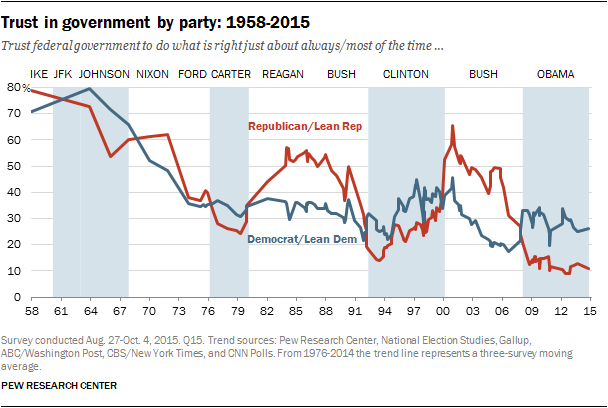
From the Pew Research Center: Trust in government: 1958-2015

Party ID matters

- Click here for the article.

Since the 1970s, trust in government has been consistently higher among members of the party that controls the White House than among the opposition party. However, Republicans are much more reactive than Democrats to changes in political power. Republicans express much higher levels of trust during Republican than during Democratic presidencies, while Democrats’ attitudes tend to be more consistent, regardless of which party controls the White House.

Trust - 2

Trust - 4

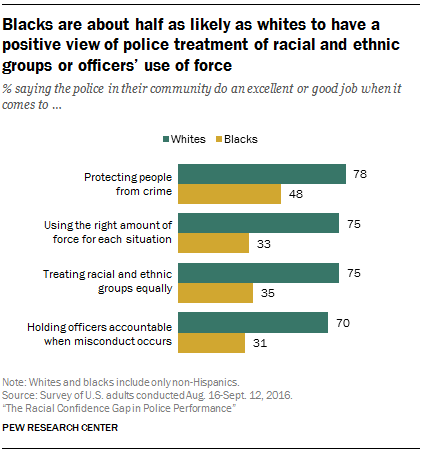
From the Pew Research Center: The Racial Confidence Gap in Police Performance - Blacks, whites also have dramatically different views on causes of fatal encounters between blacks and police

For our look at public opinion, especially group differences.

- Click here for the article.


The deep racial tensions seen in many areas of American life underlie how blacks and whites view police in their communities, as well as their reactions to the deadly encounters in recent years between blacks and law enforcement officers, according to a new survey by Pew Research Center.
Only about a third of blacks but roughly three-quarters of whites say police in their communities do an excellent or good job in using the appropriate force on suspects, treating all racial and ethnic minorities equally and holding officers accountable when misconduct occurs. Roughly half of all blacks say local police do an excellent or good job combating crime – a view held by about eight-in-ten whites.
Blacks and whites also differ over the root causes of the fatal incidents between police and blacks in recent years. Even before the recent lethal encounters between police and black men in Tulsa and Charlotte, the survey found that blacks are 25 percentage points more likely than whites to say the deaths of blacks during encounters with police in recent years are signs of a broader societal problem and not merely isolated incidents.
At the same time, whites and blacks both see the complexity of the situation. Majorities of each race say that both anti-police bias and a genuine desire to hold officers accountable for their actions play a part in fueling the protests that have often followed these fatal incidents, though whites are more skeptical than blacks about the demonstrators’ motives. There is less agreement on which is the more important motivator: For whites, it is anti-police bias (85% vs. 63% who see a sincere desire to promote accountability); for blacks it’s reversed (79% of blacks cite accountability, 56% opposition to the police).
The survey, conducted Aug. 16-Sept. 12 online and by mail among 4,538 U.S. adults, also found that about eight-in-ten blacks and a larger share of whites favor the use of body cameras by police to record encounters with citizens. Majorities of both races also believe that the use of so-called body cams would prompt officers to act more appropriately when dealing with the public.

From the Washington Post: The New York Times risked legal trouble to publish Donald Trump’s tax return

Will this be the Pentagon Papers of 2016?

- Click here for the article.

Dean Baquet wasn't bluffing.
The New York Times executive editor said during a visit to Harvard in September that he would risk jail to publish Donald Trump's tax returns. He made good on his word Saturday night when the Times published Trump tax documents from 1995, which show the Republican presidential nominee claimed losses of $916 million that year — enough to avoid paying federal income taxes for as many as 18 years.
Federal law makes it illegal to publish an unauthorized tax return or "return information":

It shall be unlawful for any person to whom any return or return information (as defined in section 6103(b)) is disclosed in a manner unauthorized by this title thereafter willfully to print or publish in any manner not provided by law any such return or return information. Any violation of this paragraph shall be a felony punishable by a fine in any amount not exceeding $5,000, or imprisonment of not more than 5 years, or both, together with the costs of prosecution.
The term "return information" covers not only return documents themselves but also the "amount of his income, payments, receipts, deductions, exemptions, credits, assets, liabilities, net worth, tax liability, tax withheld, deficiencies, overassessments or tax payments."
The Times published the first page of Trump's 1995 New York state resident income tax return, the first page of his New Jersey nonresident tax return and the first page of his Connecticut nonresident tax return.
Under New York law, it is unlawful "to divulge or make known in any manner the amount of income or any particulars set forth or disclosed in any report or return." Non-government employees face fines of as much as $10,000 and imprisonment for as long as one year.
In New Jersey, "any person ... divulging, disclosing or using [tax] information shall be guilty of a crime of the fourth degree," which carries a maximum sentence of 18 months in prison.
Connecticut's law against disclosure of tax information is more narrowly worded and, as the Hartford Courant reported, appears not to apply to the Times.
Baquet said during a panel discussion at Harvard that if the Times' lawyers advised him not to publish Trump tax returns, he would argue that such information is vital to the public interest because the real estate mogul's "whole campaign is built on his success as a businessman and his wealth."
Two weeks later, Times reporter Susanne Craig found tax documents in her mailbox.

From Slate: The Democratic Party’s Racial Reckoning

The article is harsh on Trump supporters, but it offers analysis supporting the argument that a realignment is occurring that will change the coalitions within each party for the next few elections. We may finally be on the dawn of a new party era.

Or maybe not.

The racial dynamics have shifted since Bill Clinton has been in office.

- Click here for the article.


The Democratic Party of Bill Clinton relied on voters who were unfriendly—even hostile—to racial liberalism. And it moved accordingly. Bolstered by the economy as well as these cultural moves, Clinton would claim the center of American politics, winning an easy re-election and eventually ending his term as one of the most popular presidents in recent memory, despite scandal and an impeachment attempt.
But that was then. Today, those voters—among them millions of working-class white men—are lost to the Democratic Party, in a shift that began under George W. Bush but accelerated under the presidency of Barack Obama. Democrats today win a smaller share of white voters—and the white workers in particular—than ever before. The home for those voters is in the GOP, under Trump, who turned a substantial majority with working-class whites into an overwhelming one, enough to win Ohio and Iowa and possibly other Midwestern states. But there’s been a backlash to this backlash. Trump’s success with working-class whites has come at the expense of the Republican Party’s historic advantage with college-educated and professional whites, who now favor Hillary Clinton. Increasingly, the Democratic electorate is shorn of those voters who are skeptical of racial and cultural liberalism or who vote on that skepticism.
Hillary demonstrated her distance from racists just as her husband used Sister Souljah to demonstrate his independence from black interests.
Bill Clinton distanced himself from anything that smacked of identity politics or traditional liberalism. Hillary Clinton has not. This speaks to a larger reality in American politics. Racism—either virulent or implicit—is the enemy of progressive political coalitions. It’s either an obstacle to building those coalitions in the first place, or it’s a part of the process that unravels them. White departure from the Democratic Party cost it the Oval Office for nearly 20 years, and the effort to win those whites back yielded a disappointing and myopic centrism. But now those whites aren’t as central to Democratic presidential fortunes, and it has given many in the party the space they need to move in a more liberal direction. And looking at the tenor of Democratic policy debates over the past year—debates over how the welfare state should expand, not if it should—they have. Which is to say that the great upside of this shift is for the blacks, Latinos, and young people who form a critical part of the Democratic Party’s national electorate. Their demands for criminal justice reform, immigration reform, and broader economic reform—as channeled through the primary campaign of Bernie Sanders—aren’t a deal-breaker for national Democratic politicians.

From the NYT: For Every 10 U.S. Adults, Six Vote and Four Don’t. What Separates Them?

For both 2305 and 2306: Perhaps the biggest problem with low voter turnout is that it is not uniform. Some groups vote at higher rates than others, and have more electoral muscle as a result. This is especially true for groups that habitually vote in all elections, even primary, special, and municipal elections where one vote can in fact matter.

- Click here for the article.

While young people, poor people and Hispanics are often singled out for low voting rates, there are millions of nonvoters in every demographic group. In fact, the majority of people who didn’t vote in the 2012 presidential election were white, middle-income and middle-aged.
But what distinguishes voters from nonvoters can be only partly explained by demographics. Experts say individuals tend to be motivated by a combination of their priorities, their group culture, how competitive their state is, and how easy or hard it is to vote.
The richer, older and more educated you are, the more likely you are to vote.
At the individual level, education and income are still two of the strongest predictors of whether someone will turn out at the polls.
“Most of the differences between people who vote and those who don’t vote can be accounted for by motivational reasons — levels of political interest and engagement,” said Benjamin Highton, a professor of political science at the University of California, Davis. “And levels of political interest and engagement are strongly correlated with education and income.”

From Wired: Clinton and Trump Get Most of Their Campaign Funds from These 250 Neighborhoods

More support for the argument that despite the general idea that the US is a democracy, it is actually more of a plutocracy.
- government by the richest people- a country that is ruled by the richest people
- a group of very rich people who have a lot of power
- Click here for the article.


The FEC, which compels political candidates to file regular reports on their fundraising and expenditures, provides data on funding by zip code in addition to tracking donations by employer and state. For the month of August, the 10 zip codes sending the most funding to Clinton are all on the east coast: eight in New York City, one in Washington DC, and one in Cambridge, Massachusetts. Last month wereported that Clinton took in lots of cash from the west side of Manhattan, and this month the trend continues: Clinton drew $364,000 from four West Side neighborhoods in August. Republican nominee Donald Trump, by contrast, raised that amount from his top 32 zip codes.

Monday, October 3, 2016

From the Washington Post: Courts & Law Supreme Court declines to hear immigration and Redskins cases

Sometimes the court makes a decision by choosing to not make a decision - and deferring to the lower courts.

- Click here for the article.

The Supreme Court will not reconsider President Obama’s plan to shield undocumented immigrants from deportation and denied the Washington Redskins’ bid to get its trademark case on this term’s docket.
With oral arguments postponed for a day because of the Rosh Hashana Jewish holiday, the first Monday in October that marks the beginning of the new Supreme Court term became a day of rejection. The court issued a thick stack of cases that had accumulated over the summer that the justices decided not to hear.
Among the other losers: the NCAA, which had asked the court to review an appeals court ruling about its policies involving the amateur status of college football and basketball players. The issue remains alive in other court proceedings.
The administration’s request was a long shot bid to salvage what had been the biggest legal defeat of Obama’s presidency. In June, a deadlocked court failed to revive his stalled plan to shield millions of undocumented immigrants from deportation and give them the right to work legally in the United States.
The justices’ votes at the time were not announced, but the court’s liberals and conservatives were split at oral argument last spring. The tie meant that a lower court’s decision that Obama probably exceeded his powers in issuing the executive action kept the plan from being implemented.
. . . The Washington football team’s request was something of a Hail Mary pass, as well. The club’s decades-old registration of its iconic nickname was canceled by the U.S. Patent and Trade Office, which said it violated the ban on disparaging trademarks.
But the team has appealed that and a lower court’s agreement to the U.S. Court of Appeals for the 4th Circuit. The Supreme Court does not usually grant cases before proceedings in the lower court are completed.| 
The issue, though, will be covered in the court’s current term. The justices last week said it would consider the similar case of an Asian American rock band called The Slants who were denied trademark registration.
A majority of the U.S. Court of Appeals for the Federal Circuit said the law — which calls for the rejection of trademarks that “may disparage . . . persons, living or dead, institutions, beliefs, or national symbols, or bring them into contempt, or disrepute”-- violates the First Amendment’s free speech guarantee.

The U.S. Supreme Court's October 2016 term starts today.

A few links about what's on the docket, lot's on their being shorthanded.

- Supreme Court to begin new term short-handed as its ideological balance hinges on fall vote.

The Supreme Court’s new term begins Monday with the focus not on the court’s docket but on the court itself and a future that will be defined by the presidential election.
For the first time in decades, there will be only eight justices, not nine, to begin the new term. Also absent are the kind of big-ticket cases — involving immigration reform, affirmative action, abortion, same-sex marriage and the Affordable Care Act — that in recent years have catapulted the Supreme Court to the fore of American civic life.
Instead, the short-handed court has assembled a docket of more-modest cases — albeit ones that touch on contemporary controversies such as the role of race in criminal justice and politics, free speech and perhaps the treatment of transgender students.

With one seat vacant, the Supreme Court returns.

Although the court has chosen, as of now, three dozen cases for decision during the new term, not one of those cases rises to the level of some of the major controversies that have been before it in recent terms – like the question of same-sex marriage, the fate of the broad new national health care law, attempts by state legislatures to restrict abortion rights, and, of course, the Obama immigration policy.
Perhaps the one case already scheduled for review that seems most likely to produce a deep division among the Justices – the right of religious schools to share equally in state-operated benefit programs – has been kept on hold without a hearing set for it, presumably because the court has been hoping that it would have a ninth Justice to join in deciding that case and thus avoiding a split. Issues of religious freedom have deeply divided this court, and that case stands right in the middle of that controversy.
The one area of brand-new controversy that could come before the court in the new term is the still-developing campaign to secure equal rights for transgender people. Already pending at the court is the first test case on that question, involving a high school senior in Virginia who is a transgender boy who wants to use the boy’s restroom at school. By a vote of 5-to-3, the court during the summer temporarily barred him from doing so, and it is a serious question whether the court will now be willing to step in and make a final decision on his claim of equal treatment at school.

“This term promises to be the most unpredictable one in many, many years,” saidNeal K. Katyal, a former acting United States solicitor general in the Obama administration now with Hogan Lovells.
There is no case yet on the docket that rivals the blockbusters of recent terms addressing health care, abortion or same-sex marriage. But such cases are rare, whether there are eight justices or nine.
“This term’s cases are not snoozers,” said Elizabeth B. Wydra, the president of the Constitutional Accountability Center, a liberal group. “This term features important cases about racial bias in the criminal justice system, voting rights and redistricting, immigration and detention, and accountability for big banks that engaged in racially discriminatory mortgage lending practices.”
There are, moreover, major cases on the horizon, including ones on whether a transgender boy may use the boys’ restroom in a Virginia high school and on whether a Colorado baker may refuse to serve a same-sex couple.
“If either of these cases is taken, it will almost immediately become the highest profile case on the court’s docket,” said Steven Shapiro, the legal director of the American Civil Liberties Union.
There is also the possibility that a dispute over the outcome of the presidential election could end up at the Supreme Court, as it did in 2000 in Bush v. Gore.
“That is the doomsday scenario in some respects of having an eight-member court,” said Carter G. Phillips, a lawyer with Sidley Austin. A deadlocked Supreme Court would leave in place the lower court ruling and oust the justices from their role as the final arbiters of federal law.

Saturday, October 1, 2016

From Bloomberg: Sept. 11 Widow Sues Saudi Arabia Following Congress Override

The first lawsuit authorized by Congress related to 9/11 has been filed.

- Click here for the article.


A woman widowed when her husband was killed at the Pentagon on Sept. 11, 2001 sued the Kingdom of Saudi Arabia just two days after Congress enacted legislation allowing Americans to sue foreign governments for allegedly playing a role in terrorist attacks on U.S. soil.

Stephanie Ross DeSimone alleged the kingdom provided material support to al Qaeda and its leader, Osama bin Laden, in a complaint filed Friday at a U.S. court in Washington. Her suit is also filed on behalf of the couple’s daughter. DeSimone was pregnant when Navy Commander Patrick Dunn was killed.

Fifteen of the 19 men who hijacked airliners used in the attack were Saudi nationals. One jet struck the Pentagon, seat of the U.S. military, two destroyed the World Trade Center’s twin towers in New York while another crashed in a Pennsylvania field as its passengers fought back against the hijackers.

A U.S. commission that investigated the 2001 attacks said in a 2004 report that it “found no evidence that the Saudi government, as an institution, or senior officials within the Saudi government funded al-Qaeda.” Long-classified portions of a congressional inquiry that were released in July found the hijackers may have had help from some Saudi officials.

The kingdom has previously denied culpability. Its embassy didn’t immediately reply to an e-mailed message seeking comment on the suit.

An official at Saudi Arabia’s Ministry of Foreign Affairs told the state-run Saudi Press Agency on Sept. 29 that the U.S. Congress must correct the 9/11 bill to avoid “serious unintended consequences,” adding the law is of “great concern” to the Kingdom.

DeSimone, who is suing for wrongful death and intentional infliction of emotional distress, is seeking unspecified compensatory and punitive damages.

The case is DeSimone v. Kingdom of Saudi Arabia, 16-cv-1944, U.S. District Court, District of Columbia (Washington).

More fallout:

9/11 bill is a global blunder that will weaken US efforts abroad.
- Congress Has Itself to Blame for 9/11 Bill.