Tuesday, March 13, 2012
An addendum to 2302's week written assignment
I asked 2302 16 week students to pretend they were president and outline how they would respond to the burning of the Koran by soldiers in Afghanistan. Suddenly that problem seems trivial compared to the recent killings. If you haven't turned in the assignment yet, feel free to change the subject to account for new developments. Do we pull the troops out?


Texas Voter ID Law Blocked by Justice Department
This applies to our discussion of federalism, as well as elections, and probably the executive branch and checks and balances as well. Citing the Voting Rights Act, the Justice Department blocked implementation of Texas' voter ID law - which mandated that pre-approved picture ID's be presented when a voter casts a vote.
The Justice Department argued that the law disproportionately disenfranchises minority voters - especially Hispanic voters. From the NYT:
In a letter to the Texas state government, Thomas E. Perez, the assistant attorney general for civil rights, said the state had failed to meet its requirement, under the Voting Rights Act, to show that the measure would not disproportionately disenfranchise registered minority voters.
“Even using the data most favorable to the state, Hispanics disproportionately lack either a driver’s license or a personal identification card,” Mr. Perez wrote, “and that disparity is statistically significant.”
Texas has roughly 12.8 million registered voters, of whom about 2.8 million are Hispanic. The state had supplied two sets of data comparing its voter rolls with a list of people who had valid state-issued photo identification cards — one from September and the other from January — showing that Hispanic voters were 46.5 percent to 120 percent more likely to lack such identification than were non-Hispanics.
Under the Voting Rights Act, jurisdictions that have a history of suppressing minority voting — like Texas — must show that any proposed change to voting rules would not have a disproportionate effect on minority voters, even if there is no evidence of discriminatory intent.
Such “pre-clearance” can be granted either by the Justice Department or by a panel of federal judges.
This story raises a few issues we will be hitting on 16-week 2301 soon enough:
- The Voting Rights Act
- Preclearance.
- Voter ID laws. State Requirements.
- Electoral Fraud.
- Justice Department, Civil Rights Division.
The Justice Department argued that the law disproportionately disenfranchises minority voters - especially Hispanic voters. From the NYT:
In a letter to the Texas state government, Thomas E. Perez, the assistant attorney general for civil rights, said the state had failed to meet its requirement, under the Voting Rights Act, to show that the measure would not disproportionately disenfranchise registered minority voters.
“Even using the data most favorable to the state, Hispanics disproportionately lack either a driver’s license or a personal identification card,” Mr. Perez wrote, “and that disparity is statistically significant.”
Texas has roughly 12.8 million registered voters, of whom about 2.8 million are Hispanic. The state had supplied two sets of data comparing its voter rolls with a list of people who had valid state-issued photo identification cards — one from September and the other from January — showing that Hispanic voters were 46.5 percent to 120 percent more likely to lack such identification than were non-Hispanics.
Under the Voting Rights Act, jurisdictions that have a history of suppressing minority voting — like Texas — must show that any proposed change to voting rules would not have a disproportionate effect on minority voters, even if there is no evidence of discriminatory intent.
Such “pre-clearance” can be granted either by the Justice Department or by a panel of federal judges.
This story raises a few issues we will be hitting on 16-week 2301 soon enough:
- The Voting Rights Act
- Preclearance.
- Voter ID laws. State Requirements.
- Electoral Fraud.
- Justice Department, Civil Rights Division.
Monday, March 12, 2012
Does the Second Amendment protect an individual right to carry a gun outside the home?
The Washington Post weighs in on a current controversy, fitting for my 16 week 2301s since they've been reading through the Bill of Rights and how the court tends to reinterpret it from time to time - occasionally finding rights beyond those explicitly listed. 8 week 2301 students will be hitting this subject soon enough.
Last week, a federal judge in Maryland concluded that it does and in the process struck down a Maryland licensing provision for carrying concealed weapons in public.
. . . Judge Legg agreed, building on the 2008 Supreme Court decision that the Second Amendment protects an individual right to keep and bear arms. The court emphasized the saliency of the right especially in the home and especially for self-defense. Judge Legg concluded that the Constitution and the high court’s holding must also be read to protect an individual’s right to carry weapons outside the home. Maryland’s “good and substantial” requirement impermissibly infringed on that right, he said.
The paper editorializes that the decision ought to be reviewed by the federal courts, and there's little doubt that they will. This is worthy of discussion. Does the state's interest in preserving public peace (as it sees fit) trump individual rights?
- An editorial from the Daily Caller.
Last week, a federal judge in Maryland concluded that it does and in the process struck down a Maryland licensing provision for carrying concealed weapons in public.
. . . Judge Legg agreed, building on the 2008 Supreme Court decision that the Second Amendment protects an individual right to keep and bear arms. The court emphasized the saliency of the right especially in the home and especially for self-defense. Judge Legg concluded that the Constitution and the high court’s holding must also be read to protect an individual’s right to carry weapons outside the home. Maryland’s “good and substantial” requirement impermissibly infringed on that right, he said.
The paper editorializes that the decision ought to be reviewed by the federal courts, and there's little doubt that they will. This is worthy of discussion. Does the state's interest in preserving public peace (as it sees fit) trump individual rights?
- An editorial from the Daily Caller.
Welcome 8 week mini - semester 2301 and 2302 students.
If you're looking at this post, you've come to the right place. Writing assignment are on the right hand column, and info relevant to each week's material can be found posted most everyday here - plus posts back five years or so.
Good luck in class.
Good luck in class.
Friday, March 9, 2012
Are "independents" really independent?
For 2301's - as we approach a discussion of elections in the near future. The answer is, well it depends on why people call themselves independent. Is it because they are truly in the middle of the political spectrum and are equi distant from the two major parties - or are they so far to the right or left that Republicans are too liberal or Democrats too conservative for them. This matters, because people often make erroneous statements about independents and assume they are up for grabs by either party. They are not. The following graph shows that independents that lean towards one party are almost identical in opinion towards Obama as party identifiers. Very few people are truly independent - only 7% according to this chart.

Consider this post - Three Myths about Independents - required reading.
Consider this post - Three Myths about Independents - required reading.
Thursday, March 8, 2012
Can Citizenship Be Revoked?
A good question from this afternoon's 2301: Can a USA Citizenship Be Revoked?
I had never thought about this much before, but for various reasons it can. This would help resolve the issues Holder raised a post below - no need to worry about due process rights for the non-citizen enemy combatant, but the person subject to having citizenship revoked would probably have due process rights to challenge it. So the question is, can citizenship rights be revoked without due process? I do not know, but my guess is no.
I had never thought about this much before, but for various reasons it can. This would help resolve the issues Holder raised a post below - no need to worry about due process rights for the non-citizen enemy combatant, but the person subject to having citizenship revoked would probably have due process rights to challenge it. So the question is, can citizenship rights be revoked without due process? I do not know, but my guess is no.
Some random topical posts on bureaucratic rulemaking . . .
For 2302 (primarily) a few links to recent stories regarding the federal bureaucracy and its rule-making authority.
- First, to patch up an omission in the notes, here is a link to the Office of Information and Regulatory Affairs, which is part of the White House's Office of Management and Budget and "was created by Congress with the enactment of the Paperwork Reduction Act of 1980 (PRA). OIRA carries out several important functions, including reviewing Federal regulations, reducing paperwork burdens, and overseeing policies relating to privacy, information quality, and statistical programs.'
- From the National Review, criticism of the newly created Consumer Financial Protection Bureau, which was created in the Dodd-Frank bill which itself was a response to the 2008 financial crash and the hunch by many that the crash was made possible by the removal of regulations that minimized the incentives for banks to make risky investments with deposits. The author reports on a conference which discussed whether the agency had sufficient checks on its activities, but seemed to accept the aide that reasonable regulations were needed. He also points out that Madison was concerned about the negative impact regulatory uncertainty can created in the private sector. The article also touches on the problems of regulatory capture and the revolving door.
-- The Rule of Law and the Administrative State.
-- Congress vs. Agencies: Balancing Checks and Efficiency: Gridlock, Organized Interests, and Regulatory Capture.
-- Federalist #62.
- From Reuters, comments on the difficulty of implementing the Dodd-Frank requirements that the derivative market be regulated. 60 regulations are required to be established by the Commodity Futures Trading Commission, and they must be justified by cost-benefit analyses, but this is apparently much more difficult to achieve than one might think.
-- Cost-Benefit Analysis and the Commodity Futures Trading Commission.
- From the Economist, more criticism of Dodd-Frank, and the general trend towards over-regulation and what impact it has on the economy.
- From the Huffington Post, a report on the ability of industry lobbyists to delay the implementation of the "silica rule" which is being considered by the Labor Department: The rule "would limit the amount of breathable silica dust to which workers in the construction and mining industries are exposed. Crystalline silica dust is found in sand and granite, and it has been known for decades to lead to the respiratory disease known as silicosis. Although the regulations would strengthen protections for workers, they're expected to raise costs for businesses that mine or build with materials involving silica."
- Worker Safety Rule Under Review at OIRA for Over a Year: A Tale of Rulemaking Delay.
- Click here for the status of the review.
- First, to patch up an omission in the notes, here is a link to the Office of Information and Regulatory Affairs, which is part of the White House's Office of Management and Budget and "was created by Congress with the enactment of the Paperwork Reduction Act of 1980 (PRA). OIRA carries out several important functions, including reviewing Federal regulations, reducing paperwork burdens, and overseeing policies relating to privacy, information quality, and statistical programs.'
- From the National Review, criticism of the newly created Consumer Financial Protection Bureau, which was created in the Dodd-Frank bill which itself was a response to the 2008 financial crash and the hunch by many that the crash was made possible by the removal of regulations that minimized the incentives for banks to make risky investments with deposits. The author reports on a conference which discussed whether the agency had sufficient checks on its activities, but seemed to accept the aide that reasonable regulations were needed. He also points out that Madison was concerned about the negative impact regulatory uncertainty can created in the private sector. The article also touches on the problems of regulatory capture and the revolving door.
-- The Rule of Law and the Administrative State.
-- Congress vs. Agencies: Balancing Checks and Efficiency: Gridlock, Organized Interests, and Regulatory Capture.
-- Federalist #62.
- From Reuters, comments on the difficulty of implementing the Dodd-Frank requirements that the derivative market be regulated. 60 regulations are required to be established by the Commodity Futures Trading Commission, and they must be justified by cost-benefit analyses, but this is apparently much more difficult to achieve than one might think.
-- Cost-Benefit Analysis and the Commodity Futures Trading Commission.
- From the Economist, more criticism of Dodd-Frank, and the general trend towards over-regulation and what impact it has on the economy.
- From the Huffington Post, a report on the ability of industry lobbyists to delay the implementation of the "silica rule" which is being considered by the Labor Department: The rule "would limit the amount of breathable silica dust to which workers in the construction and mining industries are exposed. Crystalline silica dust is found in sand and granite, and it has been known for decades to lead to the respiratory disease known as silicosis. Although the regulations would strengthen protections for workers, they're expected to raise costs for businesses that mine or build with materials involving silica."
- Worker Safety Rule Under Review at OIRA for Over a Year: A Tale of Rulemaking Delay.
- Click here for the status of the review.
Tuesday, March 6, 2012
John McCain thinks the US should use its air power in Syria
In 2302's discussion of presidential foreign powers several justifications - doctrines - used by different presidents were mentioned. A more recent argument has been the Responsibility to Protect doctrine, which was used to justify US intervention in Libya.
Senator McCain invokes a similar justification for intervention in Syria, he also ties it into the conflict with Iran.
Senator McCain invokes a similar justification for intervention in Syria, he also ties it into the conflict with Iran.
Stanford Guilty
For 2302's upcoming look at the judiciary - a recently completed trial. Perhaps you heard of it?
Why does health care cost so much more in the US than in other countries?
This sounds like a silly answer to a silly question, but its because prices are higher. We pay more for procedures that cost less elsewhere. If we want to reign in the high costs of health care, we have to cut what things cost - which cuts into someone's profits and salaries of course. There are constituencies that oppose those things.
- Its the prices stupid.
- Commentary from Wonkblog.
- Its the prices stupid.
- Commentary from Wonkblog.
Can the President kill anyone he chooses, even if it denies an American citizen due process rights?
That seems to be what Attorney General Holder argued in a recent speech, a power he argues is a necessary consequence of the war on terror, and a component of the president's inherent power of commander in chief:
- Not so innocent abroad.
Some have called such operations “assassinations.”
They are not, and the use of that loaded term is misplaced.
Assassinations are unlawful killings.
Here, for the reasons I have given, the U.S. government’s use
of lethal force in self defense against a leader of al Qaeda or an
associated force who presents an imminent threat of violent attack would
not be unlawful — and therefore would not violate the Executive Order
banning assassination or criminal statutes.
Now, it is an unfortunate but undeniable fact that some of the threats
we face come from a small number of United States citizens who have
decided to commit violent attacks against their own country from abroad.
Based on generations-old legal principles and Supreme Court
decisions handed down during World War II, as well as during this
current conflict, it’s clear that United States citizenship alone does
not make such individuals immune from being targeted.
But it does mean that the government must take into account all
relevant constitutional considerations with respect to United States
citizens – even those who are leading efforts to kill innocent
Americans.
Of these, the most relevant is the Fifth Amendment’s Due
Process Clause, which says that the government may not deprive a citizen
of his or her life without due process of law.
The Supreme Court has made clear that the Due Process Clause does not
impose one-size-fits-all requirements, but instead mandates procedural
safeguards that depend on specific circumstances.
In cases arising under the Due Process Clause – including in a
case involving a U.S. citizen captured in the conflict against al Qaeda –
the Court has applied a balancing approach, weighing the private
interest that will be affected against the interest the government is
trying to protect, and the burdens the government would face in
providing additional process.
Where national security operations are at stake, due process takes into account the realities of combat.
Here, the interests on both sides of the scale are extraordinarily weighty.
An individual’s interest in making sure that the government does not target him erroneously could not be more significant.
Yet it is imperative for the government to counter threats
posed by senior operational leaders of al Qaeda, and to protect the
innocent people whose lives could be lost in their attacks.
This subject straddles 2301 and 2302 since it concerns both the procedural rights that American's have - those that are spelled out in the 4th - 8th Amendments of the Bill of Rights - and the loosely defined military powers of the President. Here is an area where they conflict and the Obama Administration - along with most any other administration I imagine - would argue that his powers trump due process rights.
2302s ought to read the speech in order to hear what the attorney general is saying about the increased efficiency of the executive branch's military and surveillance powers after the considerable reorganization it went through following 9/11.
For detail and critiques read these:
- Holder Defends Executions Without Charges.
- So we should just trust that the president wont assassinate us?
- Reviving the Constitution.
- On targeted killings, Holder strikes out. This subject straddles 2301 and 2302 since it concerns both the procedural rights that American's have - those that are spelled out in the 4th - 8th Amendments of the Bill of Rights - and the loosely defined military powers of the President. Here is an area where they conflict and the Obama Administration - along with most any other administration I imagine - would argue that his powers trump due process rights.
2302s ought to read the speech in order to hear what the attorney general is saying about the increased efficiency of the executive branch's military and surveillance powers after the considerable reorganization it went through following 9/11.
For detail and critiques read these:
- Holder Defends Executions Without Charges.
- So we should just trust that the president wont assassinate us?
- Reviving the Constitution.
- Not so innocent abroad.
8 - Written Assignment GOVT 2301 Spring Semester
Since we will be looking at civil liberties this week - which includes religious liberties - its appropriate to look at the recent controversy over the proposed rule regarding contraception coverage. Previous posts have focused on the political aspects of this controversy, but I want you to think about the constitutional questions it raises in light of previous Supreme Court decisions regarding the extent of these protections.
The truth is that the free exercise of religion has in fact been limited many times over the course of American history if the Supreme Court has ruled that the greater interests of society overrules it. This week's power points contain examples. One of the more famous was the 1878 decision to uphold laws against polygamy despite the fact that Mormons practiced polygamy as part of their religious beliefs.
Since the contraception rule has been announced, commentators have looked at the case of Employment Division v Smith to get an idea about how the current court might handle a proposed constitutional challenge. In brief, the court ruled that laws against peyote use - which led to the firings of two members of an American Indian tribe who had ingested peyote during a religious ritual - took precedence over their claim of religious freedom. This was because the laws were neutral to religion and the purpose of the law represented a "compelling public purpose" that government has the right to pursue.
Since the rule has yet to be finalized, or passed, there is nothing for the court to actually review. We don't know what an actual dispute might look like, but we do know - based on the last week's written assignment - that the Texas Attorney General is filing suit against the proposed rule. So based on what we know about the rule, and how the court's have rule don previous cases, how might they rule on this case? Try to figure out what arguments will be offered on either side.
The truth is that the free exercise of religion has in fact been limited many times over the course of American history if the Supreme Court has ruled that the greater interests of society overrules it. This week's power points contain examples. One of the more famous was the 1878 decision to uphold laws against polygamy despite the fact that Mormons practiced polygamy as part of their religious beliefs.
Since the contraception rule has been announced, commentators have looked at the case of Employment Division v Smith to get an idea about how the current court might handle a proposed constitutional challenge. In brief, the court ruled that laws against peyote use - which led to the firings of two members of an American Indian tribe who had ingested peyote during a religious ritual - took precedence over their claim of religious freedom. This was because the laws were neutral to religion and the purpose of the law represented a "compelling public purpose" that government has the right to pursue.
Since the rule has yet to be finalized, or passed, there is nothing for the court to actually review. We don't know what an actual dispute might look like, but we do know - based on the last week's written assignment - that the Texas Attorney General is filing suit against the proposed rule. So based on what we know about the rule, and how the court's have rule don previous cases, how might they rule on this case? Try to figure out what arguments will be offered on either side.
8 - Written Assignment GOVT 2302 Spring Semester
Water Policy in Texas
I've mentioned in class several times that I intend to focus attention on the water policy in the state and I've had a small number of posts about recent events related to water availability in the state. Now I want you to write about the subject.
Since this is 2302, and we're focusing on executive institutions at the moment, I want you to do a little research and figure out two things. First, what are the precise issues facing the state - as well as local governments - about water, and second, what institutions exist to develop and implement these policies?
Based on what you find out, are we in the middle of a crisis? And how capable is the state to handle this crisis if so?
Here are a few links to get you going:
- Texas Public Policy Foundation - Water.
- Texas Water Matters.
- Water Policy in Texas.
- Texas Water Development Board - Policies.
- Senate Committee on Water Policy.
- Conference on Water Policy.
I've mentioned in class several times that I intend to focus attention on the water policy in the state and I've had a small number of posts about recent events related to water availability in the state. Now I want you to write about the subject.
Since this is 2302, and we're focusing on executive institutions at the moment, I want you to do a little research and figure out two things. First, what are the precise issues facing the state - as well as local governments - about water, and second, what institutions exist to develop and implement these policies?
Based on what you find out, are we in the middle of a crisis? And how capable is the state to handle this crisis if so?
Here are a few links to get you going:
- Texas Public Policy Foundation - Water.
- Texas Water Matters.
- Water Policy in Texas.
- Texas Water Development Board - Policies.
- Senate Committee on Water Policy.
- Conference on Water Policy.
Friday, March 2, 2012
Issa set his sights on the chair of the Postal Regulatory Commission
checking, balancing, oversighting, etc ....
From the Hill:
Key lawmakers have expressed concern that the Postal Service’s top regulator is spending too much time on the road at a time when the agency faces serious financial challenges.
Rep. Darrell Issa (R-Calif.), the chairman of the House Oversight Committee, and Sen. Tom Carper (D-Del.) have suggested that Ruth Goldway’s trips are hampering the Postal Regulatory Commission’s (PRC) ability to offer advice about proposals that would change how mail is delivered in the United States.
Goldway, who has served as chairwoman of the PRC since 2009, is currently attending a postal event in Switzerland, her third trip to that country in the past year. She has also traveled, in that same time span, to Belgium, China, Portugal, Puerto Rico and Scotland.
From the Hill:
Key lawmakers have expressed concern that the Postal Service’s top regulator is spending too much time on the road at a time when the agency faces serious financial challenges.
Rep. Darrell Issa (R-Calif.), the chairman of the House Oversight Committee, and Sen. Tom Carper (D-Del.) have suggested that Ruth Goldway’s trips are hampering the Postal Regulatory Commission’s (PRC) ability to offer advice about proposals that would change how mail is delivered in the United States.
Goldway, who has served as chairwoman of the PRC since 2009, is currently attending a postal event in Switzerland, her third trip to that country in the past year. She has also traveled, in that same time span, to Belgium, China, Portugal, Puerto Rico and Scotland.
Blunt Amendment Defeated
Story in The Hill. The amendment would have been added to the transportation bill, and would have overturned Obama's contraception mandate.
Texas political maps have been accepted (I think) and the primary has been set for May 29
A brief story in the Houston Chronicle. Minority groups still claim the plans dilute minority group representation, so the story might not be over.
All maps can be found on District Viewer. Click on select plans then look for Court Ordered Interim Congressional Plan, House Plan, and Senate Plan.
All maps can be found on District Viewer. Click on select plans then look for Court Ordered Interim Congressional Plan, House Plan, and Senate Plan.
The fallout form the Texas Supreme Court's water decision
Some thoughts from the San Antonio Express-News, more litigation and higher water costs:
The court decision raises numerous questions for EAA officials and Texans who rely on the Edwards Aquifer. The ruling will have widespread impact on other water districts as well.
Can every homeowner who has a lot over the aquifer now seek permission to drill a well and win compensation if the request is denied? Has the statute of limitations for seeking new pumping permits expired?
EAA officials may file a motion for reconsideration in an effort to learn more about the court's reasoning.
EAA Chairwoman Luana Buckner said the worst-case scenario is five or six years of lawsuits and takings rulings. That could drive up the cost of Edwards water dramatically.
Property rights advocates are cheered by the ruling, but the decision did not clarify what set of circumstances constitutes a taking.
The court decision raises numerous questions for EAA officials and Texans who rely on the Edwards Aquifer. The ruling will have widespread impact on other water districts as well.
Can every homeowner who has a lot over the aquifer now seek permission to drill a well and win compensation if the request is denied? Has the statute of limitations for seeking new pumping permits expired?
EAA officials may file a motion for reconsideration in an effort to learn more about the court's reasoning.
EAA Chairwoman Luana Buckner said the worst-case scenario is five or six years of lawsuits and takings rulings. That could drive up the cost of Edwards water dramatically.
Property rights advocates are cheered by the ruling, but the decision did not clarify what set of circumstances constitutes a taking.
Some random posts on state and local matters
For 2301's look at federalism this week. 2302s should read these through to get an idea of the range of executive agencies that exist on all levels of government and what they do:
- The revenue streams of local governments in the DFW area may be limited by the end of the Barnett Shale boom. Lower natural gas prices might be benefiting consumers, are hurting local governmental revenues.
- The Electric Reliability Council of Texas (ERCOT) warns that the state's electricity grid (click here info on the grid from ERCOT) will be, once again, under severe stress this summer. The National Weather Service is predicting another brutal summer, which will lead to more AC use, and more drain on the grid. ERCOT says it is working with the Public Utility Commission of Texas to avoid blackouts.
In case you did not know this, Texas has its own grid - click here for why, and here for what the grids in the US look like. Because Texas has its own grid, it is "exempt from most regulation by the Federal Energy Regulatory Commission, the Beltway agency that governs the transmission of electricity from state to state—say, by mandating transmission standards, or requiring that prices be listed in public forums."
- A Texas legislator argues that the traditional curriculum does not reach all students. Instruction in math and sciences ought to take this into consideration. She argues in favor of additional funding for vocational programs and the Texas Workforce Commission seems to agree.
- There are disputes in San Antonio over how transportation funds approved by a 2004 election ought to be spent.
- The revenue streams of local governments in the DFW area may be limited by the end of the Barnett Shale boom. Lower natural gas prices might be benefiting consumers, are hurting local governmental revenues.
- The Electric Reliability Council of Texas (ERCOT) warns that the state's electricity grid (click here info on the grid from ERCOT) will be, once again, under severe stress this summer. The National Weather Service is predicting another brutal summer, which will lead to more AC use, and more drain on the grid. ERCOT says it is working with the Public Utility Commission of Texas to avoid blackouts.
In case you did not know this, Texas has its own grid - click here for why, and here for what the grids in the US look like. Because Texas has its own grid, it is "exempt from most regulation by the Federal Energy Regulatory Commission, the Beltway agency that governs the transmission of electricity from state to state—say, by mandating transmission standards, or requiring that prices be listed in public forums."
- A Texas legislator argues that the traditional curriculum does not reach all students. Instruction in math and sciences ought to take this into consideration. She argues in favor of additional funding for vocational programs and the Texas Workforce Commission seems to agree.
- There are disputes in San Antonio over how transportation funds approved by a 2004 election ought to be spent.
Are we looking at the wrong depression when we try to figure out how to deal with economy?
Economist Stephen Davies suggests that we are, and that the current recession - or whatever it is - look more like the Long Depression of 1873 - 1879, than the Great Depression of the 1930s. This matters because our policy responses as of yet has assumed that the factors driving the current economy are similar to those of the 1930, but these responses might be the wrong ones.
Here's his rationale: What we are going through is a prolonged global contraction driven by the disruptions caused by ongoing consequences of shifts in technology, not a sharp decline in economic activity driven by a lack of liquidity (capital). The same shifts were occurring in the late 19th Century. New technologies replaced the old and the disruptions caused very real pain on those not able to adjust, but ultimately benefited those who could, as well as the country as a whole:
. . . the 30 to 40 years after 1870 saw the advent of technologies that would define modern life, including electricity, the internal-combustion engine, the telephone, the diesel engine, and the modern petroleum industry.
As a result, the official figures are seriously misleading. While nominal wages stagnated or declined, real living standards increased because of the falling cost of products. Output increased, but this is not captured unless one applies a GDP inflator to account for the increasing value of money. So the Long Depression of the 1870s and 1880s was not a simple story of economic standstill.
So what happened? Essentially a set of innovations in technology and business organization made in the later eighteenth and early nineteenth centuries had exhausted their potential to raise productivity and growth by the 1860s. This, combined with mistaken policies, had led to malinvestment and a significant buildup of debt by the early 1870s in both Europe and the United States.
What followed, Irving Fisher argued, was a crisis brought about by the realization that many investments were not going to pay enough and the consequent need for sustained “deleveraging” (paying back or writing off of debt). At the same time there was a burst of technological and organizational innovation. This increased productivity and created many new products but also led to large adjustments as older industries and forms of employment shrank, prompting a large movement of labor. This took some time, so the costs of the transition in human terms were significant.
Here's his rationale: What we are going through is a prolonged global contraction driven by the disruptions caused by ongoing consequences of shifts in technology, not a sharp decline in economic activity driven by a lack of liquidity (capital). The same shifts were occurring in the late 19th Century. New technologies replaced the old and the disruptions caused very real pain on those not able to adjust, but ultimately benefited those who could, as well as the country as a whole:
. . . the 30 to 40 years after 1870 saw the advent of technologies that would define modern life, including electricity, the internal-combustion engine, the telephone, the diesel engine, and the modern petroleum industry.
As a result, the official figures are seriously misleading. While nominal wages stagnated or declined, real living standards increased because of the falling cost of products. Output increased, but this is not captured unless one applies a GDP inflator to account for the increasing value of money. So the Long Depression of the 1870s and 1880s was not a simple story of economic standstill.
So what happened? Essentially a set of innovations in technology and business organization made in the later eighteenth and early nineteenth centuries had exhausted their potential to raise productivity and growth by the 1860s. This, combined with mistaken policies, had led to malinvestment and a significant buildup of debt by the early 1870s in both Europe and the United States.
What followed, Irving Fisher argued, was a crisis brought about by the realization that many investments were not going to pay enough and the consequent need for sustained “deleveraging” (paying back or writing off of debt). At the same time there was a burst of technological and organizational innovation. This increased productivity and created many new products but also led to large adjustments as older industries and forms of employment shrank, prompting a large movement of labor. This took some time, so the costs of the transition in human terms were significant.
Thursday, March 1, 2012
Independent Payment Advisory Board repealed in the House Subcommittee
A bill repealing the Independent Payment Advisory Board, which was designed to curb growth in Medicare spending passed the Energy and Commerce Health subcommittee in a 17-5 vote.
Story in The Hill.
Story in The Hill.
Some Thoughts on Jury Duty
I've yet to build up sufficient information on the jury system for 2302s- which is a major omission I'll try to correct this semester - but there are a few thoughts on jury duty from Andrew Sullivan's site - and places he links to - to get something kick-started.
A writer at Slate wonders why people don't enjoy the opportunity to do something different for a few days, and offers this indictment: "I feel like as a society we've coordinated on a pointless anti-social norm that you're some kind of sucker if you're willing to just smile and do what the judge wants even though there are no really good self-interested reasons to want out." The author offers the following link as a guide for those who want to opt out: be verbal, be subtle and be biased. The story refers to the American Society of Trial Consultants.
A response points out that not everyone can take significant time off of work. This is especially true for service on grand juries - the people who decide what cases go to trial. It always seemed tome likely that this introduces tremendous bias in the criminal justice system. There are certain to be significant demographic differences between the type of people who can and cannot serve on grand juries. It seems likely that this has consequences for what cases do and do not go to trial.
The jury remains one of the more interesting institutions in American government - where else might the bulk of population have their opinions heard in the actual operations of government?
A writer at Slate wonders why people don't enjoy the opportunity to do something different for a few days, and offers this indictment: "I feel like as a society we've coordinated on a pointless anti-social norm that you're some kind of sucker if you're willing to just smile and do what the judge wants even though there are no really good self-interested reasons to want out." The author offers the following link as a guide for those who want to opt out: be verbal, be subtle and be biased. The story refers to the American Society of Trial Consultants.
A response points out that not everyone can take significant time off of work. This is especially true for service on grand juries - the people who decide what cases go to trial. It always seemed tome likely that this introduces tremendous bias in the criminal justice system. There are certain to be significant demographic differences between the type of people who can and cannot serve on grand juries. It seems likely that this has consequences for what cases do and do not go to trial.
The jury remains one of the more interesting institutions in American government - where else might the bulk of population have their opinions heard in the actual operations of government?
Wednesday, February 29, 2012
Zombie Muhammed
From a discussion in Wednesday's 2302-02 class:
A judge says its OK for a Muslim to attack an atheist dressed as Zombie Muhammed. The judge has since received threats.
A judge says its OK for a Muslim to attack an atheist dressed as Zombie Muhammed. The judge has since received threats.
Tuesday, February 28, 2012
From the Atlantic: Can a Town Get By Without Its Public Works Department?
The mayor of a town in New Jersey thinks the public sector can do a better job than city government collecting trash etc....
Are state legislatures ignoring real problems for symbolic ones?
This author says yes, and its undermining self governance. The legislation (ultra-sound, anti-Sharia Law) is designed to placate special interests, not solve real problems.
The author is concerned that state legislatures are also attacking the independence of the judiciary:
Indeed, the past 16 months have seen persistent and pernicious efforts by state lawmakers to undermine the independence of the judiciary. I have written about this topic before as it relates to New Hampshire. But it's rampant all over. In Arizona, lawmakers angry about a state court's redistricting decision are trying to punish the state's judicial system by dramatically reducing the number of appellate judges from 22 to six. Meanwhile, in Maryland, Florida, Minnesota, and Tennessee, to name just a few states, conservative legislators are seeking to strengthen rules that would allow "commissions" to remove judges from office for unpopular decisions. Kansas has even managed a quinella, combining anti-judicial sentiment with the "birther" movement, by pushing a measure that would require judges to prove their citizenship.
The author is concerned that state legislatures are also attacking the independence of the judiciary:
Indeed, the past 16 months have seen persistent and pernicious efforts by state lawmakers to undermine the independence of the judiciary. I have written about this topic before as it relates to New Hampshire. But it's rampant all over. In Arizona, lawmakers angry about a state court's redistricting decision are trying to punish the state's judicial system by dramatically reducing the number of appellate judges from 22 to six. Meanwhile, in Maryland, Florida, Minnesota, and Tennessee, to name just a few states, conservative legislators are seeking to strengthen rules that would allow "commissions" to remove judges from office for unpopular decisions. Kansas has even managed a quinella, combining anti-judicial sentiment with the "birther" movement, by pushing a measure that would require judges to prove their citizenship.
David Frum doesn't care for the term "The Founders"
He points out, as we have also, that the nation was built up for 150 years prior to the actual revolution. What would become the nation had already been founded in many ways prior to 1776. Between 1776 and 1787, the American Republic was constructed. He also reminds us that the North American colonies were quite aristocratic, and that would continue until the revolution:
When called to church on a Sunday morning, the people of a southern colony would not enter all at once–or even family by family. The commonfolk of the parish would enter first. Then the wives and children of the major landowners. These squires assembled as a body, and entered together after all others had sat down.
True, the colonies lacked the extremes of wealth and poverty to be seen in the mother country. As Wood notes, the most opulent house in colonial America, William Byrd’s Westover, was 65 feet long. The Marquess of Rockingham had a house ten times the size; the Sackvilles’ palace of Knole had 365 rooms.
But if the hierarchy was truncated at top and bottom, it was finely elaborated in between. In New England, people carefully assessed who ranked as a mere husbandman, who counted as a yeoman, who should be addressed as “Mr.,” and who was entitled to the yet more respectful, “Your honor.”
African slaves occupied the very lowest rank in a vast system of unfreedom and dependency. Yet their condition differed only in degree from that of white indentured servants and apprentices. The servant or the apprentice might be held only for a term of years rather than for life. The apprentice might expect some kind of support and patronage after his term expired. While the indenture or apprenticeship lasted, however, white servants could be beaten just like a black slave; could be refused permission to marry; and could discover that their service had been sold to a new master.
The American revolution collapsed this elaborate hierarchical world into a new scheme that recognized only two statuses, slave and free.
He also challenges the idea that the founders were libertarian, as is often suggested by contemporary politicians. Individualism, as we understand it today, evolved over time:
What would today’s Tea Party make of this statement? “Private property is a creature of society, and is subject to the calls of that society whenever its necessities shall require it, down to the last farthing.” No, that’s not Karl Marx–that’s the Benjamin Franklin of the Constitutional period. (p. 219, The Americanization of Benjamin Franklin.)
Nor was Franklin unique. Modern libertarianism was an utterly foreign mode of thought to the revolutionary generation.
Ironically, those members of the revolutionary generation who sound most libertarian to our modern ears (Thomas Jefferson for example) were the most mistrustful of commerce and enterprise. Those most sympathetic to commerce and enterprise (Alexander Hamilton) sound least libertarian.
Yet as commerce advanced–and as pre-modern forms of authority based on claims of public virtue were rejected–American politics evolved in directions more and more recognizable to us.
In 19th century America, equality would come to mean “not just that a man was as good as his neighbor and possessed equal rights, but that he was ‘weighed by his purse, not by his mind, and according to the preponderance of that, he rises or sinks in the scale of individual opinion.’ That was a kind of equality no revolutionary had anticipated.” (p. 243, Radicalism of the American Revolution.) The quoted words come from one of the correspondents of the painter and inventor, Samuel FB Morse.
When called to church on a Sunday morning, the people of a southern colony would not enter all at once–or even family by family. The commonfolk of the parish would enter first. Then the wives and children of the major landowners. These squires assembled as a body, and entered together after all others had sat down.
True, the colonies lacked the extremes of wealth and poverty to be seen in the mother country. As Wood notes, the most opulent house in colonial America, William Byrd’s Westover, was 65 feet long. The Marquess of Rockingham had a house ten times the size; the Sackvilles’ palace of Knole had 365 rooms.
But if the hierarchy was truncated at top and bottom, it was finely elaborated in between. In New England, people carefully assessed who ranked as a mere husbandman, who counted as a yeoman, who should be addressed as “Mr.,” and who was entitled to the yet more respectful, “Your honor.”
African slaves occupied the very lowest rank in a vast system of unfreedom and dependency. Yet their condition differed only in degree from that of white indentured servants and apprentices. The servant or the apprentice might be held only for a term of years rather than for life. The apprentice might expect some kind of support and patronage after his term expired. While the indenture or apprenticeship lasted, however, white servants could be beaten just like a black slave; could be refused permission to marry; and could discover that their service had been sold to a new master.
The American revolution collapsed this elaborate hierarchical world into a new scheme that recognized only two statuses, slave and free.
He also challenges the idea that the founders were libertarian, as is often suggested by contemporary politicians. Individualism, as we understand it today, evolved over time:
What would today’s Tea Party make of this statement? “Private property is a creature of society, and is subject to the calls of that society whenever its necessities shall require it, down to the last farthing.” No, that’s not Karl Marx–that’s the Benjamin Franklin of the Constitutional period. (p. 219, The Americanization of Benjamin Franklin.)
Nor was Franklin unique. Modern libertarianism was an utterly foreign mode of thought to the revolutionary generation.
Ironically, those members of the revolutionary generation who sound most libertarian to our modern ears (Thomas Jefferson for example) were the most mistrustful of commerce and enterprise. Those most sympathetic to commerce and enterprise (Alexander Hamilton) sound least libertarian.
Yet as commerce advanced–and as pre-modern forms of authority based on claims of public virtue were rejected–American politics evolved in directions more and more recognizable to us.
In 19th century America, equality would come to mean “not just that a man was as good as his neighbor and possessed equal rights, but that he was ‘weighed by his purse, not by his mind, and according to the preponderance of that, he rises or sinks in the scale of individual opinion.’ That was a kind of equality no revolutionary had anticipated.” (p. 243, Radicalism of the American Revolution.) The quoted words come from one of the correspondents of the painter and inventor, Samuel FB Morse.
Monday, February 27, 2012
From the National Journal: Seven States Sue Over Contraception Law
The conflict will likely come down to how the Religious Freedom Restoration Act is interpreted.
Attorneys generals from Florida, Michigan, Nebraska, Ohio, Oklahoma, South Carolina, and Texas filed the suit, arguing that the rule violates First Amendment freedom of religion rights and the 1993 Religious Freedom Restoration act. That law, passed overwhelmingly by Congress during the Clinton administration, requires the federal government to justify any burdens it places on the exercise of religion.
. . . in a response last week to a separate lawsuit from Belmont Abbey College, a Catholic college in North Carolina, the Obama administration argued that the suit should be thrown out because the contraception rule is not final.
“The forthcoming modifications, among other things, will require health insurance issuers to … offer contraceptive coverage directly to such organization’s plan participants who desire it, at no charge,” said the Justice Department. “At the outset, plaintiff’s suit must be dismissed for lack of jurisdiction because plaintiff has not alleged any imminent injury from the operation of the regulations.”
Since the rule has not been passed, there is nothing to file suit against no way to know if it is in fact unconstitutional. There is as of yet no standing, on anyone's part, to sue.
In response to the Attorney's General, here's an argument that the new rule fits under existing legal precedence, at least as articulated in Employment Division v Smith back in 1990:
But courts should not even reach that question since the provision of preventive services without a co-pay does not interfere with a religious practice or ceremony. There is no impediment to the exercise of religion, especially since the administration has revised its original rule, which exempted churches, mosques and other houses of worship — and now also relieves colleges, hospitals, charities and other religiously affiliated groups from having to provide contraceptive coverage directly. The rule does not interfere with church governance, prevent anyone from voicing opposition, or force anyone to use contraceptives in violation of religious beliefs.
Providing contraception does not interfere with an actual religious practice, the author contends, so the religious freedom argument doe not apply.
Attorneys generals from Florida, Michigan, Nebraska, Ohio, Oklahoma, South Carolina, and Texas filed the suit, arguing that the rule violates First Amendment freedom of religion rights and the 1993 Religious Freedom Restoration act. That law, passed overwhelmingly by Congress during the Clinton administration, requires the federal government to justify any burdens it places on the exercise of religion.
. . . in a response last week to a separate lawsuit from Belmont Abbey College, a Catholic college in North Carolina, the Obama administration argued that the suit should be thrown out because the contraception rule is not final.
“The forthcoming modifications, among other things, will require health insurance issuers to … offer contraceptive coverage directly to such organization’s plan participants who desire it, at no charge,” said the Justice Department. “At the outset, plaintiff’s suit must be dismissed for lack of jurisdiction because plaintiff has not alleged any imminent injury from the operation of the regulations.”
Since the rule has not been passed, there is nothing to file suit against no way to know if it is in fact unconstitutional. There is as of yet no standing, on anyone's part, to sue.
In response to the Attorney's General, here's an argument that the new rule fits under existing legal precedence, at least as articulated in Employment Division v Smith back in 1990:
The justices said the First Amendment’s protections do not mean
individuals are free to violate valid laws simply by claiming a sincere
religious objection. To “make the professed doctrines of religious
belief superior to the law of the land” would have the anarchic effect
of permitting “every citizen to become a law unto himself,” Justice
Scalia wrote. The court said the state could exempt religious peyote use
from drug laws, but was not constitutionally required to do so. Under
the Smith case, the administration policy on contraceptive coverage is
clearly constitutional: it is a neutral regulation enacted with no
motive to discriminate against religious interests.
The R.F.R.A. statute, however, uses a far stricter standard. Any federal
government actions that “substantially burden a person’s exercise of
religion,” it says, must advance a compelling interest and be the least
restrictive means of doing so. Even under that test, the new
contraceptives policy should survive legal challenge. It clearly
advances the government’s compelling interest in promoting women’s
health and autonomy, and broad participation is the least restrictive
way to carry out a complicated national health reform.
But courts should not even reach that question since the provision of preventive services without a co-pay does not interfere with a religious practice or ceremony. There is no impediment to the exercise of religion, especially since the administration has revised its original rule, which exempted churches, mosques and other houses of worship — and now also relieves colleges, hospitals, charities and other religiously affiliated groups from having to provide contraceptive coverage directly. The rule does not interfere with church governance, prevent anyone from voicing opposition, or force anyone to use contraceptives in violation of religious beliefs.
Providing contraception does not interfere with an actual religious practice, the author contends, so the religious freedom argument doe not apply.
David Brooks: America is Europe
I recommend a quick read through this David Brooks editorial. His simple point is that the differences between the United States and Europe - specifically the relative size of the government's of each - are very small. While we like to claim that they are the socialists and we are the free-market capitalists is wrong:
For example, in Europe, governments offer health care directly. In the U.S., we give employers a gigantic tax exemption to do the same thing. European governments offer public childcare. In the U.S., we have child tax credits. In Europe, governments subsidize favored industries. We do the same thing by providing special tax deductions and exemptions for everybody from ethanol producers to Nascar track owners.
These tax expenditures are hidden but huge. Budget experts Donald Marron and Eric Toder added up all the spending-like tax preferences and found that, in 2007, they amounted to $600 billion. If you had included those preferences as government spending, then the federal government would have actually been one-fifth larger than it appeared.
And this is pretty devastating:
When you include both direct spending and tax expenditures, the U.S. has one of the biggest welfare states in the world. We rank behind Sweden and ahead of Italy, Austria, the Netherlands, Denmark, Finland and Canada. Social spending in the U.S. is far above the organization’s average.
That said - we don't seem willing to accept the fact that we have a large welfare state and develop the means to pay for it.
The U.S. does not have a significantly smaller welfare state than the
European nations. We’re just better at hiding it. The Europeans provide
welfare provisions through direct government payments. We do it through
the back door via tax breaks.
For example, in Europe, governments offer health care directly. In the U.S., we give employers a gigantic tax exemption to do the same thing. European governments offer public childcare. In the U.S., we have child tax credits. In Europe, governments subsidize favored industries. We do the same thing by providing special tax deductions and exemptions for everybody from ethanol producers to Nascar track owners.
These tax expenditures are hidden but huge. Budget experts Donald Marron and Eric Toder added up all the spending-like tax preferences and found that, in 2007, they amounted to $600 billion. If you had included those preferences as government spending, then the federal government would have actually been one-fifth larger than it appeared.
And this is pretty devastating:
When you include both direct spending and tax expenditures, the U.S. has one of the biggest welfare states in the world. We rank behind Sweden and ahead of Italy, Austria, the Netherlands, Denmark, Finland and Canada. Social spending in the U.S. is far above the organization’s average.
That said - we don't seem willing to accept the fact that we have a large welfare state and develop the means to pay for it.
EDWARDS AQUIFER AUTHORITY v. DAY
For some light reading, here is the Texas Supreme Court decision limiting the regulatory power of the Edwards Aquifer Authority.
More on the disappearing moderates within the Republican Party
The following book review of Rule and Ruin helps summarize the factors that have driven the Republican Party further to the right over the last few decades.
A leading Republican moderate - George Romney - was concerned about that Barry Goldwater represented to the party and warned:
. . . against European-style polarization. “Dogmatic ideological parties tend to splinter the political and social fabric of a nation,” Romney wrote. Worse, he added, political parties with fixed ideological programs “lead to governmental crises and deadlocks, and stymie the compromises so often necessary to preserve freedom and achieve progress.”
The authors contends that this is where we are today, and further suggest that the lack of moderates within the party makes it impossible for Republicans to rule effectively:
After Bush’s 2004 reelection, Republicans held majorities in the House and the Senate for the fifth straight election, but, Kabaservice observes, “conservatives proved unable to achieve their goals, largely because they lacked the ideas the moderates had once provided and the skill at reaching compromise with the opposition at which moderates had excelled.” The irony of the decline of the moderates is that it made the achievement of conservative goals all but impossible.
A leading Republican moderate - George Romney - was concerned about that Barry Goldwater represented to the party and warned:
. . . against European-style polarization. “Dogmatic ideological parties tend to splinter the political and social fabric of a nation,” Romney wrote. Worse, he added, political parties with fixed ideological programs “lead to governmental crises and deadlocks, and stymie the compromises so often necessary to preserve freedom and achieve progress.”
The authors contends that this is where we are today, and further suggest that the lack of moderates within the party makes it impossible for Republicans to rule effectively:
After Bush’s 2004 reelection, Republicans held majorities in the House and the Senate for the fifth straight election, but, Kabaservice observes, “conservatives proved unable to achieve their goals, largely because they lacked the ideas the moderates had once provided and the skill at reaching compromise with the opposition at which moderates had excelled.” The irony of the decline of the moderates is that it made the achievement of conservative goals all but impossible.
Indeed, as conservative rhetoric has
grown increasingly hostile to government since the mid-1960s, the size
of government has continued to expand, even when conservatives have been
in power. Bush himself, having promised to restrain the growth of the government, presided over an increase in federal spending as a share of GDP from 18.2 percent in 2000 to 20.7 percent in 2008, reversing the trend under his Democratic predecessor. And between 1950 and 2009, state and local spending increased as a share of GDP from 7.7 percent to 15.5 percent. Even in states where conservatives have dominated, such as Nevada and Texas, spending has increased at an alarming rate as conservatives have aped their liberal foils, responding to a growing appetite
for public services by increasing spending rather than by improving the
productivity and efficiency of existing institutions. And at the
federal level, conservatives have generally acquiesced to increased
spending while refusing to levy taxes high enough to pay for it. In
effect, this has meant delivering big government while only charging for small government -- a politically attractive proposition that has proved fiscally ruinous.
A federal worker gets defensive
And wants to stop being treated like a punching bag:
There was a time, not long ago, when government service was seen as a higher calling. That’s the reason I decided to join the State Department in 2005 — not because I wanted job security or good health benefits, but because I wanted to devote my life to making this country stronger, to making the world a better, safer place and to have a career I was proud of. Seven years later, I still get excited to come to work every morning. I still get a thrill when I enter the State Department and see the flags of every nation with which we have diplomatic relations. And I certainly get chills each and every time I see the U.S. flag on one of our embassies. I’m fairly sure I am not the only federal employee who feels this way.
So to all our politicians, I implore you: Stop using the government workforce as a political football. Just stop. It demeans you, it demoralizes us, and it is counterproductive to drive away the best and brightest from working for the betterment of this country.
There was a time, not long ago, when government service was seen as a higher calling. That’s the reason I decided to join the State Department in 2005 — not because I wanted job security or good health benefits, but because I wanted to devote my life to making this country stronger, to making the world a better, safer place and to have a career I was proud of. Seven years later, I still get excited to come to work every morning. I still get a thrill when I enter the State Department and see the flags of every nation with which we have diplomatic relations. And I certainly get chills each and every time I see the U.S. flag on one of our embassies. I’m fairly sure I am not the only federal employee who feels this way.
So to all our politicians, I implore you: Stop using the government workforce as a political football. Just stop. It demeans you, it demoralizes us, and it is counterproductive to drive away the best and brightest from working for the betterment of this country.
7 - Written Assignment GOVT 2301 Spring Semester
This week we cover federalism. In a post below I linked you to a page in the Texas Tribune that detailed areas where the Texas attorney general is suing the federal government for infringing on the rights of the state.
Read through them and select one. Thoroughly explain the conflict and give the arguments made by state and by the federal government over why the federal government should, and should not, mandate what the state should do.
150 words at minimum.
Read through them and select one. Thoroughly explain the conflict and give the arguments made by state and by the federal government over why the federal government should, and should not, mandate what the state should do.
150 words at minimum.
7 - Written Assignment GOVT 2302 Spring Semester
This week I want you to imagine that you are the president and you are confronted with the situation President Obama faces. You've promised to pull troops out of Afghanistan, and want to leave behind a country that is stable - if nothing else.
Then someone burns a Koran and the country seems set to explode.
So what do you do?
The Constitution grants military and diplomacy powers, but there are a range of actors that can constrain you both abroad and at home, and of course whatever you do has to be dome with some eye on the 2012 election.
150 words at minimum, write as much as you like though.
Then someone burns a Koran and the country seems set to explode.
So what do you do?
The Constitution grants military and diplomacy powers, but there are a range of actors that can constrain you both abroad and at home, and of course whatever you do has to be dome with some eye on the 2012 election.
150 words at minimum, write as much as you like though.
Sunday, February 26, 2012
Is David Dewhurst the inevitable Republican nominee for the U.S. Senate?
Which makes him very likely the winner in the general election.
From the NYT: Why Do Innocent People Confess?
A great question:
If you have never been tortured, or locked up and verbally threatened, you may find it hard to believe that anyone would confess to something he had not done. Intuition holds that the innocent do not make false confessions. What on earth could be the motive? To stop the abuse? To curry favor with the interrogator? To follow some fragile thread of imaginary hope that cooperation will bring freedom?
Yes, all of the above. Psychological studies of confessions that have proved false show an overrepresentation of children, the mentally ill and mentally retarded, and suspects who are drunk or high. They are susceptible to suggestion, eager to please authority figures, disconnected from reality or unable to defer gratification. Children often think, as Felix did, that they will be jailed if they keep up their denials and will get to go home if they go along with interrogators. Mature adults of normal intelligence have also confessed falsely after being manipulated.
False confessions have figured in 24 percent of the approximately 289 convictions reversed by DNA evidence, according to the Innocence Project. Considering that DNA is available in just a fraction of all crimes, a much larger universe of erroneous convictions — and false confessions — surely exists.
If you have never been tortured, or locked up and verbally threatened, you may find it hard to believe that anyone would confess to something he had not done. Intuition holds that the innocent do not make false confessions. What on earth could be the motive? To stop the abuse? To curry favor with the interrogator? To follow some fragile thread of imaginary hope that cooperation will bring freedom?
Yes, all of the above. Psychological studies of confessions that have proved false show an overrepresentation of children, the mentally ill and mentally retarded, and suspects who are drunk or high. They are susceptible to suggestion, eager to please authority figures, disconnected from reality or unable to defer gratification. Children often think, as Felix did, that they will be jailed if they keep up their denials and will get to go home if they go along with interrogators. Mature adults of normal intelligence have also confessed falsely after being manipulated.
False confessions have figured in 24 percent of the approximately 289 convictions reversed by DNA evidence, according to the Innocence Project. Considering that DNA is available in just a fraction of all crimes, a much larger universe of erroneous convictions — and false confessions — surely exists.
Saturday, February 25, 2012
From the Washington Post: Which was the most important U.S. election ever?
A highly regarded political scientist, David Mayhew, says it was the election of 1860, followed by 1932. He outlines different factors that make for important elections.
1 - Was it considered especially important at the time?
2 - Was the election associated with major, long-lasting change in voter coalitions?
3 - What if the other guy had won?
4 - Did the campaign itself have a big impact, independent of the result?
5 - Did it set a landmark political precedent?
He mentions those of 1800, 1828, 1896, 1912, and 1968, among afew others, but surprisingly, given ongoing partisan spats, he argues that none since 1980 were especially important.
1 - Was it considered especially important at the time?
2 - Was the election associated with major, long-lasting change in voter coalitions?
3 - What if the other guy had won?
4 - Did the campaign itself have a big impact, independent of the result?
5 - Did it set a landmark political precedent?
He mentions those of 1800, 1828, 1896, 1912, and 1968, among afew others, but surprisingly, given ongoing partisan spats, he argues that none since 1980 were especially important.
Friday, February 24, 2012
A breakdown of Medicaid spending
In 2302 we discussed the problems associated with actually cutting spending, especially given the constituencies that support the bulk of specific programs that exist. Here's an analysis of the difficulty of cutting spending on Medicaid, especially considering that about 80% of the spending goes to the blind and disabled, the elderly and children.
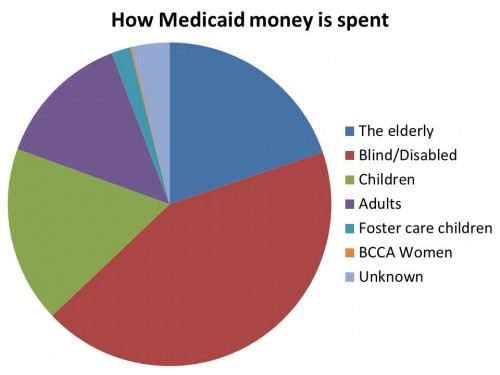
The story contains the following link to a story pointing out that many people who benefit from the social "safety net" who don't realize they do.
- What is the safety net, anyway?
- Basic info about Medicaid spending.
The story contains the following link to a story pointing out that many people who benefit from the social "safety net" who don't realize they do.
- What is the safety net, anyway?
- Basic info about Medicaid spending.
From the Texas Tribune: Interactive: Texas vs. the Federal Government
2301s will start looking at federalism next week. The following story - which highlights disputes between the federal government and Texas - should help set the stage for it.
In the fight for states’ rights, no other state comes to mind before Texas. Gov. Rick Perry has pitted the state's interests against those of the federal government on a variety of issues — including health care reform and environmental standards — arguing that the 10th Amendment grants state governments more autonomy than many of the laws passed by the federal government allow.
Texas has 17 lawsuits currently pending against the federal government, and we updated this interactive to include the most recent lawsuit filed, which challenges the constitutionality of the so-called contraception rule in the federal Patient Protection and Affordable Care Act. Flip through this interactive to see the nature of the fights and the arguments of Texas Attorney General Greg Abbott and U.S. Attorney General Eric Holder.
Cick on the story to get details.
In the fight for states’ rights, no other state comes to mind before Texas. Gov. Rick Perry has pitted the state's interests against those of the federal government on a variety of issues — including health care reform and environmental standards — arguing that the 10th Amendment grants state governments more autonomy than many of the laws passed by the federal government allow.
Texas has 17 lawsuits currently pending against the federal government, and we updated this interactive to include the most recent lawsuit filed, which challenges the constitutionality of the so-called contraception rule in the federal Patient Protection and Affordable Care Act. Flip through this interactive to see the nature of the fights and the arguments of Texas Attorney General Greg Abbott and U.S. Attorney General Eric Holder.
Cick on the story to get details.
From the Texas Tribune: Texas Supreme Court Rules For Landowners in Water Case
Here's a subject that ties in our recent look at water policy with the Texas Judiciary. A recent decision may make it difficult for local governments to regulate water use. This might make water policy very difficult to implement.
In a case with potentially vast implications for groundwater rules in Texas, the state supreme court has unanimously ruled in favor of two farmers in the San Antonio area who challenged the local aquifer authority's sharp restrictions on their use of a water well on their land.
The much-anticipated ruling is "going to make life much more complicated for groundwater districts," said Gregory Ellis, an attorney and the former general manager of the Edwards Aquifer Authority (EAA).
Texans wanting to put a well on their land generally must go to their local groundwater conservation district for permission to withdraw a certain amount of water, as part of an effort to keep aquifers healthy.
In a case with potentially vast implications for groundwater rules in Texas, the state supreme court has unanimously ruled in favor of two farmers in the San Antonio area who challenged the local aquifer authority's sharp restrictions on their use of a water well on their land.
The much-anticipated ruling is "going to make life much more complicated for groundwater districts," said Gregory Ellis, an attorney and the former general manager of the Edwards Aquifer Authority (EAA).
Texans wanting to put a well on their land generally must go to their local groundwater conservation district for permission to withdraw a certain amount of water, as part of an effort to keep aquifers healthy.
Is the Republican Party alienating independents?
Charlie Cook thinks so. This is due to the increased strength of conservatives within the party:
Republicans should be concerned that Mitt Romney’s numbers among independents have been tanking in recent weeks; he went from double-digit leads over Obama in some polls, including one by the Pew Research Center, to a 9-point deficit. He is considered the “most electable” Republican. If other GOP contenders have equally dismal or worse approval numbers among independents, you have to wonder whether this could end up as a choice election, with Republicans coming out on the losing end.
It is becoming quite clear that the conservative base of the Republican Party is driving the car. These voters prefer someone from the pull-no-punches brand of conservatism that created the tea party movement in 2009 and handed Republicans their House majority in 2010. It’s certainly the GOP’s right and choice to do that. The calendar, though, says 2012. The mood of the broader electorate—and, specifically, independents—appears to be very different. If you see any of Obama’s advisers looking bruised from head to toe, it might be from pinching themselves in disbelief.
Republicans should be concerned that Mitt Romney’s numbers among independents have been tanking in recent weeks; he went from double-digit leads over Obama in some polls, including one by the Pew Research Center, to a 9-point deficit. He is considered the “most electable” Republican. If other GOP contenders have equally dismal or worse approval numbers among independents, you have to wonder whether this could end up as a choice election, with Republicans coming out on the losing end.
It is becoming quite clear that the conservative base of the Republican Party is driving the car. These voters prefer someone from the pull-no-punches brand of conservatism that created the tea party movement in 2009 and handed Republicans their House majority in 2010. It’s certainly the GOP’s right and choice to do that. The calendar, though, says 2012. The mood of the broader electorate—and, specifically, independents—appears to be very different. If you see any of Obama’s advisers looking bruised from head to toe, it might be from pinching themselves in disbelief.
Congress is still polarized
The National Journal is out with its annual measurement of polarization in Congress and "For the second year in a row but only the third time in the 30 years
that National Journal has published these ratings, no Senate Democrat
compiled a voting record to the right of any Senate Republican, and no
Republican came down on the left of any Senate Democrat. (The first time
this happened was 1999.),"
- Find the ratings here.
- Divided we Stand.
- Find the ratings here.
- Divided we Stand.
So whose political model is superior? The United States' or China's?
I strongly recommend you read the two articles linked to below:
The pro-China author has some interesting points to make about our democratic system - which should sound familiar to my students:
The answer lies in the source of the current democratic experiment. It began with the European Enlightenment. Two fundamental ideas were at its core: the individual is rational, and the individual is endowed with inalienable rights. These two beliefs formed the basis of a secular faith in modernity, of which the ultimate political manifestation is democracy.
. . . The American Federalists made it clear they were establishing a republic, not a democracy, and designed myriad means to constrain the popular will. But as in any religion, faith would prove stronger than rules.
The political franchise expanded, resulting in a greater number of people participating in more and more decisions. As they say in America, “California is the future.” And the future means endless referendums, paralysis and insolvency.
In Athens, ever-increasing popular participation in politics led to rule by demagogy. And in today’s America, money is now the great enabler of demagogy. As the Nobel-winning economist A. Michael Spence has put it, America has gone from “one propertied man, one vote; to one man, one vote; to one person, one vote; trending to one dollar, one vote.” By any measure, the United States is a constitutional republic in name only. Elected representatives have no minds of their own and respond only to the whims of public opinion as they seek re-election; special interests manipulate the people into voting for ever-lower taxes and higher government spending, sometimes even supporting self-destructive wars.
In essence he is arguing that the limits that had allowed for stability in American politics have been eroded and we may be less able, as a nation, to solidly address our current problems. We are, he says, too democratic - less the republic than we once were. 2301s - who have just finished Fed 10, should understand the point he is making.
He argues that the greater restrictions on popular participation placed on China's people by their leadership will make it easier for the nation to handle and respond to ongoing changes in the economic and political environment.
Frank Pasquale sees flaws in the argument and suggest that China's model is not quite as stable as is suggested, and may be suffering from the same divisive factors that are impacting us.
The pro-China author has some interesting points to make about our democratic system - which should sound familiar to my students:
In the history of human governance, spanning thousands of years, there
have been two major experiments in democracy. The first was Athens,
which lasted a century and a half; the second is the modern West. If one
defines democracy as one citizen one vote, American democracy is only
92 years old. In practice it is only 47 years old, if one begins
counting after the Voting Rights Act of 1965 — far more ephemeral than
all but a handful of China’s dynasties.
Why, then, do so many boldly claim they have discovered the ideal
political system for all mankind and that its success is forever
assured?
The answer lies in the source of the current democratic experiment. It began with the European Enlightenment. Two fundamental ideas were at its core: the individual is rational, and the individual is endowed with inalienable rights. These two beliefs formed the basis of a secular faith in modernity, of which the ultimate political manifestation is democracy.
. . . The American Federalists made it clear they were establishing a republic, not a democracy, and designed myriad means to constrain the popular will. But as in any religion, faith would prove stronger than rules.
The political franchise expanded, resulting in a greater number of people participating in more and more decisions. As they say in America, “California is the future.” And the future means endless referendums, paralysis and insolvency.
In Athens, ever-increasing popular participation in politics led to rule by demagogy. And in today’s America, money is now the great enabler of demagogy. As the Nobel-winning economist A. Michael Spence has put it, America has gone from “one propertied man, one vote; to one man, one vote; to one person, one vote; trending to one dollar, one vote.” By any measure, the United States is a constitutional republic in name only. Elected representatives have no minds of their own and respond only to the whims of public opinion as they seek re-election; special interests manipulate the people into voting for ever-lower taxes and higher government spending, sometimes even supporting self-destructive wars.
In essence he is arguing that the limits that had allowed for stability in American politics have been eroded and we may be less able, as a nation, to solidly address our current problems. We are, he says, too democratic - less the republic than we once were. 2301s - who have just finished Fed 10, should understand the point he is making.
He argues that the greater restrictions on popular participation placed on China's people by their leadership will make it easier for the nation to handle and respond to ongoing changes in the economic and political environment.
Frank Pasquale sees flaws in the argument and suggest that China's model is not quite as stable as is suggested, and may be suffering from the same divisive factors that are impacting us.
Should prisons be privatized?
Texas - and a handful of other states - have been privatizing prisons for many years now. Private providers of services are assumed to be able to do so more efficiently then the public sector. But some argue that private organizations should not be granted the coercive power that properly should only belong to a government whose powers rest on the consent of the governed.
Here are thoughts about that issue.
The author points out that: In 2009, the Israeli Supreme Court ruled that prison privatization violates “the constitutional rights to personal liberty and human dignity of inmates who are supposed to serve their sentence in that prison. This is because of the actual transfer of powers of management and operation of the prison from the state to a private concessionaire that is a profit-making enterprise.”
This is likely also applicable to the increased tendency of private entities to carry out military and security functions.
2301s: we can talk this out next week when we start in on federalism.
2302s: this applies to our discussion of the ever expanding power of the executive.
Here are thoughts about that issue.
The author points out that: In 2009, the Israeli Supreme Court ruled that prison privatization violates “the constitutional rights to personal liberty and human dignity of inmates who are supposed to serve their sentence in that prison. This is because of the actual transfer of powers of management and operation of the prison from the state to a private concessionaire that is a profit-making enterprise.”
This is likely also applicable to the increased tendency of private entities to carry out military and security functions.
2301s: we can talk this out next week when we start in on federalism.
2302s: this applies to our discussion of the ever expanding power of the executive.
Reminder: No written assignment this week
Some students are not following info on the blog. Maybe I should lie and tell them to write something. Should I be mean?
Thursday, February 23, 2012
An analysis of the proposed budgets of the Republican candidates
A report from the Committee for a Responsible Federal Budget, and commentary from Andrew Sullivan.
Proposals made to lower corporate tax rates
President Obama suggests lowering the corporate rate from 35% to 28% while removing tax breaks in the code, while adding some for manufacturing and renewable energy.
Andrew Sullivan has a links to various responses to the proposal.
No one seems to think that fundamental tax reform is likely to happen in an election year.
Andrew Sullivan has a links to various responses to the proposal.
No one seems to think that fundamental tax reform is likely to happen in an election year.
A federal district court states that pharmacists with religious objections are exempt from dispensing emergency contraceptives
This might give an indication about how the courts would settle any cases arising from the Obama Administration's recent decision on contraception coverage.
Eugene Volokh highlights critical parts of the judge's decision, and USA Today has an item on it as well.
Eugene Volokh highlights critical parts of the judge's decision, and USA Today has an item on it as well.
What does "probable cause" apply to?
I'm not completely sure I understand the consequences of this court decision, but its seems to suggest that police can use their authority to search under the probable cause standard in the 4th amendment not only for items related to the accusation that one has committed a crime, but for items that will allow the prosecution to build the case against the accused that involves others not related to the crime.
Evidence can be obtained that can "impeach witnesses and respond to potential defenses."
This seems to me to be a problematic expansion of search and seizure, but this is beyond my expertise.
Evidence can be obtained that can "impeach witnesses and respond to potential defenses."
This seems to me to be a problematic expansion of search and seizure, but this is beyond my expertise.
US v Alvarez argued before the Supreme Court
The constitutionality of the Stolen Valor Act was argued before the Supreme Court yesterday. Kiran Bhat at ScotusBlog has a thorough roundup of the media coverage, so no sense trying to compete:
The Court heard arguments in two cases yesterday morning, with United States v. Alvarez garnering most of the media’s attention. The case involves a First Amendment challenge to the Stolen Valor Act, which criminalizes lies about having received military decorations. Writing for this blog, Lyle Denniston reports that the government urged the Court to interpret the law narrowly; other coverage comes from Nina Totenberg of NPR, Adam Liptak of the New York Times (who also discussed the oral argument for the paper’s At War blog), David G. Savage of the Los Angeles Times, James Vicini of Reuters, Michael Doyle of McClatchy Newspapers, Mark Sherman of the Associated Press, Mike Sacks of the Huffington Post, and Warren Richey of the Christian Science Monitor.
Commentary on the argument came from the editorial boards of the Washington Post and New York Times, both of which urged the Court to find the Act unconstitutional. At the Constitutional Law Prof Blog, Ruthann Robson analyzed the argument, concluding that Justice Alito seemed to believe that “Congress has broad authority to criminalize falsehoods” but that the other Justices did not give away their opinions during arguments; at ACSblog, she argued that “federal laws should criminalize fraudsters, not braggarts.” At the Volokh Conspiracy, Eugene Volokh observed that the Justices appeared interested in the issue of when “knowing lies [should] be restrictable on the ground that they cause emotional distress,” while Douglas A. Berman puts a “sentencing spin” on the arguments at Sentencing Law and Policy.
As with similar cases, the justices seemed concerned that the law may invite additional legislation criminalizing - meaning sending people to jail for telling - other types of lies. Having a high school diploma? Having had an extra-marital affair? Is there a clear line stating how far is too far?
The Court heard arguments in two cases yesterday morning, with United States v. Alvarez garnering most of the media’s attention. The case involves a First Amendment challenge to the Stolen Valor Act, which criminalizes lies about having received military decorations. Writing for this blog, Lyle Denniston reports that the government urged the Court to interpret the law narrowly; other coverage comes from Nina Totenberg of NPR, Adam Liptak of the New York Times (who also discussed the oral argument for the paper’s At War blog), David G. Savage of the Los Angeles Times, James Vicini of Reuters, Michael Doyle of McClatchy Newspapers, Mark Sherman of the Associated Press, Mike Sacks of the Huffington Post, and Warren Richey of the Christian Science Monitor.
Commentary on the argument came from the editorial boards of the Washington Post and New York Times, both of which urged the Court to find the Act unconstitutional. At the Constitutional Law Prof Blog, Ruthann Robson analyzed the argument, concluding that Justice Alito seemed to believe that “Congress has broad authority to criminalize falsehoods” but that the other Justices did not give away their opinions during arguments; at ACSblog, she argued that “federal laws should criminalize fraudsters, not braggarts.” At the Volokh Conspiracy, Eugene Volokh observed that the Justices appeared interested in the issue of when “knowing lies [should] be restrictable on the ground that they cause emotional distress,” while Douglas A. Berman puts a “sentencing spin” on the arguments at Sentencing Law and Policy.
As with similar cases, the justices seemed concerned that the law may invite additional legislation criminalizing - meaning sending people to jail for telling - other types of lies. Having a high school diploma? Having had an extra-marital affair? Is there a clear line stating how far is too far?
Catching up With Darrell Issa
The Washington Post details Darrell Issa's busy year as chair of the House Oversight and Government Reform Committee:
Issa issued 22 subpoenas and published 11 investigative GOP staff reports, and the panel sent 748 letters seeking information from the White House and federal agencies in his first year, according to the panel’s records.
. . .“Do we send a lot of letters out? Yes,” he said recently. “When we hear about it, we send letters. And when we get answers, we very quickly say, ‘We’re all set, thank you very much, we’re done.’ ”
In addition, Issa and his aides noted that the administration faced virtually no serious congressional oversight in its first two years, when Congress was controlled by Democrats.
Click here for an interview with Rep Issa.
2301s should file this under "ambition counteracting ambition."
2302s should see this as an example of congressional oversight.
It also highlights points we make about divided government.
Issa issued 22 subpoenas and published 11 investigative GOP staff reports, and the panel sent 748 letters seeking information from the White House and federal agencies in his first year, according to the panel’s records.
. . .“Do we send a lot of letters out? Yes,” he said recently. “When we hear about it, we send letters. And when we get answers, we very quickly say, ‘We’re all set, thank you very much, we’re done.’ ”
In addition, Issa and his aides noted that the administration faced virtually no serious congressional oversight in its first two years, when Congress was controlled by Democrats.
Click here for an interview with Rep Issa.
2301s should file this under "ambition counteracting ambition."
2302s should see this as an example of congressional oversight.
It also highlights points we make about divided government.
The Supreme Court will hear a challenge to UT's affirmative action program
You can find detail from the NYT here, and the Washington Post here. Some helpful text:
The new case, Fisher v. University of Texas, No. 11-345, was brought by
Abigail Fisher, a white student who says the University of Texas denied
her admission because of her race. The case has idiosyncrasies that may
limit its reach, but it also has the potential to eliminate diversity as
a rationale sufficient to justify any use of race in admission
decisions — the rationale the court endorsed in the Grutter decision.
Diversity, Justice Sandra Day O’Connor wrote, encourages lively
classroom discussions, fosters cross-racial harmony and cultivates
leaders seen as legitimate. But critics say there is only a weak link
between racial and academic diversity.
The Grutter decision allowed but did not require states to take account
of race in admissions. Several states, including California and
Michigan, forbid the practice, and public universities in those states
have seen a drop in minority admissions. In other states and at private
institutions, officials generally look to race and ethnicity as one
factor among many, leading to the admission of significantly more black
and Hispanic students than basing the decisions strictly on test scores
and grades would.
- Click here for commentary from the Volokh Conspiracy.
- And from ScotusBlog, plus the relevant documents associated with the case.
2301s should expect a written question about this when we start out discussion of civil rights.
- Click here for commentary from the Volokh Conspiracy.
- And from ScotusBlog, plus the relevant documents associated with the case.
2301s should expect a written question about this when we start out discussion of civil rights.
Tuesday, February 21, 2012
State and local budget problems
- Texas Remains $4.1 billion short on its budget:
The chairman of the Legislative Budget Board John O'Brien told lawmakers Tuesday that they did not appropriate enough to cover state expenses for Medicaid and other programs. The state is short more than $4.1 billion in the current budget.
The chief revenue estimator for the Texas comptroller, John Heleman, said the Texas economy had rebounded faster than the rest of the nation. He also said that the state had recovered more than 440,000 jobs, but that many people had moved to Texas since 2008 and have not found jobs.
- Houston grappling with decade of deficit spending:
The city of Houston has been papering over multimillion-dollar budget deficits for nine years by borrowing money, tapping its rainy day fund, selling buildings and just plain putting off bills to the future, according to city finance officials.
Numbers in a report from the city's Long-Range Financial Management Task Force, an ad hoc group that recently submitted more than 100 ideas on how to address Houston's looming fiscal problems, indicate that three consecutive mayors and their city councils have taken their own approaches to adhering to the city's balanced budget law while spending more than they took in.
The chairman of the Legislative Budget Board John O'Brien told lawmakers Tuesday that they did not appropriate enough to cover state expenses for Medicaid and other programs. The state is short more than $4.1 billion in the current budget.
The chief revenue estimator for the Texas comptroller, John Heleman, said the Texas economy had rebounded faster than the rest of the nation. He also said that the state had recovered more than 440,000 jobs, but that many people had moved to Texas since 2008 and have not found jobs.
- Houston grappling with decade of deficit spending:
The city of Houston has been papering over multimillion-dollar budget deficits for nine years by borrowing money, tapping its rainy day fund, selling buildings and just plain putting off bills to the future, according to city finance officials.
Numbers in a report from the city's Long-Range Financial Management Task Force, an ad hoc group that recently submitted more than 100 ideas on how to address Houston's looming fiscal problems, indicate that three consecutive mayors and their city councils have taken their own approaches to adhering to the city's balanced budget law while spending more than they took in.
More on Texas water troubles . . .
This will be a continuing theme given the strong possibility that we might be in the midst of a prolonged drought which might drive changes in how we treat the stuff:
- From the Texas Water Resources Institute: Expect changes in water policy if the drought continues.
- Water management agencies - like the Lower Colorado River Authority - are expected to announce that they will not release water to rice farmers in three counties: Wharton, Matagorda, and Colorado.
- As a consequence of the drought, the percentage of Houston's water supply that once - err - passed through the bodies of people in Dallas has increased. If the drought continues, the percentage will increase. It seems that last year, the water was not diluted at all. As bad as that sounds, DFW seems to be finding ways to reuse their own waste water, which means less down here. Houston uses a half billion gallons of water a day during the summer. Apparently Houston does not recycle its own waste water. Ain't local government sexy?
- Here's commentary last summer about the need for a long term water policy, and our inability so far to implement anything: Significant water supply planning strategies designed to protect our growing economy and communities from drought have not been implemented. Fourteen major reservoir sites designated by the Legislature in 2007 remain undeveloped due to lack of funding and federal regulatory interference. Regulatory hurdles preclude our ability to transfer water from bountiful rivers to areas in need. We need to take greater strides toward implementing water-smart conservation practices and technologies, including re-use and desalination.
Underlying each of these water supply strategies is the need for a consistent, reliable funding source for our water plan. Reservoirs, pipelines, and water desalination plants are expensive. Texas will need to invest $30 billion or more on water supply projects like these if we are to meet our needs in the coming decades. As the strings to our state's budget grow tighter, we may need to consider ways to raise revenues to finance these projects.
- From the Texas Water Resources Institute: Expect changes in water policy if the drought continues.
- Water management agencies - like the Lower Colorado River Authority - are expected to announce that they will not release water to rice farmers in three counties: Wharton, Matagorda, and Colorado.
- As a consequence of the drought, the percentage of Houston's water supply that once - err - passed through the bodies of people in Dallas has increased. If the drought continues, the percentage will increase. It seems that last year, the water was not diluted at all. As bad as that sounds, DFW seems to be finding ways to reuse their own waste water, which means less down here. Houston uses a half billion gallons of water a day during the summer. Apparently Houston does not recycle its own waste water. Ain't local government sexy?
- Here's commentary last summer about the need for a long term water policy, and our inability so far to implement anything: Significant water supply planning strategies designed to protect our growing economy and communities from drought have not been implemented. Fourteen major reservoir sites designated by the Legislature in 2007 remain undeveloped due to lack of funding and federal regulatory interference. Regulatory hurdles preclude our ability to transfer water from bountiful rivers to areas in need. We need to take greater strides toward implementing water-smart conservation practices and technologies, including re-use and desalination.
Underlying each of these water supply strategies is the need for a consistent, reliable funding source for our water plan. Reservoirs, pipelines, and water desalination plants are expensive. Texas will need to invest $30 billion or more on water supply projects like these if we are to meet our needs in the coming decades. As the strings to our state's budget grow tighter, we may need to consider ways to raise revenues to finance these projects.
Spending cuts conceptually and in reality
Building off last week's 2302 discussion of budgeting and the problems with trimming the budget, here is a year old Gallup poll showing that - with the exception of foreign aid - a majority of Americans oppose cutting specific budgetary items, even while saying that there is too much spending overall. This is a common finding, one that is repeatedly yearly and points to the difference in how the same issue can be seen in two different ways depending on whether it is an abstract consideration, or a specific, tangible one that can hit us in the pocketbook. We really don't like cuts in those areas that benefit us.
Here are the results:

Clearly Education, Social Security and Medicare are programs that everyone believes benefits themselves - at least at some point in their lives. Not so foreign aid, which probably explains why a sizable majority supports cuts. They see no tangible benefit to it. Some do clearly so its probably worth wondering whether those who support it live somewhere the economy is tied into trade.
The other point to be made about attitudes towards foreign aid - and it could be applied to other areas as well - is that people tend to greatly over-estimate how much money is spent on it:
Asked to estimate how much of the federal budget goes to foreign aid the median estimate is 25 percent. Asked how much they thought would be an "appropriate" percentage the median response is 10 percent.
In fact just 1 percent of the federal budget goes to foreign aid. Even if one only includes the discretionary part of the federal budget, foreign aid represents only 2.6 percent.
This is quite the ironic result.
Here are the results:
Clearly Education, Social Security and Medicare are programs that everyone believes benefits themselves - at least at some point in their lives. Not so foreign aid, which probably explains why a sizable majority supports cuts. They see no tangible benefit to it. Some do clearly so its probably worth wondering whether those who support it live somewhere the economy is tied into trade.
The other point to be made about attitudes towards foreign aid - and it could be applied to other areas as well - is that people tend to greatly over-estimate how much money is spent on it:
Asked to estimate how much of the federal budget goes to foreign aid the median estimate is 25 percent. Asked how much they thought would be an "appropriate" percentage the median response is 10 percent.
In fact just 1 percent of the federal budget goes to foreign aid. Even if one only includes the discretionary part of the federal budget, foreign aid represents only 2.6 percent.
This is quite the ironic result.
Subscribe to:
Posts (Atom)