Sunday, September 8, 2013

The Responsibility to Protect Doctrine

Here's another look ahead to 2305's eventual look at foreign policy making.

Not much has been said about the responsibility to protect doctrine (R2P) in regards to Syria, though it was mentioned repeatedly in regards to 2011's intervention in Libya. The doctrine outlines additional reasons why one nation may claim the right to intervene in the affairs of another. These all focus on preventing violence against one set of people by others within a nation, and it includes preventing genocide, war crimes, crimes against humanity, and ethnic cleansing. The use is chemical weapons qualifies as a reason, so it applies to the current conflict, though Obama has apparently downplayed its applicability. Its probably wise to focus on the argument that the US has self-interested reasons for going forward. R2P is not very popular politically.

Click here for a bit of history on the doctrine, it developed after the international failure to intervene in the massacre in Rwanda in the early 1990s.

Some more background below:

- responsibilitytoprotect.org.
- The UN.
- The Washington Post.

These doctrines tend to evolve over time, based on the circumstances of the moment. Wikipedia has a page that lists a variety of doctrines used to justify military intervention over time. Its not a bad idea to peruse through a few. It provides an interesting look at the evolution of American foreign policy over time.


The justification for using military force in Libya

From CBS News.

Here is a copy of the memo produced by the Office of Legal Counsel which justified the firing of missiles to protect the residents of Benghazi in 2011.The involvement of Congress hinged on the definition of "war." 


. . . in 2011, the administration took military action in Libya without any congressional approval, prompting the Republican-led House of Representatives to vote to rebuke the president.
In its legal justification for action in Libya, the Justice Department's Office of Legal Counsel (OLC) argued that Congress' authority to declare "war" was limited by the definition of war. "This standard generally will be satisfied only by prolonged and substantial military engagements, typically involving exposure of U.S. military personnel to significant risk over a substantial period," the OLC wrote.

The OLC augmented that argument by noting the operation in Libya would be limited to air strikes in support of a United Nations resolution, and that no American lives would be put at risk. And while Mr. Obama in 2007 said the president could only act unilaterally in a matter of self-defense, the OLC in 2011 justified the use of force in Libya as "in the national interest." 

 The story notes that there has been no UN support for the strikes, which makes this different than Libya. 

And if the US is the world's policeman, can it dress like a superhero?

Should American Be the World's Policeman?

Quite a few students asked this question this week, so with that in mind its probably a good idea to find out what a few smart folks think about the subject. It will be central to an upcoming look at foreign policy in the US, so its worth a look.

First off, I assume that when people complain that we are the world's policeman, they refer to the idea that we are expected to intervene when conflicts flare up around the world. I haven't been able to find data that shows how often the US responds to crises as opposed to other countries, so it would be helpful to have empirical proof of this claim.

But it is true that having the largest military, by far, in the world the US is in a better position to intervene than are other nations. $600 billion in military spending allows us to effectively control the seas, air, and space, which allows conflicts to be mediated on our terms, but it seems to come at a cost. Since we have the ability to intervene when humanitarian crises occur, it follows that many argue that we should.

Here's a link to debate on this subject from 2008 - it should still be relevant for us today.

The arguments in favor of the idea the the US ought to be the world's policeman centered on the observation that the world is a dangerous place and the predatory countries are destabilizing. Only the US - hopefully backed by allies - is in a position to keep the peace. And a peaceful world is a more prosperous world.

The arguments against the idea are that intervention can lead to anti-Americanism, and a backlash within the US of active foreign affairs. It is also not popular among the American people many of whom would prefer to spend money to improve mattes within the US. There is also a sense that we can do more harm than good when we intervene.

For more on the debate:

- BalancedPolitics.org.
- The world would miss the American policeman. (paysite)
- The US must not be the worlds policeman.
- What if the US stops policing the world?
- Debate.org.

Thursday, September 5, 2013

Written Assignment #3

2305: Let's try to understand the nature of the disagreement between those who argue that the president needs congressional authorization to fire missiles at Syria and those who think he does not. What are the arguments on each side? A related concept seems to be what the word "war" actually means. Weigh in on this dispute. After you thoroughly discuss both sides of the argument, tell me which side do you think has the better argument. What side of the issue do you come down on and why?

2306: What are the constitutional roots (the US Constitution) of the dispute between the national and states governments (Texas specifically) over laws related to voter ID requirements? What arguments is Texas using to state that they have full power to determine what their election laws are? What arguments is the United States using to argue that they have jurisdiction to oversee these laws. What is the basis of the current lawsuit the US Justice Department has filed against Texas. After you provide objective information about this, weigh in on its chances of success. Support your conclusion.

Wednesday, September 4, 2013

Texas Voter ID requirements explained

More or less anyway.

From the Texas Secretary of State's office:

A voter who has not been issued a driver’s license or social security number may register to vote, but such voter must submit proof of identification when presenting himself/herself for voting or with his/her mail-in ballots, if voting by mail.  These voters’ names are flagged on the official voter registration list with the annotation of “ID.”  The “ID” notation instructs the poll worker to request a proper form of identification from these voters when they present themselves for voting, unless they are a voter with a permanent exemption on the voter registration certificate. The voter must present one of the seven (7) acceptable forms of identification:
  • Texas driver license issued by the Texas Department of Public Safety (DPS)
  • Texas Election Identification Certificate issued by DPS
  • Texas personal identification card issued by DPS
  • Texas concealed handgun license issued by DPS
  • United States military identification card containing the person’s photograph
  • United States citizenship certificate containing the person’s photograph
  • United States passport

Fromw the Washington Post: U.S. spy agencies mounted 231 offensive cyber-operations in 2011, documents show

I still think this is a bigger story than Syria:

U.S. intelligence services carried out 231 offensive cyber-operations in 2011, the leading edge of a clandestine campaign that embraces the Internet as a theater of spying, sabotage and war, according to top-secret documents obtained by The Washington Post.
That disclosure, in a classified intelligence budget provided by NSA leaker Edward Snowden, provides new evidence that the Obama administration’s growing ranks of cyberwarriors infiltrate and disrupt foreign computer networks.
Additionally, under an extensive effort code-named GENIE, U.S. computer specialists break into foreign networks so that they can be put under surreptitious U.S. control. Budget documents say the $652 million project has placed “covert implants,” sophisticated malware transmitted from far away, in computers, routers and firewalls on tens of thousands of machines every year, with plans to expand those numbers into the millions.

No word on whether Congress is involved in authorizing these strikes.

Do these attacks fit the meaning of "war?"

Is this the future of warfare?

From the Texas Tribune: Voter ID Tried in Local Elections, Not Yet in a Big One

While the new voter ID law in Texas has been used in smaller elections, its yet to be used in a big one. This means that despite the claims made for an against it, we really don't know what impact it will have.

Julian Aguilar goes on:

That’s the assessment of at least one opposition leader, Chad Dunn, an attorney with Houston-based Brazil and Dunn who represents plaintiffs in a current lawsuit seeking to block the law. It requires voters to furnish one of several specified forms of ID before casting a ballot, the most common being a state-issued driver’s license or ID card.
It’s hard to determine the effect before next year's state elections, Dunn added, because turnout for local elections is paltry. Elections have been held in Galveston and are ongoing in the Rio Grande Valley, but the true test will be a statewide or heavily contested election in a toss-up or majority-minority district.

. . .Also at play is how election officials handle complaints or missteps, Dunn said. In Bexar County, he said, officials are likely to resolve issues quickly regardless of political allegiance, race or any other factor. In others, not so much.

“In counties like Harris, which is completely on the voter suppression bandwagon, whatever problems there are, aren’t getting worked out,” he said.

This might impact the ongoing efforts of the federal Justice Department to sue Texas over the law because there may not be a substantive issue yet to sue about - the case may not be ripe. Its been a long haul so far and there is little reason to think it wont continue to be.

Senate Foreign Relations Committee approves use of military force

From the NYT:

A divided Senate Foreign Relations Committee on Wednesday approved an authorization of force against the Syrian government, setting up a showdown next week in the full Senate on whether President Obama should have the authority to strike.

The 10-to-7 vote showed bipartisan support for a strike, but bipartisan opposition as well.

. . . The approved resolution would limit strikes against the Syrian government to 60 days, with the possibility of 30 more days upon consultation with Congress, and it would specifically block the use of ground troops. But to retain the support of Mr. McCain, considered crucial to the authorization’s final passage, the committee toughened some of the language.

Jack Goldsmith compares the version of the AUMF passed by the committee with that proposed by the Obama Administration (courtesy of The Dish).

- Here is the administration's proposal.
- Here is what passed the committee


Tuesday, September 3, 2013

State and Local Elections - 2013

Things are pretty quiet overall on the states and local level here (tough to compete with Syria) but local issues will become more prominent as the 2013 elections start to loom.

Click here for the Texas Secretary of State's page on important 2013 election dates.

It gives us an idea about what to look forward to. Houston has elections coming up, so there's a good course of content for us. We will also follow news about potential candidates for the primary elections scheduled this coming March.

Ballorpedia has a page on Texas' 2013 elections also.

Some remarks for 2306's section on federalism

Some things to think about as you we plow through it this week:

- Federalism is a decentralizing force in American politics and practically guarantees conflict between the national and state governments. Throw local governments into the mix and the conflict multiplies. Conflict doesn't just exist between the national and state governments, but between states as well. And conflict also occurs between the state and local governments - we won't hitting this point that hard in the slides, but we might discuss the occasional story about it here and there.

- Try to memorize the definitions of nation, state, city and county.

- Remember that the national government was established by representative of the different states, and that the US Constitution is full of clauses which highlight the position of states within the federal system. It also establishes the guarantees the national government has to the states and their obligations to each other. Much of Articles 4 and 6 of the US Constitution deal with this, as well as key parts of Article One.

- There was a great of debate in the constitutional convention and the ratification period over the level of autonomy states ought to have in the federal system. This continues to this day. It is crucial to understand the source of this dispute.

- You should focus on the nature of the policies states are given specific control over in the US Constitution. The notes focus on the design of the Senate, suffrage and election laws and the 10th Amendments.

- I have to point out that the material on the Voting Rights Act has to be modified due to the recent ruling in Shelby v. Holder. Expect some modifications soon, but don't stress over them. This is one of the consequences of taking a government class. Things change.

- Be familiar with the reserved, implied, delegated and denied powers. The inherent powers also. Be especially familiar with the conflict over the implied powers, those that rest on the elastic clauses. These have had a major impact on national and state relations, you should try to understand what and how.

- Know the stages of federalism and the steps that marked the change from one to the next. What factors led to the increase of national power? What kinds of reactions have resulted in Texas? How have conservatives especially tried to push back against national power over the states. Understanding this helps explain a lot of what's in the news.

I hope this overview clarifies what's in this section. I'll do the same for the one on political culture.

Monday, September 2, 2013

The Geneva Protocol of 1925

Part of the reason the chemical attacks have drawn attention is because of the negative reaction to the use of chemical weapons in World War 1, which led to their use being banned in 1925 in the Geneva Protocol.

Worth a quick look since some are wondering why the use of chemical weapons seems to be treated differently than the use of conventional weapons. The US signed the protocol, which leads to one of the arguments the president is currently using: if we sign a treaty, we should enforce it.

John Yoo says the president has the authority to strike Syria without congressional approval

Yoo was a controversial member of the W Bush Administration. He served in the Office of Legal Counsel in the Justice Department and developed arguments that promoted an expansive view of presidential powers - especially as it regards war and defense.

He sees no reason for President Obama to go to Congress to authorize action against Syria, and argues that history gives plenty of examples of the military being used without such approval. He uses fundamental text from the ratification era to argue that the framers of the Constitution saw a limited role for the legislature in conducting the military: 

Throughout our history, neither presidents nor Congresses have acted under the belief that the Constitution requires a declaration of war before the U.S. can conduct military hostilities abroad.
We have used force abroad more than 100 times but declared war in only five cases: the War of 1812, the Mexican-American and Spanish-American Wars, and World Wars I and II.
Without any congressional approval, presidents have sent forces to battle Indians, Barbary pirates and Russian revolutionaries, to fight North Korean and Chinese communists in Korea, to engineer regime changes in South and Central America, and to prevent human rights disasters in the Balkans.
A major point he makes is that war is different and the checks and balances that work during periods of peace do not work during periods of war when such checks may limit the ability of the commander in chief to effectively command the military. He also states that while the revolutionary war may have been fought against a monarch, the Constitution was written in order to create an executive branch specifically designed to act forcefully in times of war:
It is true that the revolutionaries rejected the royal prerogative, created weak state governors, and turned a skeptical eye toward federal power.  Rejecting these failed experiments, however, the Framers restored an independent, unified chief executive with its own powers in national security and foreign affairs.   
The most important of the president’s powers are commander-in-chief and chief executive.
As Alexander Hamilton wrote in Federalist 74, “The direction of war implies the direction of the common strength, and the power of directing and employing the common strength forms a usual and essential part in the definition of the executive authority.”
Presidents should conduct war, he wrote, because they could act with “decision, activity, secrecy, and dispatch.”  In perhaps his most famous words, Hamilton wrote: “Energy in the executive is a leading character in the definition of good government. . . It is essential to the protection of the community against foreign attacks.”
The Framers realized the obvious. Foreign affairs are unpredictable and involve the highest of stakes, making them unsuitable to regulation by pre-existing legislation.
Instead, they can demand swift, decisive action, sometimes under pressured or even emergency circumstances, that are best carried out by a branch of government that does not suffer from multiple vetoes or is delayed by disagreements.
 Congress is too large and unwieldy to take the swift and decisive action required in wartime.  
It's worth a full read. We'll try to make sense of these and counter arguments in class.

Obama's August 31st speech on Syria - and the people who helped shape it


Click for a transcript here.

In order to get a head start at a look at the White House Staff - which we will cover when we look at the section on Presidential Power - let's look at some of the people responsible for gathering the information contained in the speech.

The National Security Council: This group was created in the same piece of legislation that created the Department of Defense, among other things: "the function of the Council has been to advise and assist the president on national security and foreign policies. The Council also serves as the president's principal arm for coordinating these policies among various government agencies."
- Click here for the White House page on the NSC


Some relevant news items:

Here's a look at the internal debate within the council about whether to strike against Syria, and whether to ask Congress for authorization.Here's a look at the NSC's attempt to brief members of Congress - especially the members of the House and Senate Armed Services and Foreign Affairs committees.

The NYT has links to past stories involving the NSC.

The National Security Advisor is the primary advisor to the president on security affairs and heads the NSC's staff - which collects the information and conducts the research that forms the basis for the advice sent to the president.

- Here's a wayback look at the NSC staff during the Clinton years.

Something to file away for later use: The NSC is just one of the may advisory institutions which allow presidents to manage the multiple functions carried out by the executive branch. More on this in a few weeks, but its useful right now in order to figure our where the president is getting the information that suggests that a tactical strike against Syria is the right thing to do in response to the  recent chemical attack.  

Two questions to ponder as war with Syria is considered

The first is the practical question: Is it the right thing to do?

The second is the constitutional question: Does the president have the constitutional power to do so without congressional approval?

These will guide our approach to both public policy making and understanding the US Constitution in 2305, though we should kick this up in 2306 also. I'll post a few items related to the debate as they emerge.

Shelby v Holder and the Voting Rights Act

2306 students should get familiar with both the Voting Rights Act - which strengthened the voting rights of minority in the United States by giving the national government the power to pre-clear changes in laws related to elections and voting in states with a history of racial discrimination (like Texas) and the recent Supreme Court decision in Shelby v. Holder which weakened that powers.

The current conflict between the Attorney Generals of the US and Texas stems from the recent court case, as well as different points of view towards the right to vote in general.

This conflict will be central to a lot of the topics we'll hit this semester, so please get a handle on what's at issue here - we will discuss this further soon enough.

Here are few sites that will help you stew over a provocative question: Is there a guaranteed right to vote in the United States?

- The Constitution is not explicit on a right to vote.
- Voting Right or Privilege?
- Right to Vote Amendment.
- The Missing Right.
- A constitutional right to vote?

The War Powers Resolution

2305 students ought to get familiar with this significant piece of Vietnam War era legislation. It's applicability to the current situation in Syria will be debated heavily in the upcoming week - last week as well.

It was an early attempt to reign in executive war making powers, though its actual impact is subject to debate. It has never been tested constitutionally, so there's a question about whether it allows Congress to interfere with powers related to the "commander in chief."

It's Labor Day!

Here are a couple links that provide some background info on the holiday and its relationship to the labor movement in the US which picked up steam in the late 19th century, but has since withered.

- Wikipedia.
- US Labor Department.

The celebration fits into a broader discussion we will have on the evolution of ideology over history - especially that dating back to the French Revolution. The labor movement is part of a series of movements and ideologies - the socialists, progressives and populists among them - that responded to the inequities that emerged as a consequence of the classical liberalism, capitalism and the industrial revolution.

More on these soon enough.

Likely topics for Week 3's Written Assignment

I'll post something within a couple days, but for 2305 I'm leaning towards a topic related to conflict over whether the US Constitution authorizes the president to go to "war" with Syria without consulting Congress. That's obviously topical, so we'll try to make sense of the dispute.

For 2306 I'll formulate something on the conflict between the United States and Texas governments over laws related to voting and elections generally, and the Voter ID requirement specifically. I think the conflict is inevitable due to different parts of the Constitution that grant certain powers to the states and others to the national government. This hopefully helps us understand the nature of state - national conflict.

I'll post a few items related to each topic soon and I plan to have a formal assignment up by Wednesday.  

Looking Ahead to Week Two

In 2305 we will be looking at the development of the concept of both natural rights and separated powers over the course of British history and how they are embodies in two very important documents: The Second Treatise on Government and the British Bill of Rights. Both help us understand the nature of the argument presented in the Declaration of Independence.

We will also take a birds eye view of the US Constitution. We'll try to understand the conflict that occurred in the 1780's over what governing system might works best for the US - a struggle which continues in many ways - and the document's content. We will pour over the document's detail in later sections.

Note: I've yet to open up the section on ideology. I'll do so soon enough, but only have a small number of questions based on it. It's new, so I'm making sure it's worth posting before I do.

In 2306 we look at the relationship that exists between the states and national government, as well as some of the specific conflicts that exist between the government f Texas and the government of the United States. The first section looks at this from the point of view of both the Constitution and federalism. The goal will be to isolate where this conflict stems from.

The second section looks at the same general topic, but this time in terms of political culture, which can loosely be defined as the - more or less - collective agreement in a region or community about what a government should do. We will discuss three types of political culture that exist across the US and which are dominant in Texas. The goal is to help us understand the nature of conflict that exists between Texas and the US. Although it might seem confusing, once you understand what the conflict is based on, it makes perfect sense. You might even be able to predict where conflict might erupt.

Note: Chances are I'll drop the section on the syllabus that looks at the relationship between the national and local governments. Its not ready to go. I'll confirm this soon.

Email me questions and I'll post answers here.

Week One Wrap Up

Last week - in both 2305 and 2306 - we went through the syllabus and the first section of the class which tried to explain why the state of Texas has required you to take 6 hours of government. I tried to point out the role education has always been argued to play in the preservation of democratic republics.

Maybe that worked, maybe it didn't. Hopefully it addressed any concerns or complaints you have about the government requirement. I'll continue to post stories related to how government should be taught - it tend to be the subject of ideological battles.

I didn't walk through the section on definitions and vocabulary - you ought to be able to do so yourself. I'll point out the specific terms that are useful currently. I posted a few stories on the continued struggles in the Middles East and the questions about whether these traditionally autocratic governments might be able to transition into democracies. Those are two of the terms contained in the second section.

I think the post on Jeanne Kirkpatrick's 1979 column critical of Carter's foreign policy - and what she had to say about the difficulty of establishing democracies - might be the most important post of last week.

It seems like most of you were able to send me a hello through Blackboard and a good handful also got the first two assessments out of the way.

Classes resume tomorrow.

Enjoy your Labor Day.  

Saturday, August 31, 2013

Is Texas' economic growth due to economic policies or increased oil production?

One of the books available for 2306 argues that Texas' economic policies have created recent boom in jobs, and that other states should emulate them. But here's an observation that that states that have grown the most in recent years have oil based economies.

That's tough to replicate.

Is it possible that the Great Plains simply have better zoning laws, better governors, better entrepreneurial incentives, better schools, and better [other things that you typically associate with growth]? Yes, it is possible that the entire central time zone is magically gifted at matching people and jobs. It's also really, really unlikely. More likely is that the Great Plains have some of the positive aforementioned qualities -- Houston's zoning policies are exemplary, e.g. -- but most importantly, they did well because many of them shared something in common at the trans-state level: bountiful energy resources under their feet. 

Take the five or so states with fastest-growing oil production -- ND, TX, OK, CO, NM -- and draw their post-crash job performance against the rest of the country. This is the picture you get. Except for New Mexico, the four top oil-growth states fell lower and have climbed higher than the rest of the country.


Thursday, August 29, 2013

States free to legalize marijuana

The Washington Post reports that the Obama Administration will not preempt state laws:

The Obama administration on Thursday said it will not stand in the way of Colorado, Washington and other states where voters have supported legalizing marijuana either for medical or recreational use, as long as those states maintain strict rules involving distribution of the drug.
In a memo sent Thursday to U.S. attorneys in all 50 states, deputy attorney general James M. Cole detailed the administration’s new stance, even as he reiterated that marijuana remains illegal under federal law.

The memo directs federal prosecutors to focus their resources on eight specific areas of enforcement, rather than targeting individual marijuana users, which even President Obama has acknowledged is not the best use of federal manpower. Those areas include preventing distribution of marijuana to minors, preventing the sale of pot to cartels and gangs, preventing sales to other states where the drug remains illegal under state law, and stopping the growing of marijuana on public lands.

A Justice Department official said that Attorney General Eric Holder had called the governors of Colorado and Washington around noon on Thursday to inform them of the administration’s official stance.


A $52 billion dollar budget for spying

The latest revelation from the documents released by Edward Snowden. These has been classified for years.

U.S. spy agencies have built an intelligence-gathering colossus since the attacks of Sept. 11, 2001, but remain unable to provide critical information to the president on a range of national security threats, according to the government’s top secret budget.

The $52.6 billion “black budget” for fiscal 2013, obtained by The Washington Post from former intelligence contractor Edward Snowden, maps a bureaucratic and operational landscape that has never been subject to public scrutiny. Although the government has annually released its overall level of intelligence spending since 2007, it has not divulged how it uses those funds or how it performs against the goals set by the president and Congress.

The 178-page budget summary for the National Intelligence Program details the successes, failures and objectives of the 16 spy agencies that make up the U.S. intelligence community, which has 107,035 employees.

Here's a link to the document.

From Jack Goldsmith: Why Doesn’t President Obama Seek Congressional Approval for Syria?

Goldsmith headed the Office of Legal Counsel in the W Bush Administration. He questions whether an intervention in Syria is justified, and whether the president has the power to act on his own. This will be useful for our future look in 2305 about the extent of presidential war powers.


I have a pretty broad view of presidential power to use military force abroad without congressional authorization.  On that view, which is close to the past views of the Office of Legal Counsel, the planned use of military force in Syria is a constitutional stretch that will push presidential war unilateralism beyond where it has gone before.  There are many reasons why it is a stretch even under OLC precedents.  The main ones, as I alluded to a few days ago, are (1) neither U.S. persons nor property are at stake, and no plausible self-defense rationale exists; (2) the main non-self-defense U.S. interest that the Commander in Chief has invoked since the Korean War to justify unilateral uses of force – upholding the integrity of the U.N. Charter – appears (as Wells argued) to be disserved rather than served by a military strike in Syria; and (3) a Syria strike would push the legal envelope further even than Kosovo, the outer bound to date of presidential unilateralism, which at least implicated our most important security treaty organization commitments (NATO).  (Note that the USG was, as Wells pointed out, never able to publicly articulate a legal rationale for Kosovo.  In our more legalistic age 14 years later, such silence likely won’t be possible, but it also won’t be possible to rely on Kosovo as a constitutional precedent without explaining why the invasion was lawful at the time.)

The March on Washington Anniversary

If you aren't clear on what the March on Washington was about, click here.

It helped set the stage for the passage of the Civil Rights Act and Voting Rights Act. Kennedy's assassination is argued to have also been a motivating factor as was LBJ's asencion to the presidency and his desire to make his mark on history.

Is was one of a series of events that created a window of opportunity for the passage of civil rights bills. Ironically, the 50th anniversary coincides with recent court decisions that have rolled back the impact some of those bills.

The anniversary has given people the chance to speculate on the state of race relations in the country and how things have changed - or not - since the march. Click here for some charts highlighting these changes.

Charts showing economic conditions paint a diofferent picture than those focusedon political participation.

I'll post examples separately.

Wednesday, August 28, 2013

Republican congressmen predicts new preclearance map will be drawn

The Supreme Court threw out the old one this summer. Some argue that no new map will ever be drawn, which effectively nullifies the Voting Rights Act. But here's a pledge to fix it:

Rep. Jim Sensenbrenner (R-Wis.) said Monday that he will attempt to replace, by the end of the year, the portion of the Voting Rights Act that was struck down by the Supreme Court.

Sensenbrenner’s comments came Monday at an event hosted by the Republican National Committee, commemorating the March on Washington.

Sensenbrenner said he wants to fix the law so that it is immune to court challenges.


“The first thing we have to do is take the monkey wrench that the court threw in it, out of the Voting Rights Act, and then use that monkey wrench to be able to fix it so that it is alive, well, constitutional and impervious to another challenge that will be filed by the usual suspects,” Sensenbrenner said.

Members of Congress insists Obama seek congressional approval in order to strike Syria

From The Hill:

More than 100 lawmakers, including 16 Democrats, have signed a letter that says President Obama would violate the Constitution by striking Syria without first getting authorization from Congress.

A total of 107 lawmakers had signed the letter as of 3 p.m. Wednesday, highlighting bipartisan interest and growing momentum in ensuring a role for Congress in any decision to use force in Syria.

“Engaging our military in Syria when no direct threat to the United States exists and without prior congressional authorization would violate the separation of powers that is clearly delineated in the Constitution,” states the letter, spearheaded by Rep. Scott Rigell (R-Va.).

The Speaker of the House wants a case to be made for intervention:


In a letter to the president, Boehner said the briefings key lawmakers have received so far have failed to assuage their concerns about the administration's strategy.

“I respectfully request that you, as our country’s commander-in-chief, personally make the case to the American people and Congress for how potential military action will secure American national security interests, preserve America’s credibility, deter the future use of chemical weapons, and, critically, be a part of our broader policy and strategy," Boehner wrote.

He stopped short, however, of demanding a congressional vote, even as more than 107 House members have signed a letter to the president making the case for such an authorization.
Boehner hinted that he supports retaliation following allegations Bashar Assad's forces used chemical weapons, saying the president's response had implications for America's “credibility” beyond Syria, notably in Iran. But he asked no fewer than 14 pointed questions about the long-term goals of a military response, notably regarding the risks of empowering Islamist militants and drawing Assad allies Iran and Russia into the fight.

Some House members argues that an attack would violate the War Powers Resolution:

House members demanding congressional approval for a military attack against Syria are making detailed legal arguments that ignoring Congress would violate the War Powers Resolution (WPR).

Dozens of House members are now on record as insisting that Congress must authorize military action against Syria, including more than 100 who plan to deliver a letter to the White House on Thursday.

That letter argues that the Obama administration is stretching its authority under the WPR, which was passed in 1973 and defines the circumstances under which the executive branch can commit military assets overseas.

Under the WPR, the president can "introduce United States Armed Forces into hostilities" pursuant to a declaration of war, specific statutory authorization, or under a national emergency "created by attack upon the United States, its territories, or its armed forces."

In the letter to be sent Thursday, members argue that Obama has already weakened that standard in regard to Libya. It notes that in 2011, the administration's Office of Legal Counsel said Obama can rely on his constitutional power to safeguard the "national interest" by conducting limited military operations in Libya.

The pros and cons of war with Syria

I'll post more of these, but here's something to start a class discussion.

Voter ID Law implemented for the first time in the Houston region in Galveston

There disagreement over whether the law had an impact.

From the Houston Chronicle:

The first election in the Houston region conducted under the new Texas voter ID law went off without a hitch Tuesday, but officials say that doesn't necessarily mean there would be no problems in a statewide general election.
Only two out of 24 provisional ballots cast in a Galveston school district special election related to voter identification, said Bill Sargent, the Galveston county clerk's chief deputy for elections. "There is no way of knowing whether this is indicative of an election statewide, but if this trend continues, it means that voter ID is not a big deal," Sargent said.

With only 45 votes remaining to be counted late Tuesday, a measure authorizing the school district to spend money to comply with the Texas "Robin Hood" school financing law was leading 1,675 in favor and 36 opposed.
Sargent's view was disputed by the presidents of the Galveston County chapter of the League of United Latin American Citizens and the city of Galveston chapter of the National Association for the Advancement of Colored People.
"It's just another obstacle to minorities being able to exercise their right to vote," said Anna Olivares, president of LULAC Council 151. Olivares and Galveston NAACP President David Miller said they had learned through first-hand experience how difficult it can be for low-income or non-English speaking voters to obtain a voter ID.
The election is only the third in the state to be conducted under the voter ID law, the subject of a U.S. Justice Department lawsuit alleging that it intentionally discriminates against low-income and minority voters by making it more difficult for them to vote.

The Justice Department sues Texas over voting rights for minorities.

From the NYT:

The Obama administration on Thursday escalated its efforts to restore a stronger federal role in protecting minority voters in Texas, announcing that the Justice Department would become a plaintiff in two lawsuits against the state.
The Justice Department said it would file paperwork to become a co-plaintiff in an existing lawsuit brought by civil rights groups and Texas lawmakers against a Texas redistricting plan. Separately, the department said, it filed a new lawsuit over a state law requiring voters to show photo identification.
In both cases, the administration is asking federal judges to rule that Texas has discriminated against voters who are members of a minority group, and to reimpose on Texas a requirement that it seek “pre-clearance” from the federal government before making any changes to election rules. In June, the Supreme Court removed the requirement by striking down part of the Voting Rights Act.

This is likely to last a while. Its a great example of the cultural and political conflict common between the state and the national government. This specific conflict stems from the weakening of the Voting Rights Act that followed the recently decided case of Shelby v. Holder. 2306's especially should take note.

The NAACP has joined the federal lawsuit.

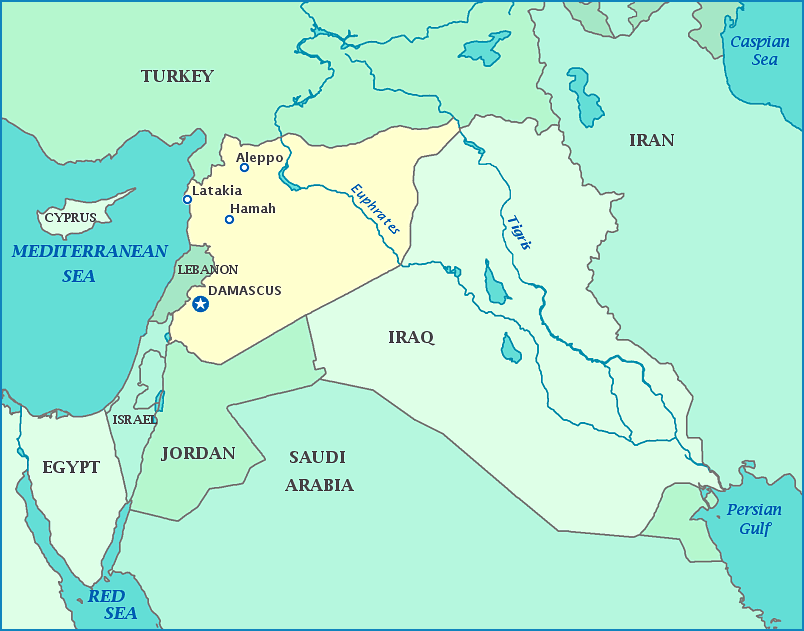
Where is Syria anyway?

If we're going to war with it, we should at least know where it is. That's just common courtesy.

The Magna Carta to come to Houston

Thanks to the student who sent this in.

A date is not given, but it will come to the Museum of Natural Science sometime soon, just before its 800the birthday!

2305's will dig through portions of the document soon.

Tuesday, August 27, 2013

Does a strong military suppress democratization?

I think the following comparison between prospects in Egypt and Tunisia suggest that it does.

W]hatever dangers Tunisia now faces, there is virtually no possibility of a military coup followed by a state-sponsored war on the Muslim Brotherhood, as in Egypt. And this is so because of what may be the most salient difference between the two countries, at least in regard to their political trajectory: Egypt has an overwhelmingly politicized and intrusive army, and Tunisia does not. “None of the generals want a coup d’état,” says Adnen Hasneoui, an activist close to the ruling Ennahda party. “The only group which could carry out a coup would be the national police, and Ben Ali” — the former dictator Zine El Abidine Ben Ali — “designed the organization chart so that the police don’t have the power.” Indeed, Ben Ali’s inadvertent gift to Tunisia was to keep the military weak — Tunisia has only 27,000 very poorly equipped troops — and to exercise firm control over the Interior Ministry police.

From the Pew Research Center: How Millennial Are You?

If you are in my class, you are likely to be a millennial - that is if you are between 33 and 10.

Here's a quiz that sees where you stand on issues and whether you think like a millennial.

Will the millennial generation keep the republic?

Too early to tell really, but this article suggests that those born between 1982 and 2003 are committed to public service, just not politics or government.

In their landmark books on Millennials, the sociologists Morley Winograd and Michael Hais compare young Americans today to other great “civic generations” that cycle through U.S. history every eight decades, starting with the Founding Fathers and including the generation that elected Abraham Lincoln and of course the Greatest Generation that won World War II. Raised in troubled times, “as adults, they focus on resolving social challenges and building institutions,” Winograd and Hais write in their recent Millennial Momentum. The authors believe Millennials have the makings to be the next great generation.
The trouble is that Millennials believe traditional politics and government (especially Washington) are the worst avenues to great things. They are more likely to be social entrepreneurs, working outside government to create innovative and measurably successful solutions to the nation’s problems, even if only on a relatively small scale. One is Matt Morgan, a Kennedy School student, who launched a website that helps readers respond to articles with political action. “There are so many problems Washington can’t fix that we can,” he says. Another is his classmate Sarah Estill, who wants to provide police departments with technology to fighting crime. “For my generation there are more ways we can effect change than in the past -- more tools in the toolbox,” she said. “Why not use all of them?” A generation ago, government had a monopoly on public service. To Millennials, the world is filled with injustice and need, but government isn’t the solution. They have apps for that.

The author speculates on the consequences of this shift, while another suggests that this is just kids being kids.

This does raise a good questions though - what commitment does - or should - one generation have to the governing and political institutions established by the previous generation? Is the republic worth keeping? Can better systems be developed? How do we know.

This brings attention to the concept of a political generation - which we will discuss more later this semester. Political change tends not to happen because people change their minds, but because different generations emerge that have different opinions on issues while older generations - and ideas - die off.

Monday, August 26, 2013

Please submit answers to the written assignments through blackboard

Do not send them to me as a comments on this site - thanks.

From the vaults: Dictatorships and Double Standards

I stumbled across this 1979 article from Jeane Kirkpatrick - an early neo-conservative who would work in the Reagan Administration.

In it she criticizes the foreign policy of the Carter Administration, but does so by making some interesting comments about what types of nations are more likely to turn democratic and why (leftist or rightist) as well as what preconditions are necessary for democracy to be sustained.

Her principle criticism seems to be that we over-estimate our ability to establish democratic governments:

Although most governments in the world are, as they always have been, autocracies of one kind or another, no idea holds greater sway in the mind of educated Americans than the belief that it is possible to democratize governments, anytime, anywhere, under any circumstances. This notion is belied by an enormous body of evidence based on the experience of dozens of countries which have attempted with more or less (usually less) success to move from autocratic to democratic government. Many of the wisest political scientists of this and previous centuries agree that democratic institutions are especially difficult to establish and maintain-because they make heavy demands on all portions of a population and because they depend on complex social, cultural, and economic conditions.

Here's some text relevant to this inquiry, I think its worth a read.

Although most governments in the world are, as they always have been, autocracies of one kind or another, no idea holds greater sway in the mind of educated Americans than the belief that it is possible to democratize governments, anytime, anywhere, under any circumstances. This notion is belied by an enormous body of evidence based on the experience of dozens of countries which have attempted with more or less (usually less) success to move from autocratic to democratic government. Many of the wisest political scientists of this and previous centuries agree that democratic institutions are especially difficult to establish and maintain-because they make heavy demands on all portions of a population and because they depend on complex social, cultural, and economic conditions.
Fulfilling the duties and discharging the functions of representative government make heavy demands on leaders and citizens, demands for participation and restraint, for consensus and compromise. It is not necessary for all citizens to be avidly interested in politics or well-informed about public affairs–although far more widespread interest and mobilization are needed than in autocracies. What is necessary is that a substantial number of citizens think of themselves as participants in society’s decision-making and not simply as subjects bound by its laws. Moreover, leaders of all major sectors of the society must agree to pursue power only by legal means, must eschew (at least in principle) violence, theft, and fraud, and must accept defeat when necessary. They must also be skilled at finding and creating common ground among diverse points of view and interests, and correlatively willing to compromise on all but the most basic values.
In addition to an appropriate political culture, democratic government requires institutions strong enough to channel and contain conflict. Voluntary, non-official institutions are needed to articulate and aggregate diverse interests and opinions present in the society. Otherwise, the formal governmental institutions will not be able to translate popular demands into public policy. 
In the relatively few places where they exist, democratic governments have come into being slowly, after extended prior experience with more limited forms of participation during which leaders have reluctantly grown accustomed to tolerating dissent and opposition, opponents have accepted the notion that they may defeat but not destroy incumbents, and people have become aware of government’s effects on their lives and of their own possible effects on government. Decades, if not centuries, are normally required for people to acquire the necessary disciplines and habits. In Britain, the road from the Magna Carta to the Act of Settlement, to the great Reform Bills of 1832, 1867, and 1885, took seven centuries to traverse. American history gives no better grounds for believing that democracy comes easily, quickly, or for the asking. A war of independence, an unsuccessful constitution, a civil war, a long process of gradual enfranchisement marked our progress toward constitutional democratic government. The French path was still more difficult. Terror, dictatorship, monarchy, instability, and incompetence followed on the revolution that was to usher in a millennium of brotherhood. Only in the 20th century did the democratic principle finally gain wide acceptance in France and not until after World War II were the principles of order and democracy, popular sovereignty and authority, finally reconciled in institutions strong enough to contain conflicting currents of public opinion.

She goes on to scold the Carter Administration for over stating their ability to promote democracy and suggests we tamper our expectations about what we can accomplish. I like the story she tells for self interested reason since I adopt a gradualist approach to the development of governments in general, especially what we have in the US. 


Will democracy take root in the Middle East?

The Dish flags a few studies that suggest it will not.

Both 2305 and 2306 begins with a look at why these introductory classes are required and I try to make the point that it has a lot to do with the notion that an educated and engaged population is more likely to sustain a democratic republic than one that is not. Keeping a republic is one thing, establishing one is another, and it is much more difficult to accomplish.

A special discipline within political science focuses on the factors that allow for nations to democratize. Writing in Reason (a libertarian magazine that some of you might find worth a look, at least since we will be discussing libertarianism soon enough) Robert Bailey digests the research and sees four principle factors that help determine whether a specific country may be a proper candidate for democratization.

The lack of these factors leads the authors to predict that the countries that recently went through the Arab Spring will likely slip back into autocracy.

Youth, or more precisely, fertility rates: The younger the population, the less likely a nation might transition into a democracy. The older the population, the lower the fertility rate. Why does this matter? Because fertility rates are taken to be an indication of the amount of control people have over their lives. Older people are better able to challenger autocratic structures and support their replacement with democratic ones. The median ages in the middle east are far lower than those in the US and Western Europe.

This thought sticks out. Gender matter as well: Democratic countries with large populations of young males are more likely to become dictatorships than those with smaller populations.

History: None of the middle eastern nations at issue has experience as democracies. Since the 1960s, the middle east has become more autocratic. There is no experience of self rule nor memory of working within institutions that allow for representation.

Income: The wealthier the nation, the more likely they will become democratic, and then sustain that democratic system. Studies suggest that $6,000 per capita income is the threshold. Above that line democracies take hold and are sustained, beneath it they do not and are not. None of the nations at issue have incomes above that level.

Complexity: This is a fancy term that refers to the "range of social, political, and economic interests" that exist in a nation. The fewer the interests, the easier it is for one person and his supporters to impose their will on a population by establishing an autocratic government. Complex societies are more difficult to control.

The author also suggest that this is related to the level of violence that occurred in a revolution against an autocracy. The greater level of violence, the greater chance that social institutions have been destroyed, which creates an easier opportunity for an autocratic system to develop. Opposing forces have been eliminated.

This might be worth a class discussion - you call.

Sunday, August 25, 2013

Written Assignment #2

This should be a little bit more difficult than the first assignment, but not by much.

Locate and purchase the book assigned for the class. Give a rough outline of its contents. What is the book about? What general point does the author seem to make in it?

You assignment for week 4 will be to give me a paper proposal based on some aspect of the book's content. The more work you do now, the easier it will be to get a good proposal together.

Written Assignment #1

I want all students to prove to me you know hos to send an assignment through BlackBoard.

Find the first assignment and send me a quick hello. If you'd like to introduce yourself, please do.

If you get this to me before the due date - which you will find on both blackboard and the class syllabus - you will receive a 100. If you get it to me late you will receive a 75.

The Break is Now Over - The Fall Semester Begins Tomorrow

I'll start posting material relevant to the class in just a few moments.

New students should visit this site regularly. You'll find assignments here as well as news items we'll cove in class. I'm open for whatever suggestions you have about what's worth our time.  

Monday, July 15, 2013

Written Assignment #7 - GOVT 2306 - 11 week online class only

Attorney General Greg Abbott has announced that he is running for governor. Media reports indicate he has already a substantive campaign war chest. This suggests that he has a huge advantage over his potential opponents, but it also suggests whose interests he is most attuned to.

The link above gives you an idea who has donated to his campaign so far. Here's additional data:

- Project Vote Smart.
- Ballotpedia.
- Capital Tonight.
- Influence Explorer.

There are more places to get information so surf around.

Abbott has already staked out his positions on different issues - which he has already developed over time as Attorney General. For this week's writing assignment I want you consider what influence campaign contributions might have on either the positions he has taken, or on the fact that Abbott has received these contributions rather than someone else.

To what degree are the issues on the agenda in the state of Texas influenced by the money that flows through the process? Can you offer proof that it does, or evidence that it does not?

You know the rules.

Sunday, July 14, 2013

Written Assignment #7 - GOVT 2305 - 11 week online class only

A jury in the state of Florida acquitted George Zimmerman of charges of murder and manslaughter in the shooting death of Trayvon Martin - in case you've been living under a rock - but this may not be the end of the story.

Which give us an opportunity to tie recent subject matter - civil rights - to this case.

The NYT reports that the U.S. Justice Department is considering filing federal hate crimes charges against Zimmerman. The applicable law is the Matthew Shepard and James Byrd, Jr., Hate Crimes Prevention Act of 2009 (see Wikipedia entry here) which builds on federal hate crime law dating back to 1968. These laws allow the federal government to prosecute people who commit crimes based on a variety factors including a person's race.

Originally the laws only applied to those attempting to limit a "victim's attempt to engage in one of six types of federally protected activities, such as attending school, patronizing a public place/facility, applying for employment, acting as a juror in a state court or voting." The Shepard Act expanded protected categories to sexual orientation, and removed the requirement that a federally protected activity be affected.

This suggests that the shooting of Martin may fall under the scope of this law, though that is not conclusive and the Justice Department has yet to determine whether there is enough evidence to prosecute.

Your writing assignment this week is to read through existing hate crime laws mentioned, review the facts associated with the shooting of Trayvon Martin and determine whether there is enough evidence to warrant a federal charge. What makes this a civil rights issue - or not? Consider both sides of the argument, be objective.

You know the requirements.

Saturday, July 13, 2013

Perceptions of poverty

I thought a segment of the article linked to in the previous post was worth a separate post. When the public thinks of the poor, does it have an accurate picture of who the poor really are? The authors of a study titled "How the Poor Became Black" trace how over time media coverage of poverty over time began to portray poverty increasingly as an African-American phenomenon, ignoring the fact that 2/3rds of those in poverty are not African-American.

This meant that when people - anglos anyway - thought about poverty, they thought of it in terms of race. This may have contributed to increased animosity towards the program.

The 1960s saw a rise in poverty and children born out of wedlock, particularly in urban communities. Sensational media stories about families "abusing" welfare -- especially when the putative abusers were portrayed as African-American -- helped cement opposition to public assistance. One study found that in the early 1970s, nearly three-quarters of magazine stories about welfare or poverty featured images of African-Americans, even though African Americans comprised only about a third of welfare recipients.

africanamericansmagazines.png "I do think that racial divisions are an important factor here -- the sense among many people that universal benefits will take from 'us' and give to 'them' -- to a part of society that is seen as different, less deserving, imagined as racially different," Cook, from Brown University, said. "I think that many middle-class Americans favor social benefits for what they see as 'deserving' people who have worked and earned them -- so Medicare is good -- but universal health care would provide benefits for people who are imagined as not deserving."

In a 1976 speech, Ronald Reagan made mention of supposed "welfare queens" who make six-figure salaries while drawing government funds, stoking a sense of outrage over perceived waste in public assistance. (It was later shown that he used an exaggerated anecdote). Arguing that social insurance dis-incentivized work, and prioritizing markets and individual liberty, the growing new conservative movement eventually joined together businesses and working-class voters in pushing for cuts in government programs.

The Anti - US

At least among western democracies, Finland seems to be everything the United States isn't. Staunchly egalitarian most of all. And their educational system is among the best in the world.

What gives?

Over time, Finland was able to create its "cake" -- and give everyone a slice -- in large part because its investments in human capital and education paid off. In a sense, welfare worked for Finland, and they've never looked back.

"In the Finnish case, this has really been a part of our success story when it comes to economic growth and prosperity," said Susanna Fellman, a Finn who is now a professor of economic history at the University of Gothenburg in Sweden. "The free daycare and health-care has made it possible for two breadwinners -- women can make careers even if they have children. This is also something that promotes growth."

With this setup, Finns have incredible equality and very little poverty -- but they don't get to buy as much stuff.

The Great Wall of Texas

Here's a provocative piece. Something that fits one of the themes touched on occasionally in class: how is a republic best preserved? Or, what are the principle dangers faced by republics?

The author points out that the decline of great civilizations and/or nations is sometimes accompanied by an effort to wall itself off from the world. Is this what the US might be doing in not only building a border fence, but in restricting free trade pacts?

I found this part especially interesting:


The psychological impulse to protect a nation's wealth and culture from foreign contamination is an example of what behavioral economists call "loss aversion" - the idea that people are more concerned about what they might forfeit than gain from change. History tells us that with great power comes great loss aversion.
Take the fate of Ming China, the world's most fabulously wealthy civilization in the 15th century. The empire cut itself off from foreign trade after the 1430s, an action urged by Mandarin bureaucrats in order to clip the power of the merchant class, their rivals at court. Court intrigue is also revealed by the extension of China's Great Wall, and the abrupt termination of the voyages of Admiral Zheng He, both reflecting the Confucian attitude that foreign barbarians offered nothing of value. The following centuries saw China transform into a weak and isolated time capsule.

Are forces in American politics driven more by fear of losing current benefits than the promise of future gains? Will these lead to a static society and, ironically, future loss?

The author ties a similar episode Britain faced a couple centuries back with American independence:

Britain itself is a particularly interesting frontrunner to the U.S., but not because of its reputation as the birthplace of free market economics. During the peak years of empire, Britain's Parliament neglected to extend citizenship to its colonial subjects not once, but twice. The first time it fumbled a continent full of human capital was in North America in the 1770s. The second time was in the 1880s, when a fear of declinism stymied progress.
Prime Minister William Pitt (the elder), who led Britain during the 18th century, recorded his own expansive dream of a Greater Britain in his personal papers. Pitt's "scheme for better uniting" proposed that there be four members of Parliament to represent Virginia, four for Pennsylvania, four for Massachusetts, three for Jamaica, three for New York, two for Canada, and so on. Adam Smith's The Wealth of Nations made the same appeal. And yet it never came to pass. In 1707, the English Parliament added Scotland's representatives to its chamber. Northern Ireland was given direct representation in 1800. Conspicuously absent was an offer to the Americas during the decades in between, or the Indians later.
Later, at the dawn of the 20th century, the British Empire was fading relative to other European nations. British economic power was roughly double that of France and triple that of Germany in 1820, a lead that eroded over the following century. Leaders in Parliament were puzzled by the relative decline, and began to question their historical "laissez faire" policies. Rather than reform its colonial structures, as Cambridge professor John Seeley called for, prime ministers debated which trade barriers to erect and how high. Decline followed.

A quick heads up - road trip looming

In a week I'm heading out on a road trip and wont be back until August 2nd. I'll have lap top with me so I should be able to stay in touch regularly, but communication will be a bit slower than normal. I'll have as much as possible open prior to me leaving, but expect that I will a bit more out of pocket than usual during that period.

More details to follow.

The 5 Republican Parties

One of the small handful of points I try to hammer on in class is that the two major parties in the US are best thought of as coalitions of factions that feel enough in common to fit under the same party category. Determining just what those factions are can be a bit of an art.

Here is Norm Ornstein's take on the current factions within the Republican Party and the impact each has on the governing process, as well as the future competitiveness of the party:

. . . I see at least five Republican parties out there, with a lot of overlap, but with enough distinct differences that the task is harder than usual. There is a House party, a Senate party, and a presidential party, of course. But there is also a Southern party and a non-Southern one. The two driving forces dominating today's GOP are the House party and the Southern one -- and they will not be moved or shaped by another presidential loss. If anything, they might double down on their worldviews and strategies.

He argues that the increased influence of the South on the party will help it retain power in the House, but make it less competitive in Senate and presidential elections in the near future:

The South has gone from being a trace element of the Republican Party in the 1950s and 1960s to becoming the solid base and largest element of today's GOP -- and its driving force on social and economic issues. And while some Southern Republicans such as Lindsey Graham remain fierce internationalists, the South, and the House, have become the epicenter of anti-defense and anti-diplomacy isolationism typified now by border Senator Rand Paul.

So here's the Republican dilemma: The House and Southern Republican parties are more concerned with ideological purity and tribal politics than they are with building a durable, competitive national party base to win presidential and Senate majorities. In most cases, they are in no danger of losing their House seats or their hegemony in their states. They will be resistant to changes in social policy that reflect broad national opinion; resistant to any policies or rhetoric, including but not limited to immigration, that would appeal to Hispanics, African-Americans, or Asian-Americans; and resistant to policies like Medicaid expansion or Head Start that would ameliorate the plight of the poor. They also will be more inclined to use voter-suppression methods to reduce the share of votes cast by those population groups than to find ways to appeal to them. I see little or nothing, including a potential loss in 2016, that will change this set of dynamics anytime soon.

While a minority might be powerless in the US House of Representatives, it is not in the US Senate

A useful reminder by James Fallows.

In the House, a minority is indeed "largely powerless." Just ask Nancy Pelosi, Steny Hoyer, et al about how life has changed since 2010.

In the Senate, it's very different. There a minority is extremely powerful. Just ask Mitch McConnell, who has made 60 votes -- not a simple majority of 51 -- the de-facto minimum for getting either nominees or legislation approved.

Here's one way to think about it: in both the Senate and the House, the minority party has about the same proportional strength. The Republicans now have 46 Senate seats, obviously 46% of the total. And the 201 Democrats in the House are just over 46% of its makeup.

But in the House, those 46% might as well be 0%, since everything is run by majority vote. While in the Senate, 46% is a fully empowered blocking minority -- which can keep judgeships vacant, legislation from being approved, and essentially anything else from being done. That is, as long as they vote as a bloc, as they usually have; and are committed to making the filibuster not an emergency matter but a daily routine, as under McConnell they have done.