Showing posts with label conservatives. Show all posts

Thursday, February 25, 2016

Republican incumbents face primary challengers from their right

It's what primaries are all about. Texas isn't conservative enough for some people apparently.


Rep. Dan Flynn Faces Challenger From the Right.

In a race pitting an East Texas incumbent against an upstart challenger endorsed by conservative activists, a pair of unlikely issues has dominated the Republican primary fight for House District 2: toll roads and a controversy at the University of Texas at Austin. Bryan Slaton, a businessman and former Baptist minister, is hoping to unseat six-term incumbent state Rep. Dan Flynn of Canton, saying Flynn has stayed in office too long and has become less conservative over time.

Three House Committee Chairman from Texas Face Primary Challengers from the Right.

Three of Texas’ seven U.S. House committee chairman are facing primary challenges from the right wing of the Republican Party. Other Texas Republican House members are also facing serious challengers. The newly selected House Ways and Means chair, Rep. Kevin Brady (R-TX), Rules Committee chair Rep. Pete Sessions (R-TX)  and Science Space and Technology chair Rep. Lamar Smith (R-TX) all have primary opponents who are challenging their conservative credentials, The Hill reported.


Culberson faces challengers from the right. (behind a pay wall)

Thursday, December 18, 2014

FYI


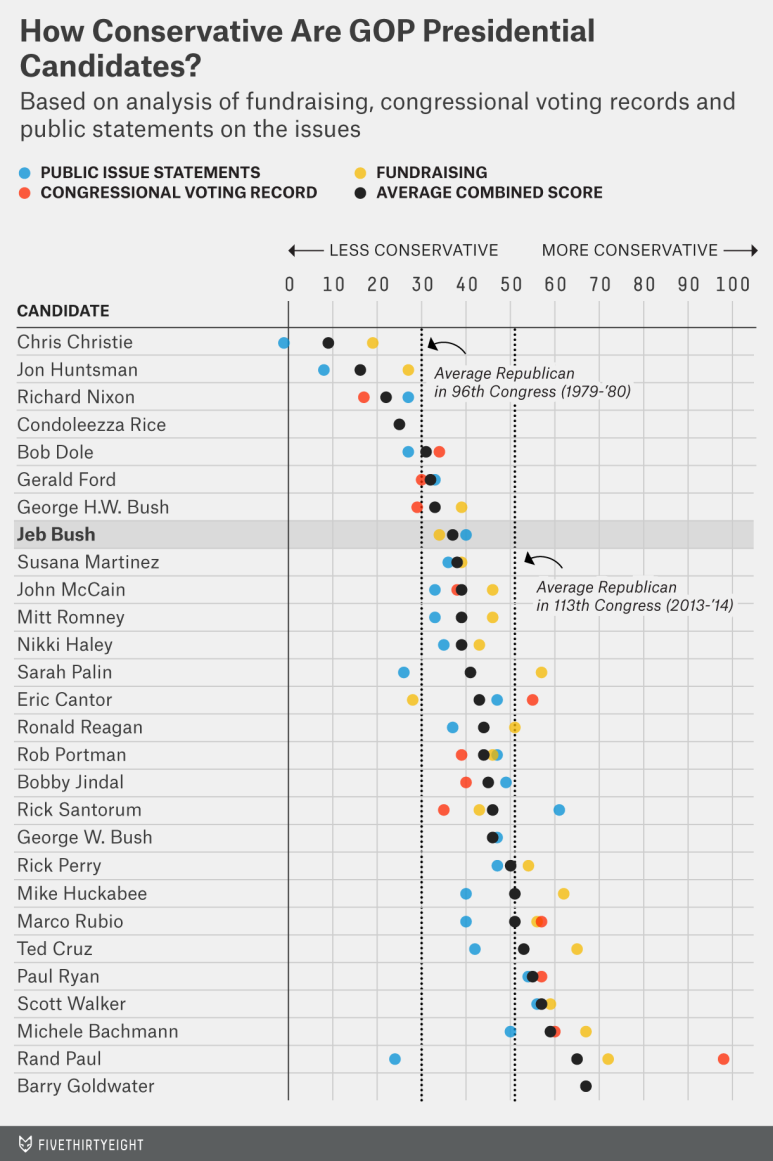
This is helpful for a variety of topics covered in class including campaigning, ideology, and the battle for the 2016 Republican presidential nomination in historical context.

The image comes from 538 - click here for the post.

This gets a bit geeky, but the story points out three separate ways that a candidate ideology can be measured.

DW-Nominate scores - which are based on a candidate’s voting record in Congress
CFscores - based on who donates to a candidate
 OnTheIssues.org scores - based on public statements made by the candidate 

Monday, March 28, 2011

5 flirt with Iowa's conservatives; one fires them up ...

From the Chronicle -- for my 2301s -- potential presidential candidates meet with party activists in Iowa:

In these preliminary stages of the contest for the 2012 Republican presidential nomination, Iowa conservatives have begun to flex their muscles, and the candidates are responding.

Five potential candidates - party veterans and long shots alike - came here Saturday for a day of attacks on President Barack Obama's policies, talk of constitutional principles and a chance to gauge the mood of the most conservative wing of the GOP base.

Rep. Steve King, R-Iowa, one of the most conservative members of the House, hosted the daylong conference, which drew hundreds of activists. It was the second conservative gathering of the month in the state to draw a handful of presidential hopefuls - the first was hosted by a religious conservative group - and was another reminder of how deeply intertwined fiscal and cultural issues are in the state with the nation's first presidential caucuses.

The possible presidential candidates included Mississippi Gov. Haley Barbour, former House Speaker Newt Gingrich, businessman Herman Cain, and former United Nations ambassador John Bolton. But it was Rep. Michele Bachmann, R-Minn., who lit up the gathering with a rapid-fire denunciation of the president that had the audience on its feet cheering.

"Are you in for 2012?" she called out to the audience. "Are you in? Are you going to make it happen? Are we going to take our country back?" As the applause built, she concluded by saying, "I agree with you. I say we do. I say I'm in. You're in. We will take this back in 2012."

Thursday, January 13, 2011

Very Conservatives vs. Everyone Else

The Gallup Poll discovers that self identified "very conservatives" prefer members of Congress vote belief over compromise, while everyone else prefers the opposite.

Saturday, October 2, 2010

Washington Republicans Try to Maintain Cohesion

Neo-Conservative Republicans are rightly concerned about the possible impact Libertarian Conservatives might have on the cohesiveness of the party should the latter be elected in large number in November. Libertarians object to the aggressive use of American military power and want to cut the military as much as other spending areas. Marc Ambinger comments on neocon efforts to persuade the libertarians to support high levels of military spending.

Thursday, June 24, 2010

Sobering News For Republicans

David Frum thinks they may not do as well as they hope in November.

Tom Schaller and Ruy Teixeira thinks they have serious work to do if they want to avoid becoming the permanent minority party.

Update: Alan Abramowitz argues that Democrats have more safe seats this year the 1994, which gives Republicans less to work with this November.

Sunday, May 9, 2010

Utah Tea Party Defeats Incumbent Republican Senator Bob Bennett

Bennett was apparently not conservative enough for the movement. His support of the bailout, continued acquisition of earmarks for the state and willingness to work with Democrats apparently worked against him. Endorsements by Mitt Romney, Newt Gingrich and Dick Cheney had no effect. Commenters argue that this will pull ordinarily moderate Republicans further to the right.

Attention now turns to Kentucky.

- Some background on Utah's peculiar method for selecting nominees.

Monday, May 3, 2010

Sacrificing Freedom to Gain Greater Freedoms

Here's some commentary on the different conceptions liberals and conservatives have about freedom. This guy uses an example I've used in class for years:

If freedom involves having a decent set of alternatives available to us, then government action can enhance our freedom even if it involves restraints on conduct that would not otherwise violate anyone’s rights. Consider traffic laws. Those of us who drive are constantly subjected to government dictates telling us what we can and cannot do. We can only drive on one side of the street. We have to stop at red lights and stop signs even when no one else is around. If freedom means only that government should not tell us what to do, then the traffic laws are a massive intrusion on our liberty.

I suspect that most people don’t see things that way, though. They probably agree with Elizabeth Anderson, from whom I have taken
this example:

To be sure, in a state of gridlock, one has the formal freedom to choose any movement in one's opportunity set -- which amounts to being able to rock forward and back a couple of inches from bumper to bumper, getting nowhere. Some freedom!

Normally, the point of driving is to get somewhere. The traffic laws enable us to get where we are going much more quickly and safely than we would if each of us had to decide for him- or herself which side of the street to drive on. The traffic laws do not tell us where to go. They leave the choice of destination, and for that matter the decision whether to drive at all, entirely up to us. They simply tell us which side of the road to drive on, that we should stop at various points, and so forth. By taking away our freedom to drive on the left, or to blast through busy intersections, they grant us much more freedom in the form of a greatly enhanced ability to get wherever we want to go quickly and safely.
Anyone who thinks that the traffic laws enhance our freedom should acknowledge that in some cases, including this one, government action can enhance our freedom, even if that action takes the form of restrictions on what we can and cannot do.

Tuesday, April 27, 2010

We Are All Activists Now

Barry Friedman and Jeffrey Rosen argue that both the left and right have grown accustomed to the use of an activist court to achieve their political aims.

Defining the Terms of Political Debates

E.J. Dionne thinks conservatives have been able to do so for several decades now and that its about time liberals stepped up.

Sunday, April 18, 2010

Are Conservatives Closing Their Minds to New Ideas?

Bruce Bartlett thinks they are. The fancy term is "epistemic closure." Some conservatives argue that this is not good for the long term vitality of the movement.

Tuesday, April 6, 2010

Thursday, February 25, 2010

Ron Paul wins CPAC Straw Vote and Gets Booed

Our own congressman Ron Paul won the straw vote for president in the CPAC Convention held last weekend, and then gets booed for it. Apparently he was not CPAC's preferred candidate.

- Rep. Ron Paul on Getting Booed at CPAC, Intentions for 2012
- Ron Paul Wins CPAC Straw Poll, Crowd Boos
- CPAC red-faced over Paul's straw poll win

By the way, CPAC is the annual convention held by the American Conservative Union. Keeping tabs of this group is a great way to keep track of what "conservatism" means at a particular moment in time.

Sunday, November 8, 2009

Thursday, November 5, 2009

Wednesday, November 4, 2009

Centrists Win, Conservatives Lose

Yesterday's elections seem to prove the importance of running centrist campaigns if a party wishes to actually win elections to office, and underscore the problems when extreme candidates, or at least candidates that veer far to one side of the political spectrum represent the party.

Republicans won the two governors races (in New Jersey and Virginia) where the candidates largely refrained from excessive anti-Obama rhetoric in an apparent attempt to lure independents that voted for the president (and could do so again) to vote Republican. It was a big tent strategy that worked.

In New York's District 23rd however, where a more extreme conservative ran under the Conservative Party Label, the Republican vote was split. Some moderate Republicans -- possibly turned off by the conservative positions of the candidate -- voted for the Democrat. The Democrat won a seat the party had not held in over a century.

Now it will be interesting to see whether the national party will be able to encourage candidates to adopt the more centrist, inclusive strategy, or whether the conservative movement will continue to attempt to pull the party to the right and purge it of moderates.