Friday, September 5, 2014

The Social Responsibility Assessment

In the opening section of this class - the one where I try to explain why the state of Texas has mandated that you take two classes in government - you would have seen the following quote from Jeanne Kirkpatrick, an official in the Reagan Administration, and a leading neo-conservative. (The quote is actually only in the GOVT 2305 section - but it should make sense if you are only taking GOVT 2306.)

The quote comes from an article she wrote for Commentary in the late 1970s. Click here for the article, and here is the quote:

In his essay on Representative Government, John Stuart Mill identified three fundamental conditions which the Carter administration would do well to ponder. These are: "One, that the people should be willing to receive it [representative government]; two, that they should be willing and able to do what is necessary for its preservation; three, that they should be willing and able to fulfill the duties and discharge the functions which it imposes on them."
Fulfilling the duties and discharging the functions of representative government make heavy demands on leaders and citizens, demands for participation and restraint, for consensus and compromise. It is not necessary for all citizens to be avidly interested in politics or well-informed about public affairs–although far more widespread interest and mobilization are needed than in autocracies. What is necessary is that a substantial number of citizens think of themselves as participants in society’s decision-making and not simply as subjects bound by its laws. Moreover, leaders of all major sectors of the society must agree to pursue power only by legal means, must eschew (at least in principle) violence, theft, and fraud, and must accept defeat when necessary. They must also be skilled at finding and creating common ground among diverse points of view and interests, and correlatively willing to compromise on all but the most basic values.
In addition to an appropriate political culture, democratic government requires institutions strong enough to channel and contain conflict. Voluntary, non-official institutions are needed to articulate and aggregate diverse interests and opinions present in the society. Otherwise, the formal governmental institutions will not be able to translate popular demands into public policy.


I want you to pay special attention to what's in bold.

As opposed to the Personal Responsibility Assessment where I'm asking you to consider how much work you have to do on your own to be the type of citizen a democratic republic requires, here I want you consider how what want must mesh with the what other's want.

One of the problematic things about living in a diverse society based on mass participation is that sometimes our side loses, or at least has to compromise. It seems that Ms. Kirkpatrick's point is that part of our social responsibility to is to recognize this - though she also states that we do not have to compromise on basic values, with out defining what these are.

I'm not sure I  know exactly what this means, so I'd like you to comment on it. What responsibilities do you have - as a citizen - to compromise and accept defeat? Maybe you don't. Establish a position on this, give specific examples and justify it.

This is due at the end of the semester.
Make it as long as necessary to make your point.
Turn it in in Blackboard.


Weekly Written Assignment #3

Next week I want you to give me a preliminary proposal for your 1000 word critical essay.

This week I want you to read through the book and give me a general idea about what it is all about.

Hopefully by now you've purchased the assigned book - high school dual credit students don't have a book because I was assigned the class late, so you to look online for information related to the 2014 elections.

I don't expect you to have read the entire thing, but I do want you to skim through the contents and get a general idea about what the books principal contents and arguments are and think about hos it relates to the content of the classroom. Even though we are still early in the semester, we've covered enough that you should find content in the book that gives you something to analyze.

I'll help you clarify this after next week's assignment, but I'll need you to start the process by getting used to what you book is about. Just in case you haven't purchased it, remember that it is listed on your syllabus, and is also listed on the right hand column of this blog.

150 word minimum.
Due September 15.
Let me know if you have questions about it.

Thursday, September 4, 2014

From the New Republic: The Greatest Threat to Our Liberty Is Local Governments Run Amok: And only a strong federal government can stop them

Here's a provocative article.

It's something we can talk about in both 2305 and 2306, and it reminds me of  counter-intuitive point we will see in Federalist #10. James Madison though that the lack of diverse points of view in local governments were more likely to allow for tyrannical majorities to emerge and threaten unpopular minorities.

Being a wealthy landowner, as were the rest of the Founders, he was worried about what the property less would do to the propertied class. They were in fact a numerical minority. But the same logic applies to any minority group. Local governments - he claims - are dangerous, and the federal government is needed to limit that danger.

The fault lies in the increased number of states that are dominated by one political party, the demise of the press and an increase in voter ignorance about the working of local government. We are not really aware of the abuses happening at the local level because we tune them out.

This is worth a good discussion in class, but its worth noting that a key point he makes is contrary to what we saw in a previous post suggesting that local government are very responsive to the preferences of the electorate. But if the government is responsive only to the majority, and the majority wishes to violate the rights of the minority, there's little to stop them other than the state or federal government.

Here's a bit from the article - note the use of the terms autocracy and oligarchy.

These are boom times for provincial autocrats. In many chunks of the country, state and local politics were once a competitive affair; there was an opposing political party ready to pounce on its foe’s malfeasance. That sort of robust rivalry, however, hardly exists in an era in which blue and red states have become darker shades of themselves. Thirty-seven states now have unified governments, the most since the early ’50s. And in many of these places, there’s not even a remote chance that the ruling party will be deposed in the foreseeable future. The rise of one-party government has been accompanied by the evisceration of the local press and the near-extinction of metro-desk muckrakers (14,000 newsroom jobs have vanished in the last six years), crippling the other force most likely to call attention to official misdeeds.
The end of local media hasn’t just removed a watchdog; it has helped to complete a cultural reversal. Once upon a time, Jefferson and Tocqueville could wax lyrical about local government, which they viewed as perfectly in sync with the interests of its yeoman citizenry. Whether this arcadia ever truly existed is debatable. But it certainly hasn’t persisted into the age of mass media. Nowadays, most Americans care much more passionately about national politics than they do about the governments closer to their homes. They may harbor somewhat warmer feelings toward states and localities, but those sentiments are grounded in apathy. Most Americans can name their president. But according to a survey conducted by Georgetown University’s Dan Hopkins, only 35 percent can identify their mayor. The nostrum that local government is actually closer to the people is now just a hollow piece of antique rhetoric.

With so many instances of unobstructed one-party rule, conditions are ripe for what the political scientist Jessica Trounstine calls “political monopoly”—officials and organizations who have so effectively defeated any potential predators that they can lazily begin to gorge. She writes: “When politicians cease to worry about reelection, they become free to pursue government policy that does not reflect constituent preferences. They acquire the ability to enrich themselves and their supporters or pursue policies that would otherwise lead to their electoral defeat.”

From Grits for Breakfast: Court: Texas cops can access cell-phone location data without a warrant

Click here for the story, or read this below:

Texas' Fourth Court of Appeals in San San Antonio recently ruled that police are not required to obtain a warrant to acquire cell-site location data from a service provider because of the Third Party doctrine.
As the prosecutors' association's weekly case summary put it, the question in Ford v. State was "Did the State violate the Fourth Amendment by acquiring from the phone company, without a warrant, the defendant’s cell phone records that revealed information (tower-pings, outgoing and incoming communication, etc.) connecting him to a murder?"
The court's holding, again from TDCAA: "No. Fourth Amendment protections are surrendered when a person exposes activities to a third party. That exposure makes the records merely business records of the phone company and not protected communications." See pp. 16-28 of the opinion for the court's reading of current Texas law on cell-phone location data.
This is important because law enforcement interests have been telling legislative staff at the state capitol that last year's changes in Texas law to Art. 18.21 of the Code of Criminal Procedure regarding cloud-based email and other content already require Texas cops to get warrants for location data. My response has been 1) it's not true, for reasons evident in theFord opinion, and 2) if it is true, there's no harm in updating CCP 18.21 to get rid of the outdated language and make the warrant requirement explicit.

Wednesday, September 3, 2014

Brazoria County is the most conservative of the most populous 21 counties in Texas

This probably explains a lot of what goes on around here;

- From the Houston Chronicle.

Data from eight University of Texas/Texas Tribune Polls conducted among registered voters between May of 2011 and June of 2014 allow us to estimate the mean ideological position of the voting public in 20 of the state’s 21 most populous counties — counties which combined contain almost three-fourths (73 percent) of the Texas population. Insufficient survey data exist at the present time for Webb County, the 19th most populous county in the state.
The UT/Tribune Poll contains an ideology variable based on a question asking respondents to place themselves on a seven-point ideology scale ranging from “Extremely Liberal” (1) to “Extremely Conservative” (7), with a 4 indicating the respondent considers their ideological position to be “In the Middle.” A mean ideological position for every county is calculated by averaging the valid self-reported ideological placement of its residents.

Here's the graph - we are way off to the right, literally:


CountyIdeology


The figure arrays the 20 counties from left (most liberal) to right (most conservative) based on the respective mean ideological location of their registered voters. Travis County is a clear liberal outlier, with a mean ideological position of 3.63, substantially more liberal than the mean ideological position found in the next most liberal county, Nueces, which has a mean position of 4.21. The ideological gulf separating Travis County from Nueces County is greater than that separating Nueces County from all but the four most conservative counties in the figure.
An overwhelming majority of these counties have relatively proximate ideological profiles, with a mere 0.26 separating the fourth most liberal county (Dallas) at one end (4.35) from the sixth most conservative county (a three-way tie between Collin, Denton and Fort Bend) at the other end (4.61). The mean ideological position for the entire state is located within this 4.35 to 4.61 range at 4.56.
While among these 20 counties there does not exist a true conservative analog to liberal Travis County, Brazoria County comes closest with a mean ideological position of 5.13. In fact, the Houston metropolitan region contains three of the four most conservative large counties in the state: Galveston County (4.80), Montgomery County (4.81), and Brazoria County (5.13).

It's worth comparing this graph with the one below showing the ideological differences between cities in the United States. Remember that it showed the many cities in Texas are actually liberal. Notice here that - with the exception of Travis County - all Texas Counties are conservative, at least a little. A 4 indicates moderation. This can be explained easily by pointing out the counties contain not only cities, but suburbs and rural areas, which tend to be more conservative than cities.

Tuesday, September 2, 2014

This week - 2 - in GOVT 2306

Like GOVT 2305, the goal last week was to get you up to speed with why you have to take this class and what terms we will use in it. The difference in 2306 was that we also looked at the how states fit within the federal landscape. This involved a bit of history and a look at the U.S. Constitution.

One of the peculiarities of studying U.S. government is that we look at states as if they are afterthoughts, when in fact the U.S. government was created by representatives of the states, albeit one's who wanted to restrict state authority and increase that of the U.S. government. It is vitally important to have a sense of not only what the U.S.Constitution states about the relative powers of the national and state governments, but also how reinterpretations of the document over time have altered that relationship.

Much of the conflict between the national government and the states - especially Texas - makes more sense once you understand this background, and the various issues associated with it.

Here's what's up this week.

- Texas Within the National Political Landscape: Political Culture. This section continues to put the state of Texas in context with the rest of the nation - the other states and the national government. The section on federalism did so in terms of the nation's legal foundation, this section does so in terms of the attitudes and dispositions of the people in each state - especially that of those with political power.

Much of this takes us to the historical background of the nation's founding and how the political attitudes present in each of the regions of the nation traveled westward. Texas - we will see - contains a political culture dominated by traditionalists and individualists, while other parts of the country have a different political mindset. As with the section on federalism, much of the conflict in the news that pits the interests of the state against those of the nation - or of other states (think: California) stems from this fact.

- The Texas Declaration of Independence. As with the United States - in fact probably because of it - the people who wanted to establish Texas as an independent nation and break with Mexico needed to articulate why. That was the point of the document. Reading through it helps us understand the cultural differences between Mexico at that time and Texas at that time as well, and to some degree current attitudes as well.

A little time is spent looking at the nature of the Republic of Texas and understanding why it was so short lived. While statehood seem to be controversial to some in the state, it benefited the state financially, even though it put Texas in a position to be forced to give up some of what it thought was essential to its way of life - like slavery. One consequence of this section should be an understanding of why the Mexican - American War was fought.

- State Constitutions and the Texas Constitution. This section does two things. First is described the nature of early state constitutions - some of which were examples of what to do and not to do in the United States Constitution. Second it looks at the evolution of the Texas Constitution.

As we will see, Texas has had a number of constitutions, beginning when it was a state - along with Coahuila - in Mexico. Within a span of 50 years Texas went through over half a dozen documents until it ratified the 1876 Constitution. Even that document has been modified multiple times since originally written. Each constitution - and each set of modifications - is a product of its times.

We'll try to come to terms with its lengthy and convoluted design and how it compares with the national document. This will be done from a birds-eye view however. Future sections will hone in on specific articles within the document as they apply to our subject matter.

This week - 2 - in GOVT 2305

The goal last week was to (1) explain why you have to take this class, (2) make sure you are familiar with key terms, and (3) dig into the history of ideology. I wasn't able to lecture on these all in class, but expect a few questions here and there, plus blog posts that focus on current issues that use these terms.

Any of this material can reappear on the final later this semester, so be mindful of that.

This week we have another 3 sections.

- Public Policy and Sub-Governments. This actually should be considered to be another introductory section. Establishing public policy is what governments do. This section walks through the stages in the process and - perhaps more importantly - explains the networks of actors that assemble around a piece of public policy.

This last part - which introduces the concept of an iron triangle and describes the relationships involved in it - is one of the more important concepts we will cover in class. It helps explain the logic surrounding much of what happens within government and politics. Networks of actors develop around pieces of public policy that provide tangible benefits for these groups, They find ways to establish and maintain relationships with each other in order to mutually preserve that public policy item. In our area one of the better ways to describe this relationship is around preserving the Johnson Space Center, or funding to keep the Houston Ship Channel operational.

We will refer to this concept later this semester hen we talk about Congress, executive agencies and interest groups.

- Natural Rights, Separated Powers, and the Declaration of Independence. In this section we start to look at the concepts and historical events that led to the decision - by colonial leaders - to break the governing relationship with Great Britain. This was done - officially - when it was decided to draft and sign a declaration stating the reasons why this decision was being made.

We don't cover the Revolutionary War in this class. I leave that to our history instructors.

The principle goal here is to understand the logic contained in the document's argument, and the fact that this argument embodies major shifts in political thought. The first had to do with the proper source of governing authority. Did it rest on the divine right of the monarch or the consent of the governed? The second had to do with the scope of executive power. Did all governing power rest - absolutely - with the monarch or was the monarch to be restrained by other institutions?

The answers to each question helps us understand how the colonists were able to justify the extreme measures they were about to take. It's problematic when you decide to overthrow a king.

- The U.S. Constitution. This is the first of many sections where we look at parts of the document. The purpose here is to take an overview of it. We'll cover what constitutions are, factors associated with the Articles of Confederation, the decision to have a constitutional convention and why the participants produced what they did.

This will also include a look at the ratification process and the changes to the document since it was ratified in 1789. Afterwards - next week - we start to dig into detail.

Some comments on the political knowledge quiz

I've graded all of the written assignments sent in on time - and few sent a bit late. I took 5 points off for late work, but some of the late replies were very A worthy.

Most of you admitted to having low levels of political information - and admittedly some of the questions were a bit odd. The question about age distribution in Nigeria for example. But if you read anything about Africa - in comparison with the other nations - you should have been able to infer that it is a very young country. Lots of kids get born, and lots of older people die sooner than they should. That has a major impact on governance. Its doesn't bode well for stability.

You may have clicked on this on your own already, but the center summarizes the findings and provides a graphic with what questions the general public got right and what they got wrong:

9-5-13 #1

They coupled this with a break down by age groups as well, so we can get an idea about what questions the 18-29 year old age group - which most of you belong to - got right, especially in comparison to older folks like me.

There were only three questions the youngest age group performed better on than the older generation. Those on the states with same-sex marriage, the age distribution in Nigeria, and Google Glass. The first and the last make some sense since they are at least indirectly related to hi-tech. I have no idea about Nigeria.

All groups blew the question on Dow Jones, which could be problematic. Even though the Dow is an imperfect measure of the state of the economy, it does tend to track how the economy has ebbed and flowed over the past few years. Not knowing which of the graphs was correct is the same as not knowing when the financial crash occurred and how the overall economy has fared since then.

We should revisit this topic from time to time over this semester. Is it significant that most people can only answer a handful of these questions correctly?

Some cutting edge political science research: Representation in Municipal Government

Since we've discussed - mostly in GOVT 2305 - democracy and wondered whether the national government is becoming more oligarchic, meaning it is increasingly responsive mostly to the needs of the wealthy, this recently published study about representation at the municipal level is worth looking at.

This also makes the subject relevant to 2306, where we are about to look at local governments more in-depth.

- Click here for the study.

The study was able to gather and process data that confirmed that liberal cities tend to get liberal policies, and conservative cities conservative policies - which suggests democracy is alive and well and the municipal level in the United States - if not, seemingly, the national level.

Both the Economist and Vox have reported on the study and focused on a graph it contains showing which cities are conservative and which are liberal. It's worth pointing out that the large cities in the nation tend to be liberal, very few are conservative, even in Texas.

Here's the proof. If you want to see how the numbers were generated, open up the study.


So you want to make an A on the weekly written assignments ...

A means excellent - so keep that in mind.

Well written, comprehensive, lengthy answers that are easy to read tend to get A's. It helps if it obvious to me what question you are addressing - I get answers sometimes that are so vague it is difficult to figure that out. A basic answer that barely meets the requirements gets a passing grade, but not much more.

Make it next to impossible to deny you an A. I hope that helps.

No Class Today - 9/2/14

This will affect my GOVT 2306-02 that meets at 11am and my GOVT 2305-06 that meets at 1pm.

I;m nursing sick kids at home

I'll be online most of the day, so contact me if you have questions. I'll post items related to this week's subject matter also.

From the Texas Tribune: Abbott to Call for Credit for Massive Online Courses

This promises to shake things up for all of us.

- Click here for the story:

Republican gubernatorial candidate Greg Abbott will call for students to receive college credit for taking massive open online courses — often referred to as "MOOCs" — as part of the higher education plan he unveils on Tuesday, sources with knowledge of his plans say.
Abbott is scheduled to lay out his higher education plan in an afternoon speech at the University of Texas at Dallas.
MOOCs are online courses with unlimited enrollment that anyone — regardless of whether they are enrolled at a university — can sign up for and take for free. Right now, the courses rarely earn students college credit.
Abbott intends to make the case that to improve flexibility and affordability in higher education, credit should be offered for completing such courses.

C
ompletion rates are low however, so not everyone sees these as a good idea. His opponent in the gubernatorial race does not mention MOOCs in her higher proposals.

Abbott's Democratic opponent, state Sen. Wendy Davis of Fort Worth, has already unveiled her higher education policy proposals. Her plan makes no mention of MOOCs. Her proposals pertaining to affordability include providing more funding to the state's main grant program for low-income students, expanding access to a state loan program designed to encourage timely graduation and establishing a sales tax exemption on textbooks.

Assuming the change is adopted, what does this mean for community colleges?

- Here's one opinion:

Community colleges comprise a unique sector of higher education focused on the teaching and learning process. They have their own history, mission and diverse student populations, each member of which has distinct needs and aspirations. Further, community colleges have developed a considerable body of empirical knowledge and hands-on experience in providing effective pedagogical experiences. In communities across America, these institutions provide centers for lifelong learning, both by degrees and community education courses. Considering this context, MOOCs are unlikely to completely reinvent community college education or, for that matter, any other sector of higher education, as their most ardent proponents have argued. On the other hand, they have in their early use, demonstrated enough potential in expanding access and learning options to be considered more than a fad as critics of MOOCs have warned.

One author sees the push towards MOOCs as apart of a conservative war on college.

Several laws passed by the 83rd Legislature took effect September 1st

From ABC13, a list of laws adopted last year which are now in being adopted:

- Click here for the story:

Texas state legislators meet every other year, but some laws passed more than 12 months ago are finally effective today, September 1, 2014.
"These are the more complicated laws," says State Representative Garnet Coleman, a Democrat from Houston. "We're talking about legislation that we pass and then give to the regulatory agencies. They have to figure out the best way to implement the laws and that can take time."
That's certainly the case with House Bill 5, the sweeping legislation changing the course load requirements for graduating high school seniors. Now, there are multiple tracks a student can choose his or her freshman year. The non-binding track guides a student through classes which offer preparation for college or a job in the workforce.
Also effective today is a new law which makes it easier to go through the inspection/registration process for businesses with fleets of vehicles running on natural gas. The streamlined process is intended to encourage businesses to purchase and run the cleaner burning cars and buses.
Juveniles charged with crimes are now getting a fairer shake in the state's legal system. A law effective today provides indigent juveniles with appointed counsel immediately after arrest. Previously, juveniles who couldn't afford attorneys would get much farther into the legal process before being appointed an attorney.
The state's new abortion law, House Bill 2, will not go into effect as intended today. A federal judge ruled against key parts of that law which would have shuttered abortion clinics not meeting certain enhanced medical standards.

Monday, September 1, 2014

From the Texas Tribune: Analysis: A Lot of Races, But Not as Much Drama

The author does not expect much to change in Texas as a result of the upcoming election.

- Click here for the article.

The elections are coming, but voters in most regions can go back to sleep — at least when it comes to down-ballot contests: Only a handful of legislative and congressional races are competitive.
Here is a safe prediction: Texans will elect a legislature that looks — philosophically, anyway — a lot like the legislature that it is replacing. The same goes for the state’s congressional delegation, where only one incumbent faces a serious challenge.

Sunday, August 31, 2014

What is ISIS anyway?

GOVT 2305 students won't be getting into foreign policy for some time, but the conflict with ISIS will be with us a while - almost certainly throughout this semester - so here are a few readings which will let us get up to date on what it is exactly, and what threats it does and does not pose to the United States.


These also touch on the range of options that exist for how to handle the group, which is an example of the policy formulation stage of the public policy process - part of the subject matter of week 2. Before that can be done successfully its good to have a firm grasp of what led to the rise of the group - as well as others.

Peruse through these at your leisure:

- ISIS Annual Report 2013.
- ISIS as Start-Up: Explosive Growth, Highly Disruptive, Super-Evil.
- The Sickness that gave birth to ISIS.
- ISIS Isn’t the Real Enemy. The “Game of Thrones” Medieval Mindset That Birthed It Is.
- You Can't Understand ISIS If You Don't Know the History of Wahhabism in Saudi Arabia.

An article titled Fathers of ISIS lists these six factors giving rise to this and other similar groups:

1 - Decades of despotism in Iraq and Syria
2 - The American invasion of Iraq in 2003
3 - Iranian regional meddling
4 - The growth of Salafist networks
5 - A belief that seventh-century religious ideas can solve modern problems
6 - An environment of violence

I don't know nearly enough to challenge these. They sound like a good place to start.

A "dominant minority"

I just ran across this phrase and am surprised I haven't seen it before.

It has it's own wikipedia page. Here is the text in its entirety:

A dominant minority is a minority group that has overwhelming political, economicor cultural dominance in a country despite representing a small fraction of the overall population (a demographic minority). Dominant minority is also known as alien elites[1] if they are recent immigrants.
The term is most commonly used to refer to an ethnic group which is defined alongracial, national, religious or cultural lines and that holds a disproportionate amount of power.

In both 2305 and 2306 we're going to start reading through the relevant declarations of independence and constitutions. It's worth pointing out that in each case the participants in the political process did not represent a majority of the population. They were part of  dominant minority.

On the national level its worth considering how the governing system was structured so that minority would be able to continue to rule despite adopting a governing and political system that would gradually open up participation. It's worth considering whether the United States is democratic only superficially.

A related term: tyranny of the majority.


Saturday, August 30, 2014

Revolving Door Report: Former House Education Chairman Lobbying for Pearson


2305 students will learn a few things about sub-governments and the revolving door next week. Public policy making tends to include groups of people who form networks that tie together the various institutions involved in the policy making process. One of the ways these networks are formed is when someone who had been a participant in one institution moves into another.

As an example, the Texas Tribune reports that a key member of the Texas Legislature is now lobbying for a major producer of textbooks and testing materials.

- Click here for the article.
- Click here for information on Rob Eissler.


Former House Public Education Chairman Rob Eissler has taken on publishing and testing giant Pearson as a client, according to recent Ethics Commission filings.
The Republican from The Woodlands, who lost his seat in the 2012 Republican primary, is now an Austin lobbyist whose clients include the Harris County Department of Education and the Barbers Hill Independent School District.
Pearson's $468 million, five-year contract to administer the state's new standardized exams has proved controversial amid a growing backlash against high-stakes testing.
"Part of my job is education, and I think they are the No. 1 education company in the world. To focus on their testing seems to be a hot-button issue now, but they are also a publisher," said Eissler, who added that he thought the company had done a "very professional job" fulfilling its responsibilities to the state.

Weekly Written Assignment #2

I was considering using this week to get everyone to research who represents them in the Texas or United States Congress - whichever applies to your particular class - but a recent court decision has made me postpone this assignment.

Be sure to answer the question for your class - 2305 or 2306.

For GOVT 2305:

I posted previously on the conflict in Ferguson, Missouri. Click here for the post. I want to use this case as a way for you to apply some of the information contained in the slides for the 3rd and 4th sections of this class, the ones on ideology and public policy.

First I want you to think about the shooting as an agenda setting event, one that has led the media and general population to think about issues they may not have otherwise. Then I want you to consider it in terms of ideology. What different responses might someone who identifies themselves as socialist, liberal, libertarian or conservative make of these issues - what "problem" might each see as underlying them - and what proposals might they support to address that problem.

I want you to demonstrate some proficiency in using ideological terms and the public policy process.

For GOVT 2306:

I posted below about the recent decision by a federal court judge to strike down certain parts of the bill passed by the Texas Legislature to place requirements on abortion providers in the state. These requirements have led to the closure of some clinics and - according to the judge - a violation of rights established on the national level.

- Click here for the post.

I mentioned in the post that this is the latest in a series of issues where national political values conflict with those of the state of Texas. This is a theme in the 4th section - which covers political culture. It is also a theme, of sorts, in the sections on federalism.

I want you to read through the relevant text and comment on this conflict. Try to make sense of the judge's ruling and see what lies next. Also comment on how this issue is treated nationally and statewide. Do you see anyway that this conflict could be resolved?

- Click here for the judge's ruling.

For both 2305 and 2306:

Write at least 150 words and get this in by Monday September 8th.

From the Texas Tribune: Federal Judge Strikes Down Texas Abortion Regulation

Since this story illustrates some key points made in the opening sections of GOVT 2306 - those on federalism and political culture - it makes a good subject for this week's written assignment. Its a great example of ongoing tension between the state of Texas and the national government regarding values and culture. It should help put in context the points I try to make in the section on political culture especially.

It also demonstrates the consequences of living in a federal system. The laws on each level are often in tension. And since the people who live in Texas also live in the United States, they can play off this tension. In this case people who disagree with the abortion policies Texas has passed can appeal to the national government and argue they violate laws established on the national level.

It's no guarantee of success, but its a common tactic.

- Click here for the article.

The state law placing restrictions on clinics that provided abortions were argued - by a federal judge in Texas, Judge Lee Yeakel of the District Court for the Western District - to violate guarantees established on the national level. Expect this to wind its way to the U.S. Supreme Court.

Here's a key part of the article:
In his ruling, Yeakel wrote that the law's ambulatory surgical center requirement "burdens Texas women in a way incompatible with the principles of personal freedom and privacy protected by the United States Constitution for the 40 years since Roe v. Wade."

Yeakel also said the state had reached a "tipping point" in limiting access to abortion when the ambulatory surgical center requirement is viewed in the context of the other state-imposed regulations. The regulations
Yeakel mentioned include a 24-hour waiting period for abortions and requiring doctors to perform a sonogram on a woman at least 24 hours before she has an abortion.
"The court is firmly convinced that the State has placed unreasonable obstacles in the path of a woman's ability to obtain a previability abortion," Yeakel wrote.

Friday, August 29, 2014

What is the Public Integrity Unit?

It's the unit at the heart of the dispute which led to the indictment of the governor.

Here's a description from the Texas Tribune:

The Public Integrity Unit is a state-funded division of the Travis County District Attorney's Office. It investigates public corruption, insurance fraud, and motor fuels tax fraud.

The Travis County DA holds the chief responsibility for enforcing the government and election code statewide. The unit was created under the leadership of Ronnie Earle, who served as the Travis County DA for three decades until his retirement in 2008. Earle captured national attention with his investigations into U.S. Sen. Kay Bailey Hutchison and former U.S. Rep. Tom DeLay, R-Sugar Land, and became the poster child for what Republicans view as the unit’s politically motivated prosecutions. He told the Texas Tribune that he started the unit in the early ‘80s because “it made no sense to me to see an aggravated robbery case next to a case about a state employee cheating on travel vouchers.” At the time, Earle says the investigation of government crimes was “mostly left to the newspapers” because the Travis County DA spent most of its time fighting street crime.
Dismantling the unit is a perennial platform plank of the Texas Republican Party, and numerous members of the GOP, included DeLay and Hutchison, have criticized what they view as its politically motivated prosecutions. According to Earle, between 1978 and when he retired, in 2008, he prosecuted 19 elected officials, just five of whom were Republicans. Cathie Adams, the former Republican Party of Texas chair, filed an equal protection lawsuit over the issue in federal court last year. Her argument: Why should the voters of Travis County get to elect an official who has the power to prosecute offenses statewide? A frequently proposed solution — and one that state Sen. Dan Patrick, R-Houston, put forth unsuccessfully during the last legislative session — would be to put state corruption probes under the statewide-elected Attorney General.

Click here for stories related to it.

Texas State Judge John Dietz - again - finds Texas' school finance system unconstitutional

In GOVT 2306 this week we covered the purpose behind education in the Texas - the fact that it is tied into the ability of the electorate to secure right and liberties, as well as the capacity for self governance.

This point is made in both the Texas Declaration of Independence and the Article 7 of the Texas Constitution. We read through the first section of that article and say the following language: "it shall be the duty of the Legislature of the State to establish and make suitable provision for the support and maintenance of an efficient system of public free schools."


While the Texas Constitution is normally held to be clear - that's what 80,000 words gets you - there can be a debate over what the phrase "suitable provision" and the word "efficient" actually mean.

That's the broader context for the judge's decision. More specific is the fact that the 82nd Texas legislature cut over $5 billion in education funding, some of which was restored by the 83rd Legislature. Over 600 school districts sued the state alleging that the Texas Constitution - the language highlighted above - had been violated.

For detail on the case, click on these articles:

- Texas Tribune: Judge: Texas School Finance System Unconstitutional.
- Dallas Morning News: Texas' school finance system again overturned in court.
- Austin American-Statesman: Judge: Texas school finance system unconstitutional.

More importantly:

- here is a link to the judge's decision.
- here is the findings of fact and conclusions of law.

In case you're curious - this applies to later parts of the class - here's Judge Dietz's website. Her serves as the judge for the 250th District Civil Court.

The AAS summarizes the basic argument made by the judge. these will be reviewed by the Texas Supreme Court.
Dietz found four constitutional problems with the way Texas finances its schools:
• The Legislature has failed to suitably provide for Texas public schools because the school finance system “cannot provide a constitutionally adequate education for all Texans,” Dietz said in his order.
• The finance system is inadequate because it does not provide enough money to accomplish a “general diffusion of knowledge.
• The system effectively imposes a property tax, in violation of the Texas Constitution, because districts do not have “meaningful discretion” over how the taxes are raised, assessed or spent.
• The system is financially inefficient because all Texas students do not have equal access to the educational money needed.
“Consequently, the court enjoins further funding under the system until the constitutional infirmities are corrected,” Dietz wrote.

Thursday, August 28, 2014

So you want to get a job on Capitol Hill?

I just stumbled on this. Enjoy.

- Career Advice and Office Etiquette for Congressional Staff.

I don't have a full list, but many current members of Congress began their careers as staffers, including Pete Olson. If you are thinking abotu a political career, there are few better ways to kick one off.

From PunditFact: Fact-checking claims about race after Ferguson shooting

The shooting of Michael Brown has also led to questions about race relations and whether that has created the tension which exploded in the community following the shooting. Various claims have been made about the current state of it, and not all are accurate.

- Click here for PunditFact's analysis of some of them.

Their conclusions:

1 - It is true that murder is the leading cause of death for African American males between 15 and 34.
2 - It is not true that an unarmed black person is shot by a cop every 28 hours.
3 - It is half true that more whites are victims of police shootings. It's half true because there are more white people than black people. As a percentage, more blacks than whites are killed.
4 - It is false that the president is behind the disparity in unemployment between whites and blacks.

Provocative stuff - worth a look in class.

My quibble: What about factors that influence other minority groups?

Cameras on Cops

It looks like the unrest in Ferguson will put policing on the public agenda for a period of time, which raises a host of related issues. I'll try to compile a list in a later post, but one issue is whether police should wear cameras.

This - at least in theory - provides a visual record of what happens on the ground and helps clarify the nature of any confrontation that might arise.

Here are a few article laying out the arguments:

- Should Cops Wear Body Cameras? One Ex-Cop Says Yes.

Wednesday, August 27, 2014

Some information for my dual credit GOVT 2305 class


Following our discussion in class earlier today. This is James Foley. He's been in the news recently.

Defining Democracy

Democracy can be defined in many different ways - some positive, some not so.

Here's one persons list of how different authors define the term:

- Click here for it.

And here's his description of how the term can be defined:

. . . actual definitions of democracy come in all shapes and sizes. . . . Each emphasizes one or more things thought to be true about democracy: 1) it is a dangerous form of government; 2) it includes genuine competition for power; 3) it permits mass participation on a legally equal footing; 4) it provides civil and other liberties that restrict the sphere of state power within the society; or 5) it promotes widespread deliberation about how to make and enforce policy so as to promote the common good.

Making sense of the various issues raised by the Michael Brown shooting

I'll expand on this post soon, but I want to go over it in class today since it illustrates a key part of the public policy process - agenda setting.

Sometimes certain events occur which raise awareness of things that had previously been - if not ignored - pigeon holed. This shooting seem to be a great example. I'll elaborate on this soon enough, but here's a link to a website that's been covering various aspects of the shooting ans might give us a few things to chew on.

- Click here.

This post will be heavily edited soon.

Tuesday, August 26, 2014

From the New York Times: Who Will Win The Senate?

As of right now - Republicans have a 67% chance to be the majority party in the Senate after this election.

- Click here for the story.

Making sense of the indictment of the governor

As you have probably heard our governor was indicted on August 15th on charges of "abuse of official capacity" and "coercion of a public servant." The charges were filed in Travis County - where you'll find Austin, the state capital - and the uproar since then was pretty predictable.

Since we will be spending time discussing and following the case, it's not a bad idea to lay out the facts associated with the case - it's background and all that - so we can make sense of all it entails.

Here are few links to stories that should get you up to speed, expect more. This story should have legs.

- From the Austin American Statesman: An Interactive Timeline. This might be the best resource available, especially if you are completely new to this. It starts with the events that led to this particular dispute, though it lacks general context.
- Also from the AAS: Rick Perry indicted for Lehmberg veto threat. Thsi walks through the day of the indictment.
- From the Texas Tribune: Five Things to Know About the Perry Indictment. Among the points made: It will be hard to dismiss as purely partisan, but the prosecution wont be easy.
- The Texas Tribune has links to all its stories related to the indictment here.
- From the Texas Observer: Everything You Need to Know* About Rick Perry’s Newest Scandal (*But were afraid to ask). Another overview of the issues in the case, including commentary on the broader issues associated with it, such as the fact that the Travis County's District Attorneys was investigating possible corruption in awarding contracts to the Concern Prevention and Research Institute of Texas. Critics of the governor argue that he had overseen the awarding of contract to political supporters, which is illegal. Getting rid of the DA would have allowed him to appoint a - presumably friendly - replacement.

Vodka Politics: Alcohol, Autocracy, and the Secret History of the Russian State

A peculiar take for our discussion of governing arrangements.

A recently published book argues that alcoholism in Russia has been promoted by the state - be it tsarist, communist, or whatever you choose to call it now - as a deliberate means of keeping the population in check and preserving autocracy.

Vodka has a political purpose. Its an interesting argument, because generally its held that nations like Russia tend to have populations that prefer iron-fisted autocratic rule, but seldom is there an explanation about why that's the case. According to this theory, the population doesn't really choose it at all. They are lulled into accepting autocratic -authoritarian rule. It's a twist on the bread and circuses that kept the Roman population entertained during the Roman Empire.

It was also a consistent source of revenue for the state.

- Click here for vodkapolitics.com.

- Here's a review of the book.

The work’s author, Mark Schrad, an assistant professor of political science at Villanova University, deftly weaves sociological data into a rather alarming portrait of a country brimming with binge drinkers. Presenting the book recently at the Woodrow Wilson Center for Scholars in Washington, DC, Schrad cited World Health Organization data to show that Russians’ annual consumption of pure alcohol is roughly 15.7 liters per capita. Excluding children and abstainers, Schrad says that this figure boils down to the average Russian male drinker consuming two bottles of vodka and 13 beers per week.

Placing Russia in a broader context, Schrad suggested that Russia bucks geographic trends. Generally, as one travels northward, wine consumption turns to beer consumption. But Russians, who readily admit that wine and beer taste better, favor vodka since “it is something you do to get drunk. You down it as quickly as you can” since it tastes “horrible.”
Schrad contended that alcoholism is not “hard-wired” into Russian society. Instead, he argued that Russia’s problem with alcoholism is “an outcome of generations of autocratic government that has reaped the benefits of the intoxication of the population.”
Noting how Stalin tried to get his colleagues inebriated in order to manipulate them, Schrad argued that Russia’s rulers have applied this approach to their population for centuries. They see mass alcohol consumption as a means of keeping the population “discombobulated” and “off-balance” and “unable to mount a challenge to the government itself.”


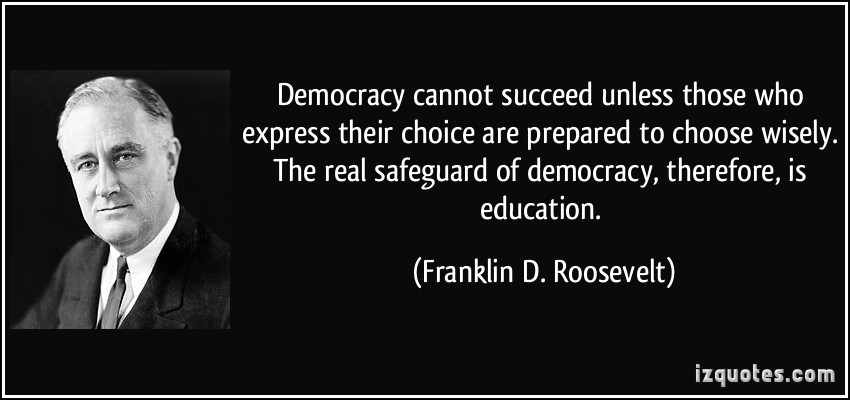
http://thedailyblog.co.nz/wp-content/uploads/2013/11/quote-democracy-cannot-succeed-unless-those-who-express-their-choice-are-prepared-to-choose-wisely-the-franklin-d-roosevelt-157938.jpg

http://izquotes.com/quotes-pictures/quote-democracy-is-beautiful-in-theory-in-practice-it-is-a-fallacy-you-in-america-will-see-that-some-benito-mussolini-255133.jpg

http://izquotes.com/quotes-pictures/quote-there-is-no-democracy-in-physics-we-can-t-say-that-some-second-rate-guy-has-as-much-right-to-luis-walter-alvarez-302898.jpg

 http://blog.loususi.com/wp-content/uploads/2013/11/quote-democracy-cannot-consist-solely-of-elections-that-are-nearly-always-fictitious-and-managed-by-rich-che-guevara-234135.jpg

Is America Really a Democracy?

http://www.hermes-press.com/money1.gifOnce we get the introductory meetings out of the way, I'd like to start with some provocative questions. None are more so than the idea that despite all that we have been told, that the United States is not - and in fact has never been - a democracy.

What's more, we were never really intended to be.

You'll note that I use the term "republic" or "democratic republic" to refer to the governing arrangement in the United States. It's closer to the truth because it reminds us that the preferences of the general public - at least those who choose to vote - are filtered through governing institutions. This means they are subject to modification. And since those institutions can be more readily influenced by the wealthy - who can contribute to elections, and hire lobbyists and lawyers - the preferences of the general population can be modified in favor of the preferences of the wealthy.

I've compiled a few blog posts on the subject of oligarchy - and its cousin plutocracy - in the United States. These lay out the argument relatively well and offer some supporting evidence.

- oligarchy.
- plutocracy.

So let's hash this out.

Should we give up the pretense that the United States is a democracy and accept that it is a plutocracy?

From Vox: Caesar Augustus died 2000 years ago. Here's why he was one of history's greatest leaders.

In the opening section, you'll note that Caesar Augustus is not mentioned as one of the great leaders of world history, but instead as the person most responsible - after Julius Caesar - of leading to the demise of the Roman Republic and having it replaced with an empire with himself as its sole leader. The institutions and checks and balances that had existed previously were undermined and all power was concentrated in the single, arbitrary hands of whoever happened to be emperor.

This look at Augustus - on the 2000th anniversary of his death - is a bit more kind to him, mostly because it tells us that the republic had seemingly run its course. Conflict was no longer solved through peaceful political means, but through warfare and bloodshed.

The consolidation of power in the hands of the emperor was also a way to keep the peace. And that's what happened, 200 years worth of peace which allowed Rome to reach new heights of prosperity. The author suggests that Augustus was able to achieve peace by masking his consolidation of power. Outwardly he still respected and seemed to defer to other institutions, but beneath the surface all Roman institutions were oriented to him. As we will see soon, this concentration of power - notably the legislative, executive and judicial - is the definition of tyranny, at least as adopted by James Madison.

- Click here for the article.

To get a better handle on the Roman Empire, click on this collection of maps. Why the fuss? Allusions to Rome - especially why the republic was good and the empire bad - were common among the American founding generation. GOVT 2305 students will notice these as we proceed through class.

Section 1 - Why do you have to take this class?

Both 2305 and 2306 begin with sections that attempt to justify why each class is not only offered, but required. The short answer - as we will cover in class -  is that an educated electorate is supposed to be more capable than not of providing the stability necessary to secure the survival of a democratic republic.

Here are the links:

- 2305 - Why do I have to take this class?
- 2306 - Why do I have to take this class?

It's not a guarantee of course, but the uneducated are argued to be more prone to decision making based on passion rather than reason, and are felt to be more likely to succumb to the pleadings of demagogues. This leads to instability, which can potentially undermine support for the institutions designed to place meaningful limits on those in power. This in turn can allow for an ambitious leader to consolidate power.

World history is full of examples of functioning republics falling apart and then being replaced with autocratic systems headed by a tyrannical leader. The notes mention the fall of the Roman Republic, but we could also point out how the German Republic - the Weimar Republic - fell apart due to the effort of Hitler's Nazi Party. We know what happened next.

You'll note that the founding generation thought the entire enterprise of creating a republic carried risks, and it still continues to.

But this also raises an important empirical question. Is the public really as irrational as the founding generation thought? If we want to be cynical - and we can be - perhaps the founders used this assumption as a way to limit participation from populations that might challenge their authority. Some of the comments made by Hamilton and the rest were in fact demeaning to the rest of society.

Is the public really as bad off as the founder's thought?

I'll post a few separate items on this question. It's an important and ongoing one.

Sunday, August 24, 2014

Welcome to GOVT 2305 and'or GOVT 2306

Thanks for signing up.

Aside from whatever modifications I have to make due to (my) human error, this class should be ready to go. Look above for the proper syllabus and read it thoroughly. Email me your questions and I'll clarify what needs clarification.

Go to blackboard to familiarize yourself with the layout there - the first three quizzes are waiting for you, as is the first weekly written assignment. You'll see information about each on the syllabus, as well as on the column just to the right of this message. Again, ask me questions if this confuses you. The weekly schedule in the class is the same all semester, so once you get used to it, it should be easy to follow.

You'll also see information about the 1000 word critical review essay, as well as the reading assignment relevant to it. Note the posts below that talk about each book.

As with every semester, there are unique events occurring that will occupy much of the class' discussions. You'll note that I spend as much time, if not more, concentrating on them as I do the regular content of the class. This is because the purpose of learning the course's content is to help make sense of the day to day activities of government. The more the content makes sense to you, the more these activities should make sense as well.

Each week we will begin by reviewing news items that relate to that class' subject matter. I'll also try to explain how major events of the day fit into other subject matter we will cover - or have covered.

The goal is to make sure you can grasp what's up with all thins stuff and become a rational, engaged participant in the political process.

Good luck to all of us.
Kevin  

No book for GOVT 2305 - AHS2. Instead, base your 1000 word critical essay on some aspect of the 2014 election

I had a last minute addition to my fall 2014 schedule - a dual credit class at Alvin High School - and I do not have a separate book ordered for students in that class. No worries though. The 2014 midterm election is underway and will be held before the class is out. Since there's more than enough material on line about it, we can do without a book. In fact - we might just end up writing one about it. Find  a provocative topic - or question - and address it rationally and intelligently.

I want students in the class to start familiarizing themselves with the various issues associated with the election and start thinking about a possible topic. It might be wise to look ahead at the section on elections. Also consider looking through the following blog tags for past stories on this and other elections.

- 2014 elections.
- campaigns.
- campaign finance.
- elections.
- member of Congress.
- midterm elections.
- money in politics.

There are more that might apply, but this is a start. You should also look through the following to get an idea of the unique issues associated with the current election, as well as midterm elections in general.

I'll provide more specific information in forthcoming posts, and in the fourth week of class you will asked to propose a topic to me. Here's enough for now:

- Wikipedia: Midterm Elections.
- Wikipedia: United States elections, 2014.
- Politico: 2014 Elections.
- Washington Post: Election Lab 2014.
- 538: Senate Forecast.
- RCP: Election 2014.

One more thing. Since this is GOVT 2305 - and the subject is the national government - be sure to focus on the elections to national office.

The Book for GOVT 2306-IN2: Border Boss: Manuel B. Bravo and Zapata County


Machine politics are not as common today as they were in the early and mid 20th Century - or at least they've morphed considerably - but they are fascinating ways to understand how politics and government in fact work.

Studying the relationships that built these machines helps us understand how different groups work with - and sometimes against - each other in order to establish and maintain - and maybe change - certain policies. They also help us understand why and how certain interests seem to inevitably get served more than others.

While machine politics existed in some form throughout Texas (never quite as much as in other areas of the country), it was especially common in the southern counties along the Mexican border. Often these were supported by moneyed interest in the area that were able to get a loyal ally elected county judge, who was then able to control much of what happened politically within that county.

This book provides an in-depth look at one of these "bosses," Manuel Bravo, who controlled Zapata County for sometime in the mid 20th Century. The story is built up from personal papers found after his death, which says something about how quietly these networks operated.

After reading this hopefully you'll have a greater appreciation for how politics is - in many ways - all about the relationships that are developed around groups of people. You might wish to consider that idea as you develop your topic.

For relevant blog posts, click on these:

- counties.
- county government.
- oligarchy.
- party bosses.
- party machines.
- revolving door.

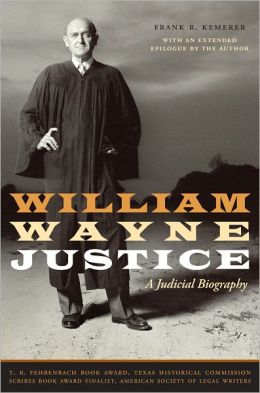
The Book for GOVT 2306-02: William Wayne Justice: A Judicial Biography


This might be the most consequential Texan you've never heard of. Judge Justice (love the name) was a native Texan who served not on the state courts, but on the federal courts, and was responsible for a large number of significant decisions that applied the equal protection of the laws to the state.

This did not make him very popular among Texans happy with the status quo. Among those he is an example of governmental overreach and judicial activism.

But that's how it goes.

The is detailed look at his career provides a great way to look at the nature of the conflict between Texas and the national government over the later years of the 20th century. Texas did not willingly go along with the expansion of civil rights. It had to compelled to, and Judge Justice was one of the people responsible for making that happen.

The sections on federalism probably fit best with this book, as well as those on elections. Remember that he was a federal judge. He is not a member of the Texas Judiciary, though he did have an impact on how it did business. Note that you will find overlap between 2305 and 2306 here. That's because as a federal judge he made decisions that made the state comply with national laws. Something some - but not all - Texans take issue with.

Relevant blog tags:

- civil liberties.
- civil rights.
- education.
- equal protection.
- federal judges.
- federalism.
- judicial activism.
- Texas Judges.
- US - Texas Conflict.
- William Wayne Justice.

The Book for GOVT 2306-01: Lines in the Sand: Congressional Redistricting in Texas and the Downfall of Tom Delay


You'll hear a lot this semester about the factors that have led to political polarization in the United States. Data shows that Democrats and Republican elected officials are becoming extreme in their views, and fewer are representing those who hold moderate viewpoints. One of the alleged causes is the fact that congressional districts are often drawn in a manner that increases the influence of the majority party in each state. This makes it necessary for elected officials who want to win elections to respond to the extreme voices that tend to dominate turnout.

The technique is called gerrymandering and few states do this better than Texas.

One of the more bold uses of gerrymandering happened in 2003 when Texas Republicans took advantage of the fact that they had just won the majority in the Texas House of Representatives and quickly redrew congressional districts in order to pad their advantage in that institution as well.

It was controversial because it occurred after districts had already been redrawn following the 2000 census, and it was noteworthy because it would eventually lead to the downfall of one of the more power Texans in the United States House at that time, Tom DeLay.

This book is useful because it tells us that elections are not simple things. The rules that govern how elections are conducted are perhaps more important that who runs, who votes and what issues are at stake. If a group of people can determine how elections are conducted they can predetermine outcomes.

Obviously the sections on elections in Texas are useful in figuring out your paper topic. So might some of the storied in these blog posts:

- gerrymandering.
- ideological polarization.
- party polarization.
- primary elections.
- redistricting.
- voter turnout.


Saturday, August 23, 2014

The Book for GOVT 2305-IN2: The Payoff: Why Wall Street Always Wins


As you've probably figured out yourself, money plays a huge role in the political / governing process. So much so that it sometimes doesn't really matter which party wins an election, moneyed interests have enough pull in each that they get what they wants whether Democrats or Republicans win.

Perhaps this is nowhere more true than with the financial sector. This is an insider's look at the influence the financial sector has on Congress and the presidency.

Click on the following blog tags to get an idea of the stories related to the financial sector I've posted over time.

- agency capture.
- campaign finance.
- corporations.
- democracy.
- economic policymaking.
- finance lobby.
- financial crisis.
- finance reform.
- iron triangles.
- money in politics.
- revolving door.

The Book for GOVT 2305-06: Days of Fire: Bush and Cheney in the White House


It always takes awhile to evaluate any presidency, so while we start to think about the pros and cons of the Obama Presidency, we might wish to do so in comparison to previous presidencies. Obviously the most recent one is George W. Bush's.

Days of Fire is a thick comprehensive look at Bush's tenure in office - one that focuses primarily on the relationship between Bush and his vice president. Dick Cheney is generally regarded as having been the most powerful VP in American history, but it seems to be a close call about whether that's a good or bad thing.

Obviously you will want to look at the sections on the executive branch - especially those related to commander in chief powers - but other parts of the class apply to the subject matter here and can provide a potentially good topic for your paper.

These blog tags might be useful also. Note that I started this blog in 2007, so I don't have as much on the Bush White House as I do the Obama White House. I might dig around for more though - you do the same.

Start thinking about a topic.

- Bush Administration.
- commander in chief.
- Defense Department.
- Dick Cheney.
- executive power.
- foreign policy.
- George W Bush.
- National Security Council.
- presidential powers.
- torture.
- war on terror.
- war powers.

The Book for GOVT 2305-02: Access to Justice


One of the cornerstones of the American constitution system is the principle of "equal justice under law." While we like to think of our justice system as available to everyone, that may not really be the case.

This book challenges the idea that the legal system in the United States is in fact available to all sectors of society - especially the middle and lower classes. The author tries to understand why this is the case, in what manner the justice system is unequal and offers some ideas about how this situation can be rectified - but she does not sound optimistic.

This is easily one of the more depressing books I've assigned, but its also one of the more provocative.

The sections on the judiciary and civil rights are clearly applicable here, as are the stories you'll find by clicking on some of these old blog posts. Gloss through these and think about a relevant topic.

- 14th Amendment.
- appeals.
- civil rights.
- criminal justice.
- death penalty.
- equal protection.
- equality.
- lawyers.
- police procedures.
- probable cause.
- race.
- Supreme Court.

The Book for GOVT 2305-01: Private Empire: ExxonMobil and American Power


ExxonMobil - as you are certainly aware - is one the nation's largest companies - one that has a significant and growing presence in the Houston area. It is also very well connected, which many large companies are. Over the years it has enjoyed connections with governing officials through a large lobbying organization that includes ex-members of Congress of both parties.

It has also been active in the promotion of policies that have increased corporate power, and simultaneously weakening environmental and trade regulations. They have also helped shape the nation's foreign and defense policies in ways that benefit the company - though not necessarily the nation.

These guys are very smart and methodical. This book outlines how they've accomplished their objectives.

The book's topic applies to a handful of the class' sections, especially those related to the influence that money - and all that brings - has on the political and governing processes.

Here are a few tags that take you to stories you might want to consider as you develop your paper's topic. Don't limit yourself to these though. Use them as a starting point.

- antitrust policy.
- business interests.
- committees.
- foreign policy.
- interest groups.
- iron triangles.
- money in politics.
- oil lobby.
- regulations.
- revolving door.

An example of a great critical essay

The author is Jonathan Rauch and the essay is titled Democlerosis.

We cover the argument he makes here in GOVT 2305 (The section on Federalist#10).

If you want to know how to write well, read good writing. I was advised that once years ago, not that it did me any good. But its good advise anyway.

The 1000 Word Critical Essay

If you read through the syllabus carefully, you'll notice that you are to write a 1000 word critical essay and that it is to be based on a book that has been assigned to your specific class and section. It's up to you to come up with the specific topic, but it has to incorporate some aspect of the class material and how it overlaps the subject of the book.

This might seem daunting right now, but I'll help you develop your topic.

Right now I want you to be sure to purchase the right book for your class and start reading it. Start thinking about it too. The weekly written assignment for week #4 will be the your proposed topic. I'll give you feedback in order to make sure its a good one - or at least one I might find interesting.

That's always a good goal.

Rule #1 of essay writing: Don't be boring.

Friday, August 22, 2014

Weekly Written Assignment #1

Let's start with some self discovery. We often go around claiming to have a specific political identity - liberal, conservative, or whatever - and we also justify that by claiming to know enough about the nature of events to make sensible decisions about this and that. But do we really have a full understanding of political terminology to peg our beliefs correctly? In other words - maybe you call yourself conservative, but your specific positions on political matters might tell a different story.

I want you to take the following two quizzes:

-  Pew Research Center: The News IQ Quiz.
-  Pew Research Center: Political Typology Quiz.

And then comment on them.

Have they confirmed or challenged your political orientation? Assuming you had one of course. And do you know as much about political affairs as you thought? Maybe you know more, maybe you know less. You're grade will be based on how comprehensive - and interesting - your comments are.

I want you to input you answer in BlackBoard.

Like all your answers, please make it at least 150 words long - and yes you can go over.

Thursday, August 21, 2014

Four days to go

The fall semester officially starts this coming Monday. The syllabus is more or less complete, so if you have signed up for the class check it out - but with the understanding that there may be minor changes in it.

The core information is good to go.

Please note that while there is no official textbook you do have to purchase a book which will be the basis of your written assignment. I'll post information about each of these books over the next few days so you can get familiar with their content quickly. Within 4 weeks I want you to be prepared to give me a paper topic based on the content of the book.

So get it quickly and start reading.

Aside from that you'll see information here related to the subject matter we will cover next week in class, as well as current event topics that highlight content we will cover at some point in this class. Part of the goal of this class is to help you put these events in context. This might be tough to realize, but there is very little new under the sun. Most of what will go on this semester can be understood in terms of what has happened in the past, as well as what political science research has discovered about how people behave and institutions work.

I'll have a separate post with information about recent events - including Rick Perry's indictment, the conflict in Ferguson, the rise of ISIS, as well as the upcoming election - up soon. Hopefully tomorrow.

Before the day is out, I'll start posting information about the books each class is supposed to purchase. Each section has a separate one - so be sure to get the correct book.

Sunday, August 17, 2014

The Fall 2014 Semester Starts in a Week

If you are a student looking to get a head start click above for the syllabus. It lacks information about the 1000 word critical review essay, but the rest of it is ready to go - more of less. There may be a few changes before we go forward, but not many.

I'll be making some adjustments to the organization of the blog over the next few days, so be mindful of that. If you want to lie low before the semester starts, I completely understand.

We'll get going on this soon enough. See you soon.